Poplar Genome Reveals WRKY Genes Linked to Cadmium Stress Tolerance

Jenn Hoskins
15th September, 2025

Poplar Genome Reveals WRKY Genes Linked to Cadmium Stress Tolerance

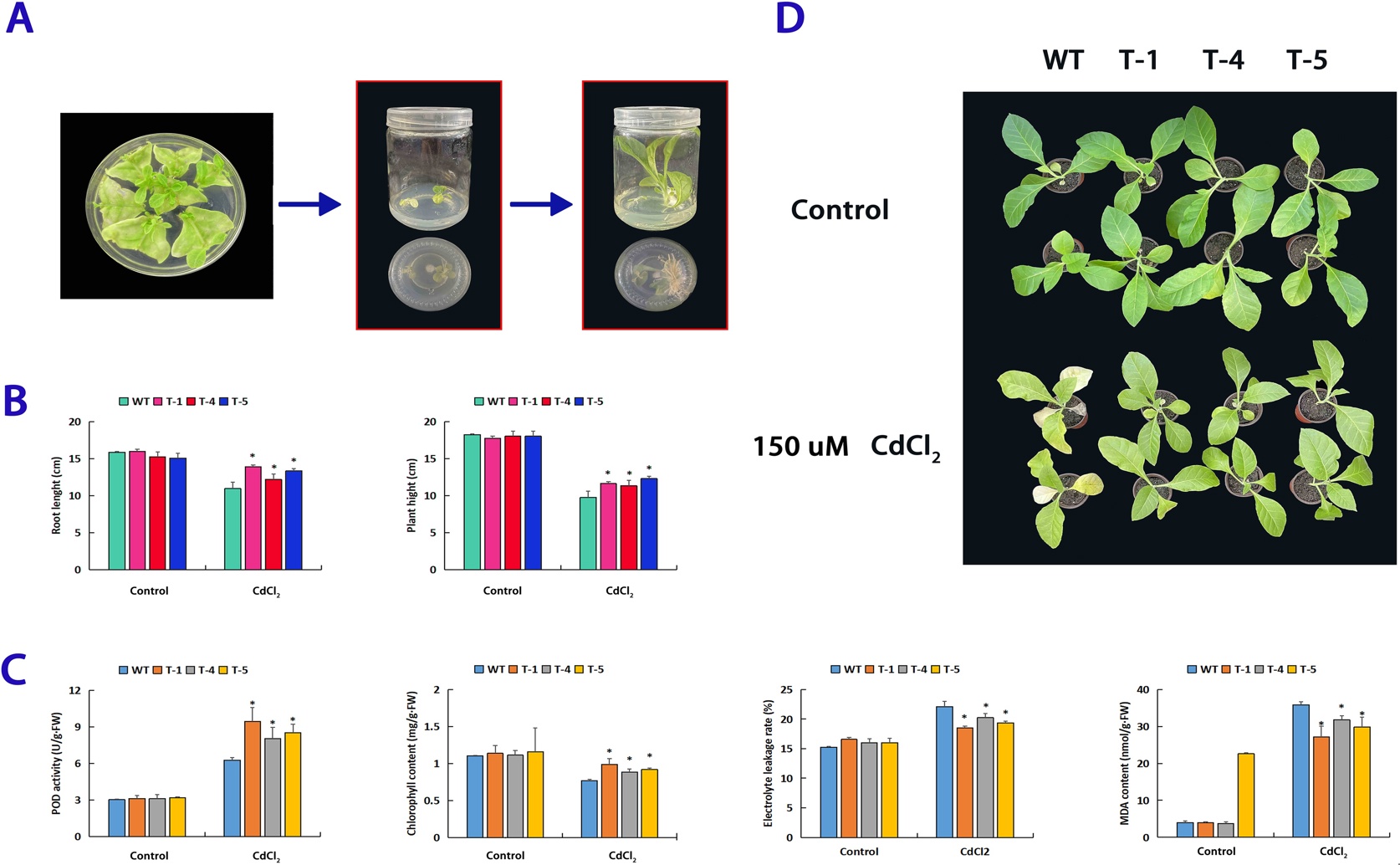
Transgenic tobacco (Nicotiana tabacum) overexpressing PsnWRKY95 exhibited enhanced cadmium tolerance, evidenced by the successful generation of resistant lines (a), significantly improved growth metrics (b), and superior physiological responses including increased peroxidase activity and chlorophyll content with reduced cell damage (c) compared to wild-type controls.

Image adapted from: Ma et al. / CC BY (Source)

Key Findings

  • Poplar trees (Populus simonii × P. nigra) in Northeast China exhibit tolerance to cadmium (Cd) in soil, prompting this study to understand the underlying genetic mechanisms
  • Researchers identified 102 WRKY genes in poplar, which are transcription factors regulating gene expression, and found that many are located in the cell nucleus suggesting a direct role in Cd response
  • Overexpressing the PsnWRKY95 gene in tobacco plants significantly improved Cd tolerance, resulting in increased plant height (16-26%), longer roots (12-27%), and higher chlorophyll levels (15-29%)
Cadmium (Cd) is a highly toxic heavy metal that accumulates in soils, posing a significant threat to plant growth and ultimately, food security. Plants respond to Cd stress through complex biological mechanisms, and identifying the genes responsible for Cd tolerance is crucial for developing strategies to improve crop productivity in contaminated areas[2]. Researchers at Heilongjiang University of Science and Technology, along with collaborators from the Chinese Academy of Sciences and Northeast Forestry University, recently conducted a comprehensive study[1] on the WRKY gene family in poplar trees to understand their role in Cd resistance. WRKY genes are a large family of transcription factors – proteins that control the expression of other genes – known to be involved in various plant processes, including responses to stress. The study began with an inventory of the WRKY gene family within the poplar genome, identifying 102 WRKY genes distributed across the poplar’s chromosomes. These genes were grouped into three subgroups based on their genetic similarities, with members within each group sharing common structural features. Importantly, all poplar WRKY proteins were found to be located within the cell nucleus, suggesting a direct role in regulating gene expression. Furthermore, these genes were found to interact with a variety of microRNAs (miRNAs), small molecules that can fine-tune gene activity, and contained genetic sequences known to be involved in stress defense. The researchers also investigated how the WRKY family expanded over evolutionary time, finding that segmental duplication – the replication of larger sections of the genome – was the primary driver. They also observed strong genetic relationships between WRKY genes in poplar and other plant species, suggesting a conserved role across different organisms. To determine which WRKY genes are actively involved in responding to Cd stress, the team analyzed gene expression data following exposure to Cd. This analysis revealed that 83 WRKY genes showed significant changes in activity in response to Cd, indicating their potential role in Cd tolerance. Focusing on one gene in particular, WRKY95, which was strongly up-regulated (increased in activity) in the roots, stems, and leaves of poplar trees exposed to Cd, the researchers conducted further experiments. To test the function of WRKY95, they created poplar plants that overexpressed the gene – meaning they produced more of the WRKY95 protein. These plants showed remarkable improvements in Cd tolerance. Compared to normal (wild type) plants, the overexpressing plants exhibited increased plant height (16-26%), longer roots (12-27%), and higher levels of chlorophyll, a pigment essential for photosynthesis (15-29%). Importantly, they also showed reduced levels of malondialdehyde (MDA) and decreased electrical conductivity, both indicators of cellular damage caused by Cd stress (13-32% and 9-20% reductions respectively). These results suggest that WRKY95 protects plants from the damaging effects of Cd. Further investigation revealed that WRKY95 achieves this protection by activating the production of specific proteins, including peroxidase (POD) and HMA1. POD is an enzyme that helps to break down toxic reactive oxygen species (ROS) – unstable molecules that can cause cellular damage – while HMA1 is involved in transporting Cd within the plant. The overexpressing plants had higher levels of both POD and HMA1 compared to wild type plants. To understand how WRKY95 activates these protective genes, the researchers conducted experiments in yeast. These experiments showed that WRKY95 directly binds to a specific DNA sequence called the G-box, a cadmium resistance element, effectively turning on the genes responsible for clearing reactive oxygen species and initiating the downstream stress response. These findings build upon earlier research highlighting the complex mechanisms plants use to counteract heavy metal toxicity[2]. For example, chicory (Cichorium intybus L.) has been identified as an effective accumulator of cadmium, capable of relieving Cd toxicity by enhancing photoprotection and ROS scavenging systems[3]. The study provides a molecular explanation for these observed tolerance mechanisms, demonstrating how WRKY transcription factors like WRKY95 can activate these same protective pathways in poplar trees. Furthermore, research into rice Al tolerance identified OsGASR1, a gene that upregulates oxidative stress responses[4], similar to the ROS clearance ability activated by WRKY95. The research provides valuable clues for understanding the molecular basis of WRKY-mediated Cd resistance, potentially paving the way for developing more Cd-tolerant crops.

EnvironmentGeneticsPlant Science

References

Main Study

1) Genome-wide identiffcation of the WRKY gene family in poplar and the positive role of PsnWRKY95 in response to cadmium stress

Published 12th September, 2025

https://doi.org/10.1371/journal.pone.0332076


Related Studies

2) Heavy Metal Tolerance in Plants: Role of Transcriptomics, Proteomics, Metabolomics, and Ionomics.

https://doi.org/10.3389/fpls.2015.01143


3) Cichorium intybus L. is a potential Cd-accumulator for phytoremediation of agricultural soil with strong tolerance and detoxification to Cd.

https://doi.org/10.1016/j.jhazmat.2023.131182


4) Overexpression of OsGASR1 promotes Al tolerance in rice.

https://doi.org/10.1016/j.plantsci.2024.112294


Related Articles

An unhandled error has occurred. Reload 🗙