Changes in Milk Fat and Vitamins A and E From Early to Regular Milk

Jenn Hoskins
15th August, 2025

Changes in Milk Fat and Vitamins A and E From Early to Regular Milk

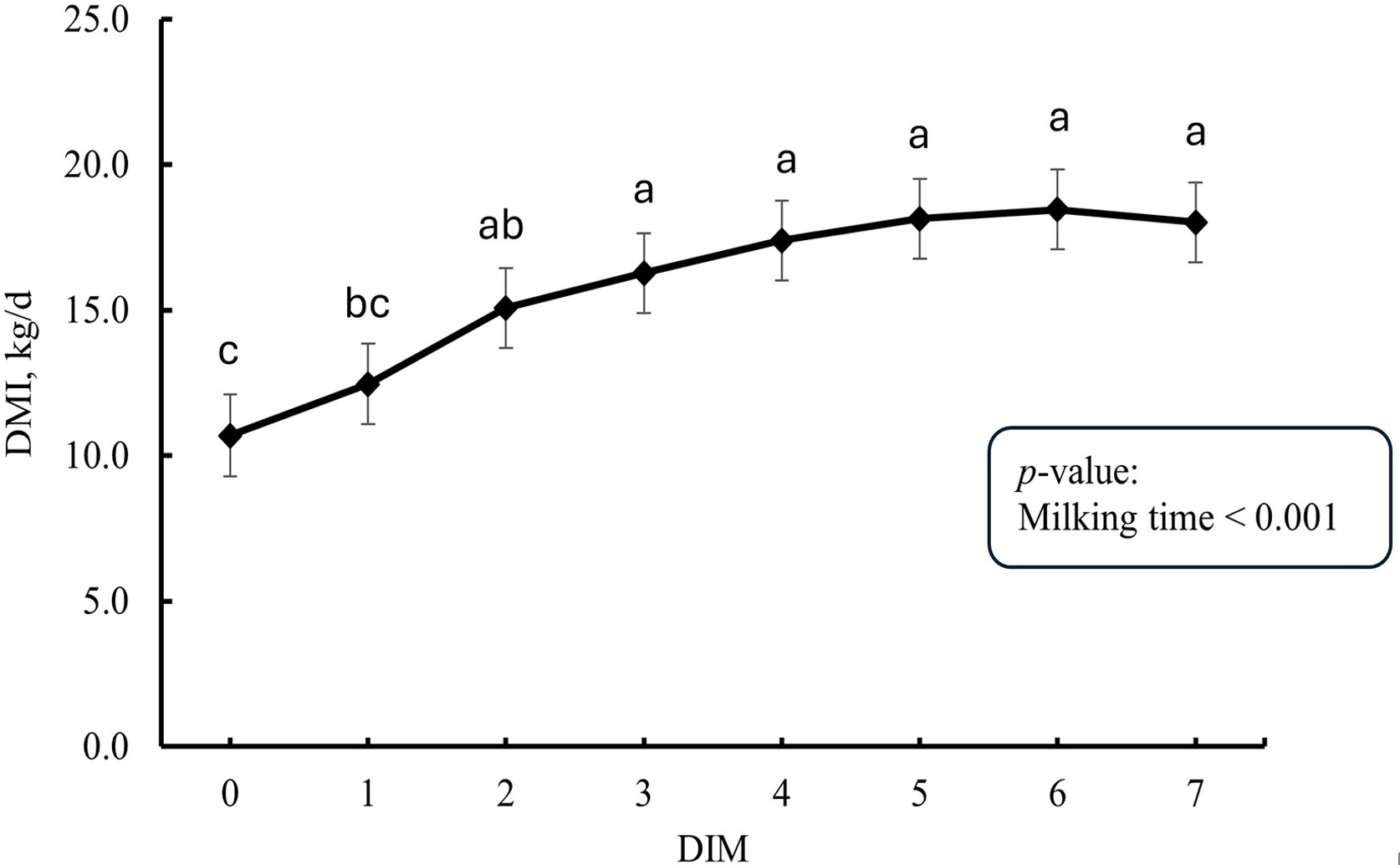
Daily dry matter intake significantly increased during the first week post-partum, providing the necessary substrates for the observed changes in fatty acid composition as colostrum transitions to mature milk.

Image adapted from: Lashkari et al. / CC BY (Source)

Key Findings

  • A study at Aarhus University in Denmark found that colostrum from Danish Holstein cows is a rich source of vitamins A and E, which dramatically decrease as milk matures
  • The milk's fatty acid profile also changes significantly, with beneficial n-6 fatty acids decreasing and some n-3 fatty acids increasing from colostrum to mature milk
Colostrum, the initial milk produced by mammals immediately after giving birth, is vital for newborn survival and development. It provides a concentrated dose of essential nutrients, immune factors, and growth hormones crucial for the vulnerable early stages of life. However, the composition of milk changes significantly as the lactation period progresses, transitioning from colostrum to mature milk. Understanding these changes, particularly concerning fat-soluble vitamins and fatty acids, is important for ensuring optimal calf health and potentially for dairy management. Researchers at Aarhus University in Denmark recently investigated these changes in Danish Holstein cows[1]. Their study aimed to precisely track how the profile of fatty acids and the levels of vitamins A and E shift from the very first milking (colostrum) through subsequent milkings up to mature milk. For this, they collected milk samples from ten multiparous Danish Holstein cows at various points: the 1st (colostrum), 2nd, 3rd, 4th, 5th, 6th, and 13th milking, with the final sample representing mature milk. The findings confirmed a dramatic decline in the levels of both vitamin A and vitamin E as colostrum transitioned to mature milk. Vitamin A levels were significantly highest in colostrum, decreasing substantially by the time mature milk was produced. Similarly, vitamin E levels were found to be highest in colostrum and dropped considerably thereafter. This observation aligns with earlier research, such as a study conducted by researchers in Alexandria, which also noted a significant decrease in vitamin A and E concentrations in both buffalo and cow colostrum within the first five days after parturition, approaching levels found in normal milk[2]. The importance of these fat-soluble vitamins in early life is well-established; they are crucial for immunity, protecting against tissue damage, and supporting growth and development, as highlighted by reviews on their biological functions and transfer to offspring in mammals[3]. The high concentration of these vitamins in colostrum therefore serves as a critical initial boost for the newborn's health. Beyond vitamins, the Aarhus study also revealed significant shifts in the fatty acid profile of milk over time. Fatty acids are the fundamental building blocks of fats, playing diverse roles in energy storage, cell structure, and signaling. The study observed that the proportion of a saturated fatty acid called C16:0 decreased from colostrum to mature milk, while another saturated fatty acid, C18:0, increased. More complex changes were noted in unsaturated fatty acids, particularly the n-6 and n-3 types. These are essential fatty acids, meaning they must be obtained through diet. The proportion of n-6 fatty acids, including C18:2n-6, C18:3n-6, C20:3n-6, C20:4n-6, and C22:5n-6, consistently decreased from colostrum to mature milk. Conversely, the proportion of C18:3n-3, an important n-3 fatty acid, increased significantly as the milk matured. However, other n-3 fatty acids like C20:5n-3, C22:5n-3, and C22:6n-3 showed a decrease from colostrum to mature milk. The study also found an increase in the proportion of certain trans fatty acids, specifically trans 18:1n-10 and trans 18:1n-11, as the milk transitioned. Trans fatty acids are a type of unsaturated fatty acid with a specific chemical structure, some of which occur naturally in ruminant products. These findings from Aarhus University underscore the dynamic nature of milk composition in the immediate post-calving period. The dramatic changes observed in both vitamin levels and fatty acid profiles within days of parturition reinforce the specialized role of colostrum in providing targeted nutrition for newborns. This aligns with the broader understanding that colostrum composition undergoes significant transformations, as previously noted by researchers in Alexandria[2], who concluded that milk composition approaches that of normal milk within five days after parturition. The precise shifts in fatty acid types, such as the increase in C18:3n-3 and decrease in n-6 fatty acids, suggest a finely tuned physiological adaptation to the evolving nutritional needs of the calf. Understanding these natural changes is crucial for optimizing calf feeding strategies and could inform future research into how dietary interventions, such as those explored by other studies at Aarhus University concerning oat feed and fatty acid metabolism in cows[4], might further influence milk composition for both calf health and dairy product quality. The complex interplay of various factors affecting milk composition is a continuous area of research, with institutions like Toulouse Engineering contributing to the fundamental understanding of nutrient metabolism[3].

NutritionHealthAnimal Science

References

Main Study

1) Transition of milk fatty acid profile and vitamins A and E from colostrum to mature milk in Danish Holstein cows

Published 14th August, 2025

https://doi.org/10.1371/journal.pone.0328897


Related Studies

2) Changes in composition of colostrum of Egyptian buffaloes and Holstein cows.

https://doi.org/10.1186/1746-6148-8-19


3) Vitamins A and E: metabolism, roles and transfer to offspring.

Journal: The British journal of nutrition, Issue: Vol 93, Issue 2, Feb 2005


4) Effect of toasting and decortication of oat on rumen biohydrogenation and intestinal digestibility of fatty acids in dairy cows.

https://doi.org/10.3168/jds.2019-18125


Related Articles

An unhandled error has occurred. Reload 🗙