How Diatoms And Golden Algae Communicate

Jenn Hoskins
31st July, 2025

How Diatoms And Golden Algae Communicate

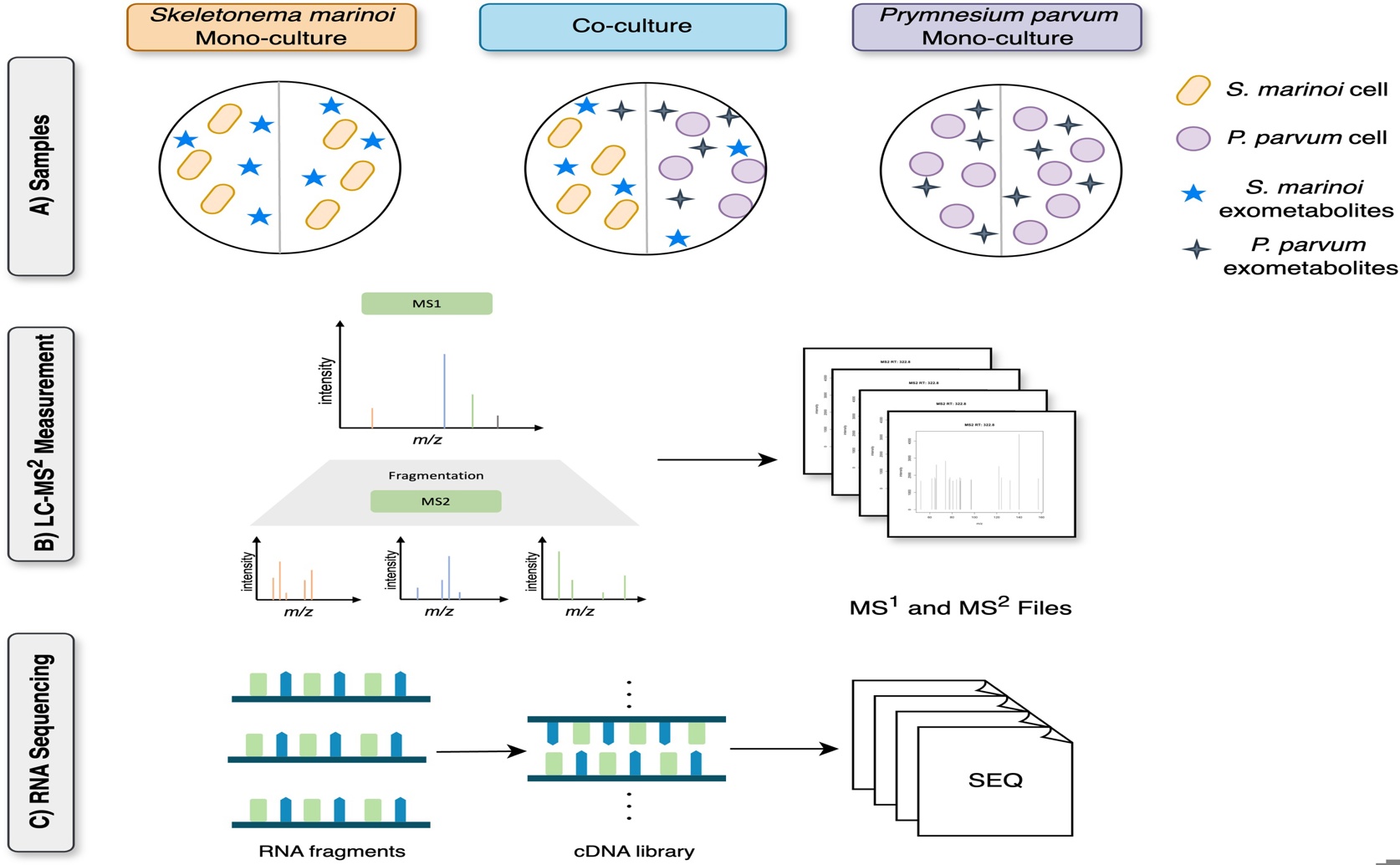
To identify differentially produced metabolites and gene expression changes indicative of microbial interaction, this experimental workflow compared mono- and co-cultures (A) of Skeletonema marinoi and golden algae (Prymnesium parvum) via LC-MS metabolomic (B) and RNA sequencing transcriptomic (C) profiling.

Image adapted from: Zulfiqar et al. / CC BY (Source)

Key Findings

  • Researchers at Friedrich Schiller University Jena found that two marine microalgae, S. marinoi and P. parvum, chemically interact, with P. parvum negatively impacting S. marinoi's growth
  • The study revealed hundreds of chemical changes (metabolites) in both microalgae when grown together, including previously unknown compounds, indicating a complex chemical exchange
  • Both microalgae showed significant changes in gene activity related to energy and repair, demonstrating their metabolic adaptation to living together
Marine ecosystems are dynamic environments where the smallest inhabitants, like microscopic algae and bacteria, play an outsized role in maintaining balance. These tiny organisms often communicate and interact through a complex language of chemical signals, known as specialised metabolites. Understanding these intricate chemical interactions is crucial because they shape the entire ecological network, influencing everything from nutrient cycling to the health of larger marine life. However, deciphering this chemical dialogue has long been a challenge, limiting our ability to fully grasp how these ecosystems function and how they might respond to environmental changes. Researchers at Friedrich Schiller University Jena have recently undertaken a study[1] to shed light on these hidden chemical conversations, specifically focusing on two types of marine microalgae: Skeletonema marinoi and Prymnesium parvum. Microalgae, which are single-celled organisms similar to plants, form the base of many aquatic food webs. The study aimed to understand how these two species interact when grown together, even without direct physical contact. To achieve this, they cultivated the microalgae in two settings: separately in mono-cultures and together in non-contact co-cultures, where the organisms shared the same water but were physically separated by a membrane, allowing only dissolved chemicals to pass through. The first hint of interaction came from observing the microalgae's growth. The scientists measured their photosynthetic potential, which is an indicator of how efficiently they can convert sunlight into energy, by monitoring their fluorescence. Changes in this potential suggested that S. marinoi and P. parvum were indeed influencing each other chemically, even without touching. This aligns with broader scientific understanding that plants, including microalgae, are intimately connected with their associated microorganisms, and that chemical interactions via natural products are vital for their health and development in both aquatic and terrestrial environments[2]. These interactions can range from beneficial to negative, often leading to a synchronization of metabolism and even coevolution between the organisms[2]. To uncover the specific chemical signals involved, the researchers employed advanced analytical techniques. They used metabolomics, a field that involves identifying and quantifying all the small molecule chemicals, or metabolites, within a biological sample. Specifically, they used Liquid Chromatography-Mass Spectrometry (LC-MS), a powerful method that separates molecules and then measures their mass, allowing for their identification. This allowed them to analyze both the endo-metabolome (chemicals inside the cells) and the exo-metabolome (chemicals released into the surrounding water). The study identified a significant number of "differentially produced features"—chemicals that were present in different amounts when the microalgae were grown together compared to when they were grown separately. For S. marinoi, 346 such features were found, and for P. parvum, 521 were identified. Despite the vast number of detected chemical signals, fully identifying the exact structure of all these molecules remains a challenge due to limited tandem mass spectrometry (MS2) data, which provides more detailed structural information. However, the team successfully structurally annotated 14 compounds, most of which were previously under-studied specialised metabolites. This highlights a broader challenge in the field of marine natural products (MNPs), where unique compounds from marine organisms and microorganisms hold immense potential for new applications, but their classification and accessibility in free databases are often poor[3]. The discovery of these under-studied compounds underscores the latent potential of marine environments as a source of novel chemicals[3]. Beyond the chemical changes, the researchers also looked at how the microalgae's genes were behaving. They performed a differential gene expression analysis on the transcriptomes of the microalgae. The transcriptome represents all the RNA molecules in a cell, indicating which genes are active or "expressed" at a given time. This analysis revealed that genes involved in energy metabolism and cellular repair were differentially expressed in both species when they were in co-culture. This indicates a metabolic adaptation of both species to their shared environment, a concept supported by previous research suggesting that symbiotic microbes synchronize their metabolism with their hosts[2]. The approach taken by the Friedrich Schiller University Jena study, combining metabolomics and transcriptomics, is particularly powerful. As highlighted in broader microbiome research, while individual "omics" approaches like metagenomics (studying genetic material), metatranscriptomics (studying gene activity), and metabolomics (studying chemical byproducts) provide valuable information separately, their combination paints a far more comprehensive picture of how microbial communities function and interact[4]. This integrative strategy, often referred to as "Algomics" when applied to microalgae, is increasingly used to understand the complex biological processes and metabolic pathways of these organisms, including their roles in symbiotic associations[5]. By using these multi-omics tactics, researchers can begin to disentangle the intricate networks that regulate metabolism and adaptation in microalgae[5]. While the study from Friedrich Schiller University Jena provides compelling evidence of chemical interactions and metabolic adaptations between S. marinoi and P. parvum, the researchers emphasize that further data acquisition and investigation are necessary to definitively confirm the precise type of interaction and the underlying mechanisms. Nevertheless, this research represents a significant step forward in understanding the complex chemical language that governs marine microbial ecosystems, building upon and demonstrating the utility of multi-omics approaches in deciphering these vital natural processes.

BiochemEcologyMarine Biology

References

Main Study

1) Analysis of metabolomics and transcriptomics data to assess interactions in microalgal co-culture of Skeletonema marinoi and Prymnesium parvum

Published 28th July, 2025

https://doi.org/10.1371/journal.pone.0329115


Related Studies

2) Microbial Metabolites Beneficial to Plant Hosts Across Ecosystems.

https://doi.org/10.1007/s00248-022-02073-x


3) Free Marine Natural Products Databases for Biotechnology and Bioengineering.

https://doi.org/10.1002/biot.201800607


4) Metagenomics, Metatranscriptomics, and Metabolomics Approaches for Microbiome Analysis.

https://doi.org/10.4137/EBO.S36436


5) Omics approaches for microalgal applications: Prospects and challenges.

https://doi.org/10.1016/j.biortech.2019.121890


Related Articles

An unhandled error has occurred. Reload 🗙