Hard Water At Home: Does It Affect Your Risk Of Gout And Its Return?

Jenn Hoskins
15th July, 2025

Hard Water At Home: Does It Affect Your Risk Of Gout And Its Return?

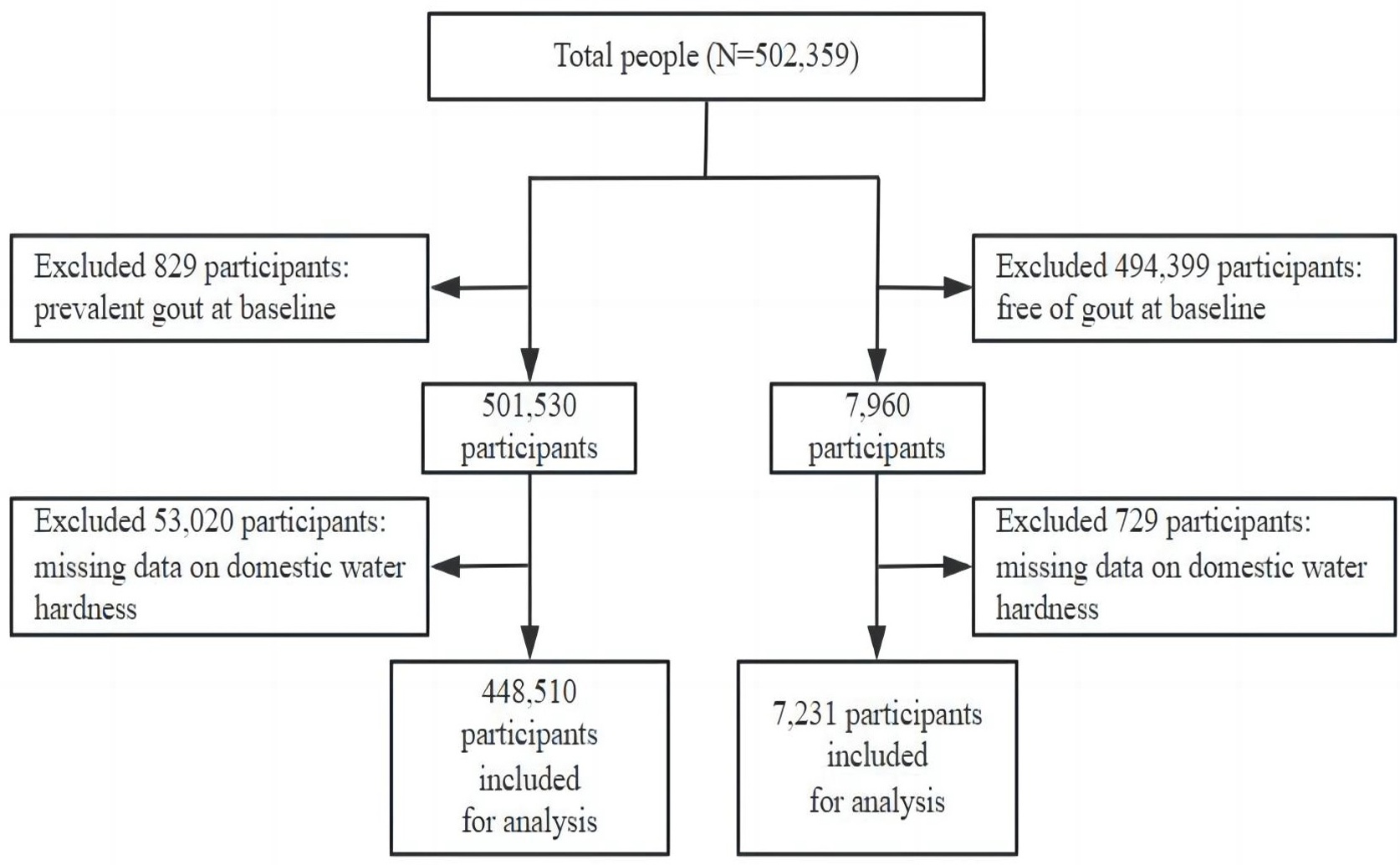
The flow charts of seeking gout incident and recurrent patients.

Image adapted from: Wei et al. / CC BY (Source)

Key Findings

  • In the UK, adults exposed to harder domestic water, particularly with more calcium carbonate, calcium, and magnesium, faced a higher risk of developing gout
  • For those already with gout, higher magnesium levels in their water significantly increased the likelihood of gout recurrence
Water, a fundamental element of life, carries various dissolved minerals depending on its source and journey through the earth. This mineral content determines what is commonly known as "hard water." While hard water is generally considered safe for consumption, accumulating scientific evidence suggests it might be linked to various health outcomes. One area that has remained largely unexplored is the potential association between domestic hard water and gout, a painful form of arthritis caused by the buildup of uric acid crystals in the joints. A recent study conducted by researchers from Anhui Institutions; Intl. Health Welfare Univ.[1] aimed to shed light on this unknown connection. Their objective was to investigate whether exposure to domestic hard water is associated with the development of new gout cases (known as "incidence") and the return of symptoms in individuals who have previously experienced gout (known as "recurrence") in adults aged 40-69 years in the UK. To achieve this, the researchers utilized data from the extensive UK Biobank study. They analyzed a large group of 448,510 participants who were free of gout at the beginning of the study (between 2006 and 2010) to track new gout cases. Additionally, they examined 7,231 participants who already had gout to observe instances of recurrence. Information on domestic water hardness was gathered from local water supply companies across England, Wales, and Scotland, providing data on mineral concentrations in the water. The scientists then used advanced statistical models, specifically Cox proportional hazard models, which are designed to assess how certain factors influence the risk of an event (like developing gout) over a period of time, to determine any associations. They also looked for linear trends, meaning a steady increase in risk with increasing hardness, and non-linear relationships, where the risk might change in a more complex way at different hardness levels. Over a median follow-up period of more than 13 years, the study recorded 6,521 new cases of gout and identified 519 instances of gout recurrence. The findings revealed a clear pattern: individuals exposed to harder water had an increased risk of developing gout. Compared to those living in areas with very soft water (0–60 mg/L of calcium carbonate, a common measure of hardness), participants exposed to higher grades of hard water showed an increased risk of gout incidence, with the risk rising consistently across the harder water categories. Specifically, for every additional 50 milligrams per liter (mg/L) of calcium carbonate (CaCO3), calcium (Ca), and magnesium (Mg) in the water, the risk of gout incidence increased. The study also found that the relationship between these minerals and gout incidence was not always a simple linear one, meaning the risk didn't just increase steadily but could accelerate or slow down at different concentrations. For gout recurrence, the study observed that only magnesium concentration showed a significant association. Each additional 50 mg/L of magnesium in the water was linked to a substantial increase in the risk of gout recurrence. This suggests that while several minerals in hard water might contribute to the initial development of gout, magnesium specifically could play a role in its return. These findings from the Anhui Institutions; Intl. Health Welfare Univ. study build upon and add to a growing body of research exploring the impact of hard water on human health. For instance, an earlier study also using UK Biobank data[2] investigated the link between domestic hard water and eczema, a chronic inflammatory skin condition, in adults. That research found that increasing levels of domestic hard water, measured by calcium carbonate concentrations, were associated with an increased prevalence of eczema in adults (meaning more existing cases), but not with new cases (incidence) or eczema at follow-up. The current gout study, however, found an association with gout incidence, highlighting that different health conditions might be affected by hard water in distinct ways. While eczema prevalence was linked, gout incidence appears to be as well. Another relevant study[3] focused on the mineral content of drinking water and its relationship to the composition of kidney stones (urolithiasis). That research found that while overall water hardness did not independently predict the type of kidney stone formed, specific minerals like sodium and magnesium did play a role. For example, water sodium concentration was linked to mixed calcium oxalate/uric acid stones, and magnesium-to-calcium ratio negatively predicted certain calcium oxalate stones. The gout study similarly delved into the specific roles of calcium and magnesium, finding that these individual minerals, rather than just "total hardness," were significant predictors for gout risk. This aligns with the kidney stone study's[3] approach of examining individual mineral contributions. However, it also presents a contrast: while the kidney stone study[3] noted that total water hardness itself wasn't an independent predictor for stone type, the gout study found that higher concentrations of calcium carbonate, calcium, and magnesium, which contribute to overall hardness, did increase the risk of gout incidence. In conclusion, the research from Anhui Institutions; Intl. Health Welfare Univ. suggests that exposure to hard water, particularly water with higher concentrations of calcium carbonate, calcium, and magnesium, might increase the risk of developing gout. Furthermore, for individuals who already have gout, higher magnesium concentrations in their water could increase the likelihood of gout recurrence. These findings indicate that ongoing efforts to understand and potentially reduce hard water exposure could have a beneficial effect in reducing the burden of gout in adults, similar to how such efforts might benefit eczema prevalence. Further research is needed to fully explore the mechanisms by which these minerals influence gout development and recurrence.

MedicineEnvironmentHealth

References

Main Study

1) Associations of domestic hard water metrics with the risk of gout incidence and recurrence

Published 14th July, 2025

https://doi.org/10.1371/journal.pone.0326052


Related Studies

2) The association between domestic hard water and eczema in adults from the UK Biobank cohort study.

https://doi.org/10.1111/bjd.21771


3) Does the mineral content of tap water correlate with urinary calculus composition?

https://doi.org/10.1007/s00240-022-01358-7


Related Articles

An unhandled error has occurred. Reload 🗙