Different Bug-Killing Nets Tested for Better Protection: A Community Study

Greg Howard
1st March, 2025

Different Bug-Killing Nets Tested for Better Protection: A Community Study

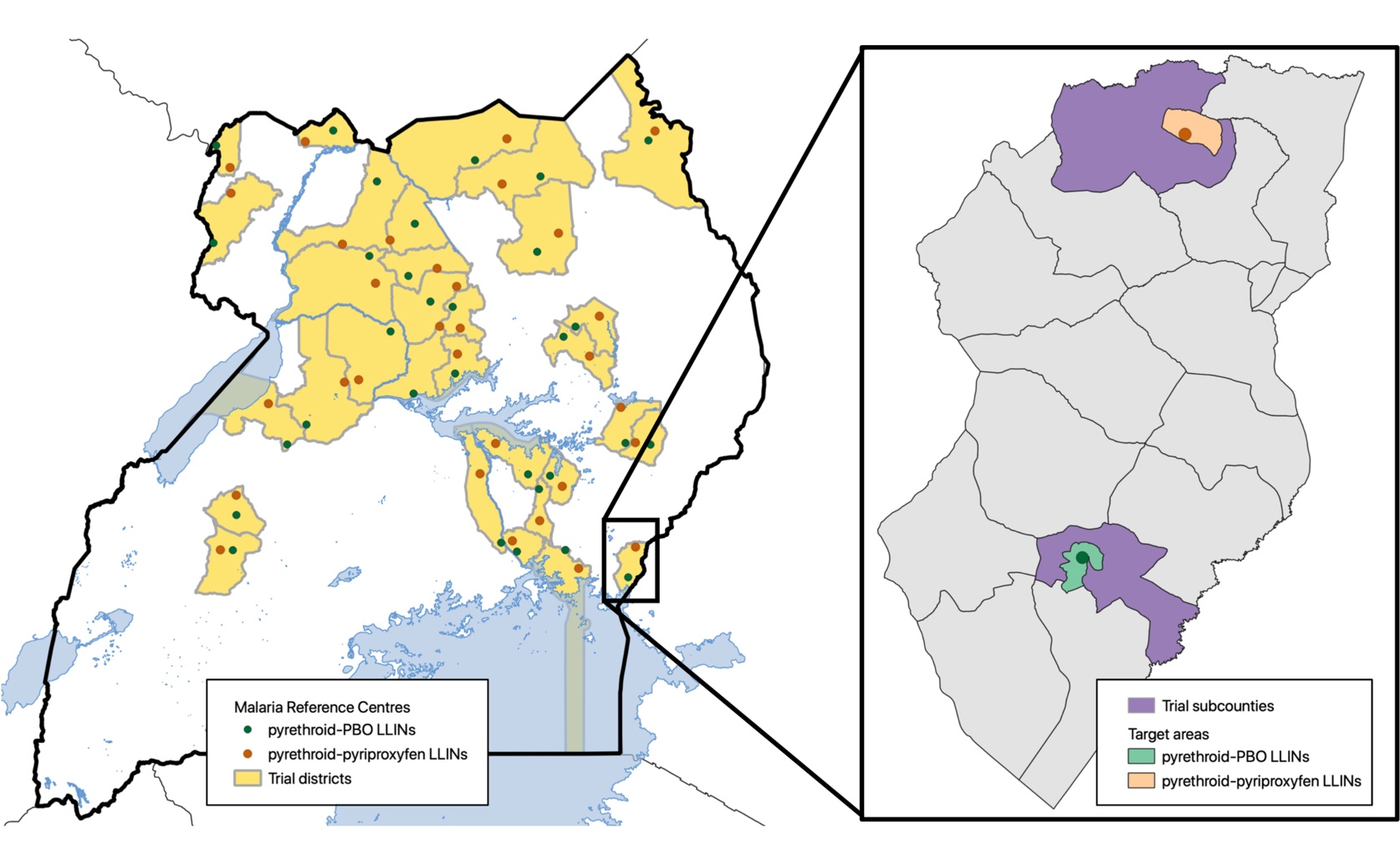
Map of study area: The study included 64 clusters across 32 districts; 2 clusters per district, one per study arm.

Image adapted from: Gonahasa et al. / CC BY (Source)

Key Findings

  • In Uganda, both specialized bed nets significantly lowered malaria cases over two years
  • There was no meaningful difference in effectiveness between the two types of treated nets
  • Only about 40% of households had enough nets, showing the need for better distribution and usage
Malaria remains a significant public health challenge in sub-Saharan Africa, despite substantial progress in controlling the disease over the past two decades. Long-lasting insecticidal nets (LLINs) have been pivotal in reducing malaria transmission by protecting individuals from mosquito bites during sleep. However, the effectiveness of LLINs is increasingly threatened by the rise of insecticide resistance among mosquito populations. A recent study conducted by the Infectious Diseases Research Collaboration[1] aimed to evaluate the effectiveness of two types of LLINs in Uganda, a country where malaria control efforts have made considerable strides but still face persistent challenges. This study was embedded into Uganda’s national LLIN distribution campaign between 2020 and 2021, providing a real-world context to assess the impact of different insecticide combinations used in LLINs. The research compared pyrethroid-piperonyl butoxide (PBO) LLINs with pyrethroid-pyriproxyfen LLINs across 64 clusters in 32 districts. Pyrethroids are commonly used insecticides in LLINs, but their efficacy has been declining due to resistance. PBO is a synergist that enhances the effectiveness of pyrethroids by inhibiting the enzymes mosquitoes use to detoxify the insecticide. Pyriproxyfen, on the other hand, is an insect growth regulator that prevents mosquitoes from reaching maturity. By comparing these two LLIN types, the study sought to determine whether alternative insecticide combinations could sustain the gains made in malaria control. Data were collected from health facilities over four years, encompassing 186,364 clinical malaria episodes among cluster residents. Additionally, community surveys were conducted at one and two years post-distribution to assess LLIN ownership and parasite prevalence in children. The primary outcome measured was the incidence of malaria in residents of all ages. The findings revealed that two years after LLIN distribution, malaria incidence had decreased in both intervention groups compared to baseline. Specifically, the pyrethroid-PBO LLINs group saw a reduction from 676 to 465 episodes per 1000 person-years, while the pyrethroid-pyriproxyfen LLINs group decreased from 674 to 469 episodes per 1000 person-years. However, there was no significant difference in malaria incidence between the two types of LLINs. Additionally, LLIN ownership remained low in both groups, with only about 40% of households having at least one net for every two residents. Parasite prevalence in children aged 2-10 years showed no significant difference between the two LLIN types in the community surveys. These results suggest that while both types of LLINs are effective in reducing malaria incidence, the addition of PBO or pyriproxyfen does not provide a measurable advantage over standard pyrethroid-treated nets in this setting. This outcome contrasts with earlier studies that highlighted the significant impact of LLINs and other interventions on reducing malaria burden[2]. For instance, a comprehensive analysis covering 2000 to 2015 demonstrated that malaria prevalence was halved and clinical cases decreased by 40% across sub-Saharan Africa, largely due to interventions like insecticide-treated nets[2]. Furthermore, another study in Uganda emphasized the critical role of indoor residual spraying (IRS) in achieving substantial reductions in malaria incidence[3]. The current study builds on these findings by exploring whether enhancing LLINs with additional insecticidal compounds could further bolster malaria control efforts. Moreover, the challenge of insecticide resistance has been a growing concern, as highlighted by previous research[4]. The effectiveness of LLINs relies heavily on the susceptibility of mosquito populations to the insecticides used. The rise in resistance to pyrethroids questioned the long-term viability of standard LLINs, prompting the exploration of alternative or supplementary insecticides. The study by the Infectious Diseases Research Collaboration addresses this issue by testing LLINs with different insecticidal properties. However, the lack of observed superiority of the modified LLINs indicates that resistance management may require more comprehensive strategies beyond simply changing insecticide types. One possible explanation for the study's findings is the inadequate coverage of LLINs two years after distribution. Despite the distribution efforts, only around 40% of households maintained sufficient nets for their members. This low coverage undermines the potential benefits of enhanced LLINs, as consistent and widespread use is crucial for effective malaria prevention. The study underscores the importance of not only distributing LLINs but also ensuring their sustained usage within communities. Furthermore, the study’s results highlight the complexity of malaria control in regions with high bed net coverage yet persistent malaria transmission[2][3]. It suggests that while LLINs remain a cornerstone of malaria prevention, their effectiveness can be limited by factors such as coverage rates and insecticide resistance. This aligns with earlier observations that increasing access to interventions and maintaining their efficacy are essential for continued progress in malaria control[2]. In conclusion, the study by the Infectious Diseases Research Collaboration provides valuable insights into the current state of malaria control through LLINs in Uganda. While enhanced LLINs with PBO or pyriproxyfen did not outperform standard pyrethroid-treated nets, the overall reduction in malaria incidence remains encouraging. The findings emphasize the need for improved LLIN coverage and comprehensive resistance management strategies to sustain and enhance the gains achieved in malaria control efforts.

MedicineEnvironmentHealth

References

Main Study

1) LLIN Evaluation in Uganda Project (LLINEUP2) – Effect of long-lasting insecticidal nets (LLINs) treated with pyrethroid plus pyriproxyfen vs LLINs treated with pyrethroid plus piperonyl butoxide in Uganda: A cluster-randomised trial

Published 26th February, 2025

https://doi.org/10.1371/journal.pgph.0003558


Related Studies

2) The effect of malaria control on Plasmodium falciparum in Africa between 2000 and 2015.

https://doi.org/10.1038/nature15535


3) The impact of stopping and starting indoor residual spraying on malaria burden in Uganda.

https://doi.org/10.1038/s41467-021-22896-5


4) Insecticide-treated nets for preventing malaria.

https://doi.org/10.1002/14651858.CD000363.pub3


Related Articles

An unhandled error has occurred. Reload 🗙