Engineering Yeast To Make Mushroom Health Compounds

Greg Howard
11th July, 2025

Engineering Yeast To Make Mushroom Health Compounds

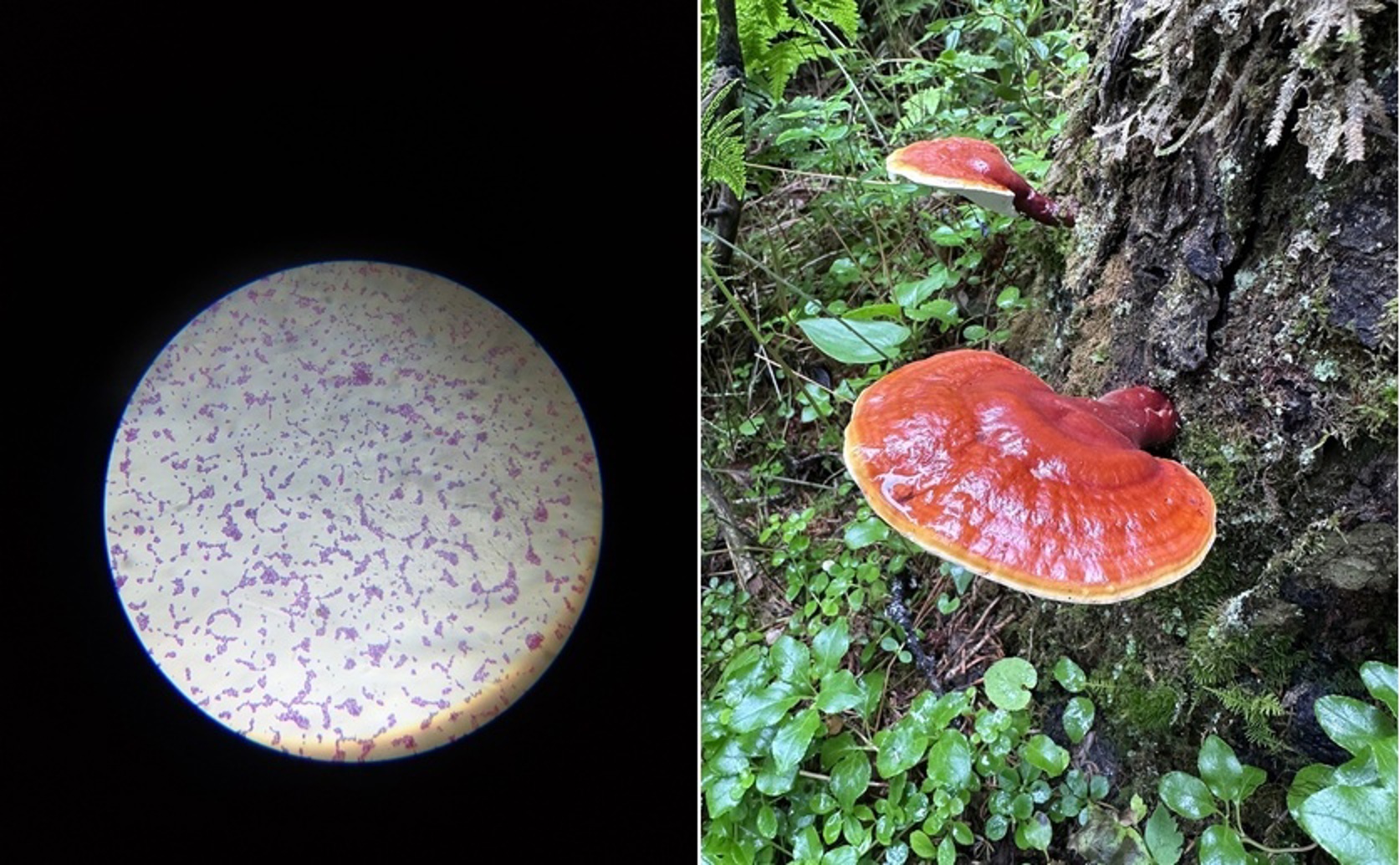
Baker's Yeast (Saccharomyces cerevisiae, left) and Lacquered Bracket (Ganoderma lucidum, right)

Composite: Natural Science News / CC BY. [Sources]
Adapted from photos by:

Key Findings

  • Researchers at Shanghai Jiao Tong University discovered the specific genetic instructions and key enzymes in the "mushroom of immortality" that create its beneficial compounds
  • They successfully transferred these instructions into baker's yeast, turning it into a "factory" to produce these valuable compounds
  • This breakthrough allowed the yeast to produce over 30 different beneficial compounds, yielding up to 10,000 times more than traditional mushroom farming
For centuries, humanity has looked to nature for remedies, and among the most revered sources are mushrooms. One such example is Ganoderma lucidum, often called Ling Zhi or "the mushroom of immortality," which has been a cornerstone of traditional medicine in Asian countries for over 2,000 years[2]. This macrofungus is celebrated for its wide array of therapeutic potentials, including boosting the immune system, fighting inflammation, and exhibiting anti-tumor, anti-diabetic, and anti-aging properties[2]. These benefits stem from a rich cocktail of bioactive compounds, with triterpenoids being among the most significant[2][3]. Despite its profound medicinal value, Ganoderma lucidum is naturally rare, making it difficult to harvest enough to meet the growing global demand for its therapeutic applications[2]. This scarcity has driven efforts to cultivate the mushroom, but even farmed varieties may not yield sufficient quantities of its most potent compounds. The challenge lies in understanding and then manipulating the complex biological processes that create these valuable substances. Scientists face a significant hurdle in decoding the intricate "biosynthetic networks"—the series of chemical reactions and enzymes that cells use to build complex molecules—and then reprogramming them to produce specific desired compounds efficiently. Addressing this critical challenge, researchers at Shanghai Jiao Tong University have made a significant breakthrough[1]. Their recent study focused on unlocking the secrets behind the production of "type II ganoderic acids" (TIIGAs), a crucial group of triterpenoids that are among the primary bioactive metabolites in Ganoderma lucidum[3]. These ganoderic acids are part of a larger family of over 400 different bioactive compounds found in the mushroom, which contribute to its diverse pharmacological effects[2]. The team embarked on a detailed investigation into the coordinated gene expression within Ganoderma lucidum to map out the biosynthetic pathway of TIIGAs. Think of this as deciphering the mushroom's genetic instruction manual for making these specific compounds. Through this process, they successfully identified several key "enzymes"—biological catalysts that speed up chemical reactions—responsible for specific steps in the TIIGA production line. For instance, they pinpointed an enzyme called CYP512W6, which performs a precise chemical modification known as C22 hydroxylation, adding a hydroxyl group at a specific position on the molecule. They also uncovered a remarkable "bifunctional acetyltransferase" enzyme, which they named GlAT, capable of adding acetyl groups at two different positions (C15 and C22) on the TIIGA molecules. Understanding these specific enzymatic steps is crucial because it reveals the precise molecular machinery the mushroom uses to create these compounds. With this newfound knowledge of the mushroom's internal chemistry, the researchers then sought to apply it to a more practical, industrial scale. They used a technique called "fluorescence-guided integration" to efficiently transfer the genetic instructions for TIIGA biosynthesis into a more common and easily cultivated organism: baker's yeast. This approach allows for the "reprogramming" of the yeast's metabolic machinery to produce compounds it wouldn't naturally make. Initially, the team encountered a "metabolic block" in the yeast, meaning the production of the desired TIIGAs was hindered at a certain point. However, by cleverly adjusting the timing of when certain acetyltransferase enzymes were expressed—effectively fine-tuning the yeast's internal chemical factory—they overcame this obstacle. The success of this reprogramming effort was remarkable. By transferring the identified genetic components and optimizing their expression, the Shanghai Jiao Tong University team was able to produce over 30 different TIIGAs. What's more, the yields, or "titers," of these compounds were astonishingly high—between 1 and 4 orders of magnitude greater than what can be obtained from traditionally farmed Ganoderma lucidum. This directly addresses the long-standing issue of Ganoderma being rare in nature and insufficient for commercial exploitation[2]. This breakthrough has profound implications. By providing a reliable, scalable, and highly efficient method for producing these valuable ganoderic acids, the research paves the way for their widespread application in medicine and health. Given the extensive list of pharmacological effects attributed to Ganoderma lucidum, including its anti-inflammatory properties[2], these compounds could be vital in developing new treatments for a range of conditions. For example, neuroinflammation is a common feature in neurodegenerative diseases like Alzheimer's and Parkinson's, and natural products from mushrooms are increasingly recognized as a promising, largely untapped source for new therapies[4]. The ability to produce specific, highly pure ganoderic acids in large quantities means they can be more thoroughly studied, tested, and potentially developed into new drugs. Furthermore, this work provides a valuable blueprint for future research, shedding light on how to decode and manipulate the biosynthetic pathways of other complex and beneficial compounds found in various medicinal mushrooms, opening doors for the discovery and production of entirely new therapeutic agents.

BiotechBiochemMycology

References

Main Study

1) Decoding and reprogramming of the biosynthetic networks of mushroom-derived bioactive type II ganoderic acids in yeast

Published 8th July, 2025

https://doi.org/10.1038/s41421-025-00812-1


Related Studies

2) Ganoderma lucidum: a potent pharmacological macrofungus.

Journal: Current pharmaceutical biotechnology, Issue: Vol 10, Issue 8, Dec 2009


3) Secondary metabolites from Ganoderma.

https://doi.org/10.1016/j.phytochem.2015.03.010


4) Mushroom Natural Products in Neurodegenerative Disease Drug Discovery.

https://doi.org/10.3390/cells11233938


Related Articles

An unhandled error has occurred. Reload 🗙