Boosting Red Pigment Production in Dairy Waste Using Natural Fermentation

Jenn Hoskins
10th December, 2024

Boosting Red Pigment Production in Dairy Waste Using Natural Fermentation

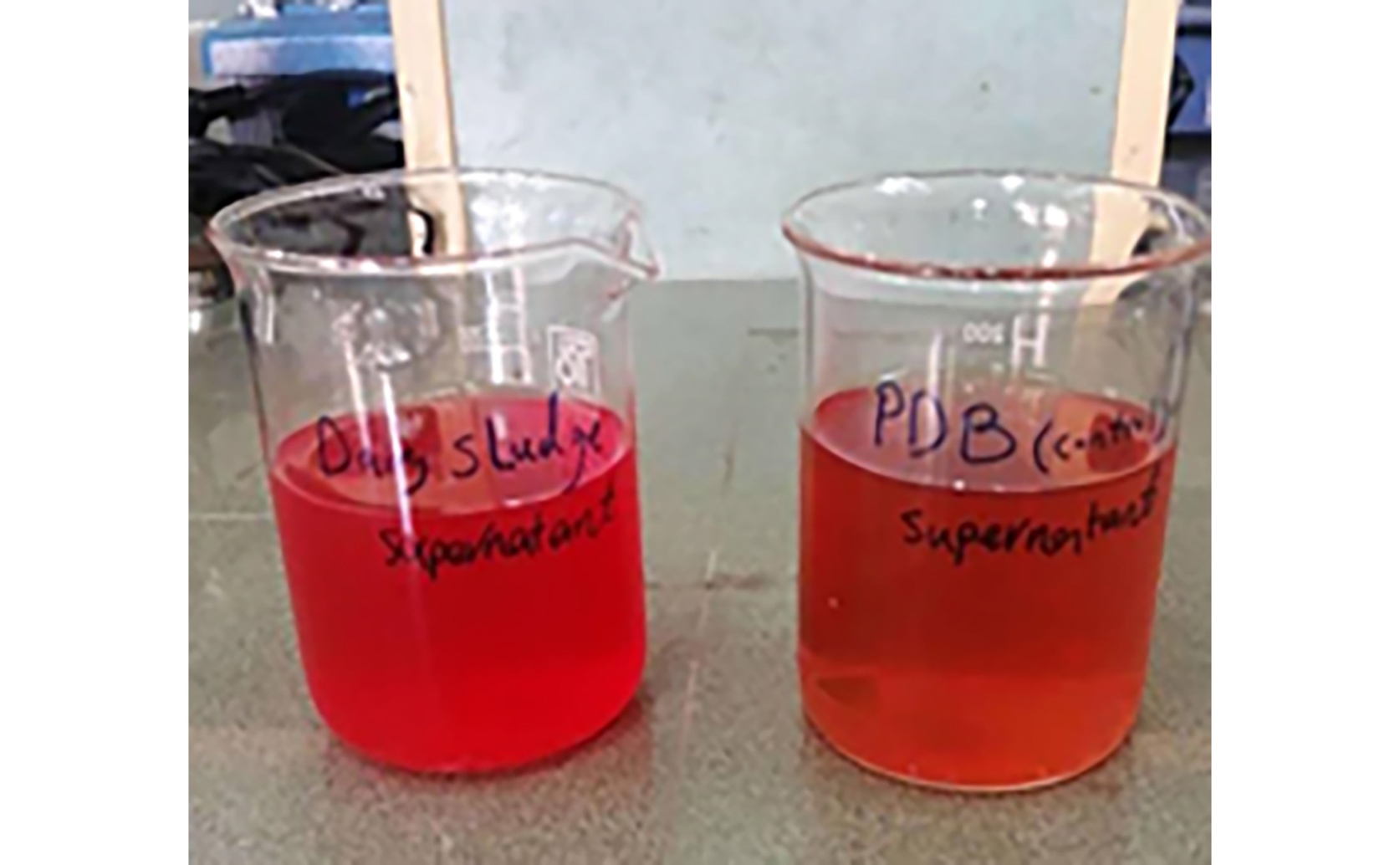
Fermentation of Monascus purpureus in a dairy sludge-enriched medium (left) produced a substantially greater yield of red pigment compared to the standard control medium (right), demonstrating the effectiveness of this waste-based substrate for enhanced production.

Image adapted from: Moradi et al. / CC BY (Source)

Key Findings

  • Researchers at Ferdowsi University of Mashhad used dairy sludge as a culture medium to grow Monascus purpureus for red pigment production
  • The study achieved a high biomass yield and produced 4.85 g of purified pigment with low citrinin levels, making it safe for food industry use
  • The findings highlight the potential of using waste products like dairy sludge for sustainable and cost-effective pigment production
The production of natural pigments from fungi has garnered significant attention due to their diverse applications in food, cosmetics, and other industries. Monascus purpureus, a fungal species known for its pigment-producing capabilities, has been a focal point of such research. A recent study conducted by researchers at Ferdowsi University of Mashhad aimed to explore the production of red pigment from Monascus purpureus using waste culture medium and its potential health benefits[1]. This article delves into the findings of this study and how it builds upon previous research. Monascus purpureus has a long history of use in producing natural colorants and food supplements[2]. The study by Ferdowsi University of Mashhad investigated the use of dairy sludge, a waste product, as a culture medium for cultivating M. purpureus. The goal was to not only produce pigments but also to assess their purity and potential health benefits. In this study, M. purpureus was grown in a medium composed of dairy sludge, monosodium glutamate (MSG), and glucose. This combination resulted in a biomass yield of 26.15 g/L. The extracted pigment, after purification, yielded 4.85 g of dry color. The purity of the pigment was confirmed using liquid chromatography mass spectrometry (LCMS) and nuclear magnetic resonance (NMR), while high-pressure liquid chromatography (HPLC) was used to measure citrinin levels—a mycotoxin that can be harmful if present in high concentrations. The findings revealed that the pigment had low citrinin levels, making it suitable for use in the food industry. Additionally, the fermentation conducted in a batch system using a fermenter showed promising results. The enriched culture conditions led to the highest concentration of monascorubramine, a red pigment, with a maximum specific growth rate of 0.029/1/h, a cell yield (Yx/s) of 0.29 g/g, and a production efficiency of 65% for M. purpureus. This study's approach to using dairy sludge as a culture medium ties into previous research that explored the use of various waste products for pigment production. For instance, previous studies have demonstrated the compatibility of brewer's spent grain hydrolysate[3] and rice straw hydrolysate[4] as substrates for Monascus pigment production. These studies highlight the potential for using low-cost, sustainable substrates to reduce production costs while maintaining high pigment yields. Moreover, the study aligns with earlier findings on the significance of optimizing fermentation conditions to enhance pigment production. For example, the use of MSG as an effective nitrogen source was previously identified as crucial for maximizing red pigment production[3]. The current study further confirms the role of MSG in achieving high biomass yields and pigment concentration. Additionally, the research builds on the understanding of how external factors can influence pigment synthesis. Prior studies have shown that the application of quorum sensing molecules like tyrosol can significantly increase pigment production while reducing citrinin levels[5]. The current study's findings of low citrinin content in the produced pigment suggest that the culture conditions and medium composition play a vital role in ensuring the safety and quality of the pigments. In conclusion, the study by Ferdowsi University of Mashhad presents a viable approach to producing natural red pigments using waste culture medium. By leveraging dairy sludge, the researchers have demonstrated an efficient and sustainable method for pigment production with low citrinin levels, making it suitable for food industry applications. This research not only contributes to the ongoing efforts to utilize waste products in biotechnological processes but also reinforces the importance of optimizing culture conditions to achieve high-quality and safe pigments.

BiotechBiochemMycology

References

Main Study

1) Evaluation of Monascus purpureus fermentation in dairy sludge-based medium for enhanced production of vibrant red pigment with minimal citrinin content.

Published 9th December, 2024

https://doi.org/10.1371/journal.pone.0315006


Related Studies

2) Complete genome sequence and transcriptomics analyses reveal pigment biosynthesis and regulatory mechanisms in an industrial strain, Monascus purpureus YY-1.

https://doi.org/10.1038/srep08331


3) Natural Red Pigment Production by Monascus Purpureus in Submerged Fermentation Systems Using a Food Industry Waste: Brewer's Spent Grain.

https://doi.org/10.3390/foods8050161


4) Cost-effective pigment production by Monascus purpureus using rice straw hydrolysate as substrate in submerged fermentation.

https://doi.org/10.1016/j.jbiosc.2019.08.007


5) Evaluation of tyrosol and farnesol as inducer in pigment production by Monascus purpureus ATCC16365.

https://doi.org/10.1002/jobm.202000037


Related Articles

An unhandled error has occurred. Reload 🗙