Early Life's Varied Feeding Methods

Jenn Hoskins
10th July, 2025

Early Life's Varied Feeding Methods

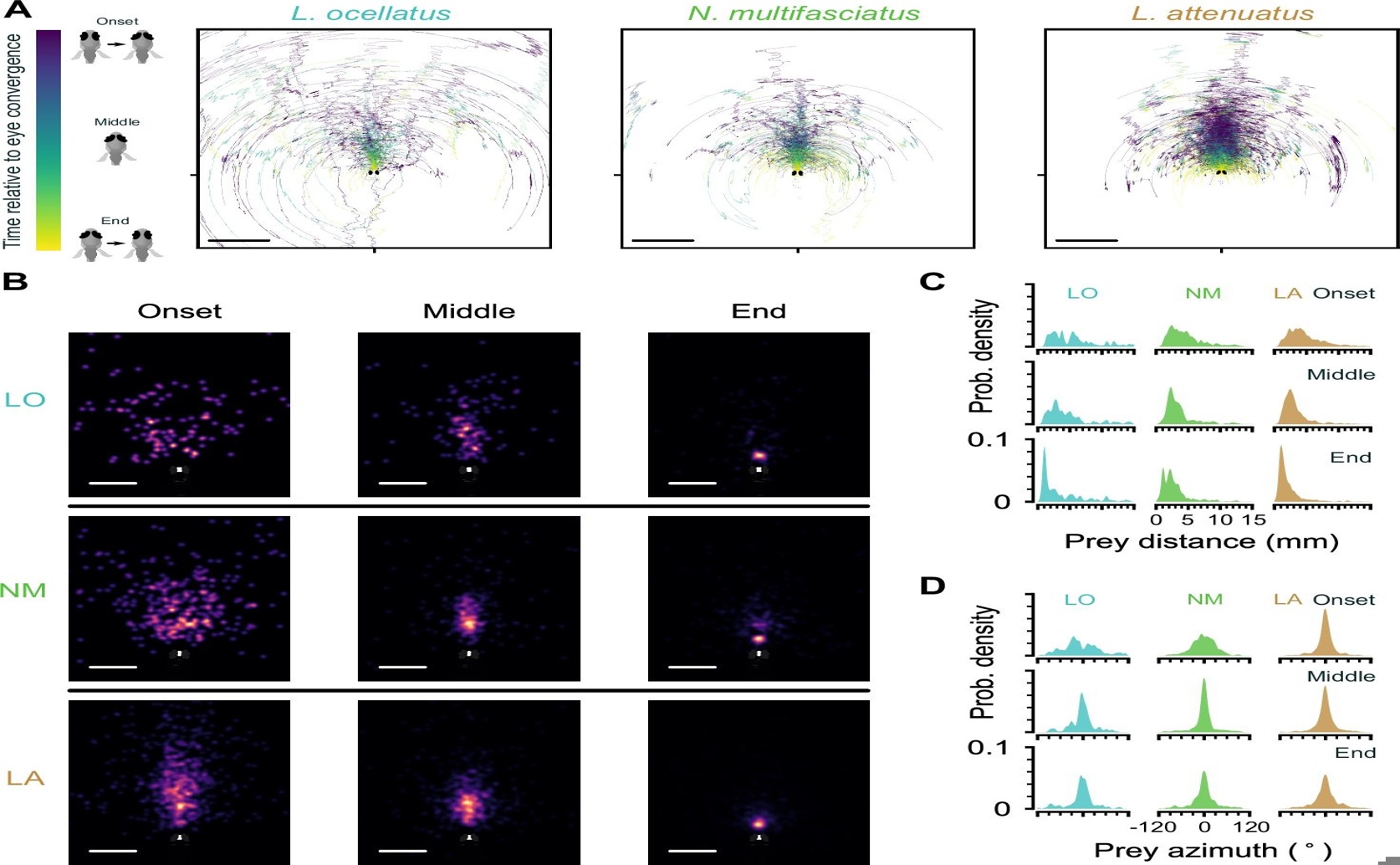
Visual tracking of prey trajectories (a) and density (b) reveals that larvae of the cichlids Lamprologus ocellatus, Neolamprologus multifasciatus, and Lepidiolamprologus attenuatus systematically reduce target distance (c) and angle (d) to center prey within a precise binocular strike zone.

Image adapted from: Mearns et al. / CC BY (Source)

Key Findings

  • Researchers at the Max Planck Institute found that cichlid larvae, like zebrafish, hunt by focusing both eyes on prey and striking directly, but use a wider variety of movements
  • In contrast, medaka larvae employ a different strategy, continuously swimming, tracking prey with one eye, and striking sideways, suggesting they judge distance differently
  • This study reveals how fish have evolved diverse swimming and eye movement strategies to catch prey, reflecting distinct evolutionary solutions to a common challenge
Animal behavior is intricately shaped by the environment in which a species evolves, alongside physical limitations, its evolutionary history, and how it develops. For instance, the hunting behavior of larval zebrafish, a fish native to streams in Eastern India, has been extensively studied. However, it has been unclear whether the specific set and sequence of movements these fish use to catch prey are common across all freshwater bony fishes. To address this, researchers at the Max Planck Institute for Biological Intelligence conducted a study[1] exploring the patterns of prey capture in larval fish from the Percomorpha group. This group's last shared ancestor with cyprinids, which include zebrafish, lived approximately 240 million years ago. This deep evolutionary split is significant, as recent advances in molecular phylogenies – which use genetic data to map evolutionary relationships – have drastically transformed how fish are classified, providing a more accurate "Tree of Life" for bony fishes[2]. Understanding this ancient divergence helps contextualize why different groups might have evolved distinct behavioral strategies. The study compared the hunting actions of four cichlid species from Lake Tanganyika, some from deep lake environments and others from rivers, with those of medaka, a fish found in East Asian rice paddies. To analyze their movements, the scientists used high-speed videography to record the fish and then employed neural networks – a type of artificial intelligence – to precisely track eye movements and extract detailed information about their swimming patterns during hunting. This approach to dissecting complex behaviors into quantifiable components is similar to methods used in other fields of behavioral science, such as the mapping of fruit fly actions, where researchers identify over a hundred distinct, stereotyped behavioral states based on underlying movement data[3]. Just as flies exhibit these "stereotyped motifs," the researchers here sought to identify similar fundamental units of hunting behavior in fish. A key finding was that cichlid larvae possess a broader range of hunting movements compared to zebrafish, yet they share several fundamental characteristics. Both cichlids and zebrafish exhibit eye convergence, where both eyes turn inward to focus on the prey, positioning it centrally within their binocular visual field – the area where both eyes overlap and provide depth perception. Their prey capture involves distinct, separate hunting attempts, including two specific types of capture strikes. This shared strategy aligns with what is known about the zebrafish visual system[4]. The zebrafish retina contains about 40 types of specialized nerve cells, called retinal ganglion cells (RGCs), which act like "matched filters" for specific visual features, including prey. These RGCs send signals to various brain areas, notably the optic tectum, which serves as a major hub for visuomotor control. This system is highly adapted for visually guided behaviors like prey capture, suggesting that cichlids may leverage similar neural pathways. In contrast, the medaka displayed a very different hunting strategy. They swim continuously, tracking their prey using only one eye (monocularly) without eye convergence. Before capturing, they position the prey to the side of their head and then strike with a sideways swing. This distinct set of kinematic motifs – the specific patterns of movement – suggests that medaka might primarily judge the distance to their prey using motion parallax. Motion parallax is a visual cue where closer objects appear to move faster across the visual field than more distant ones when the observer is moving. This differs from cichlids and zebrafish, which seem to rely more heavily on binocular visual cues for depth perception. Collectively, this research documents the significant diversification of how fish have adapted their swimming (locomotor) and eye movement (oculomotor) behaviors for hunting. By comparing these different species across a vast evolutionary timeline, the study reveals that while the goal of prey capture is universal, the specific behavioral and sensory strategies employed can vary widely, reflecting distinct evolutionary solutions to a common challenge.

EcologyAnimal ScienceMarine Biology

References

Main Study

1) Diverse prey capture strategies in teleost larvae

Published 8th July, 2025

https://doi.org/10.7554/eLife.98347


Related Studies

2) Phylogenetic classification of bony fishes.

https://doi.org/10.1186/s12862-017-0958-3


3) Mapping the stereotyped behaviour of freely moving fruit flies.

https://doi.org/10.1098/rsif.2014.0672


4) The Visual Systems of Zebrafish.

https://doi.org/10.1146/annurev-neuro-111020-104854


Related Articles

An unhandled error has occurred. Reload 🗙