How Estuarine Shrimp Share Habitat and Resources: Effects on Growth and Survival

Jenn Hoskins
28th December, 2024

How Estuarine Shrimp Share Habitat and Resources: Effects on Growth and Survival

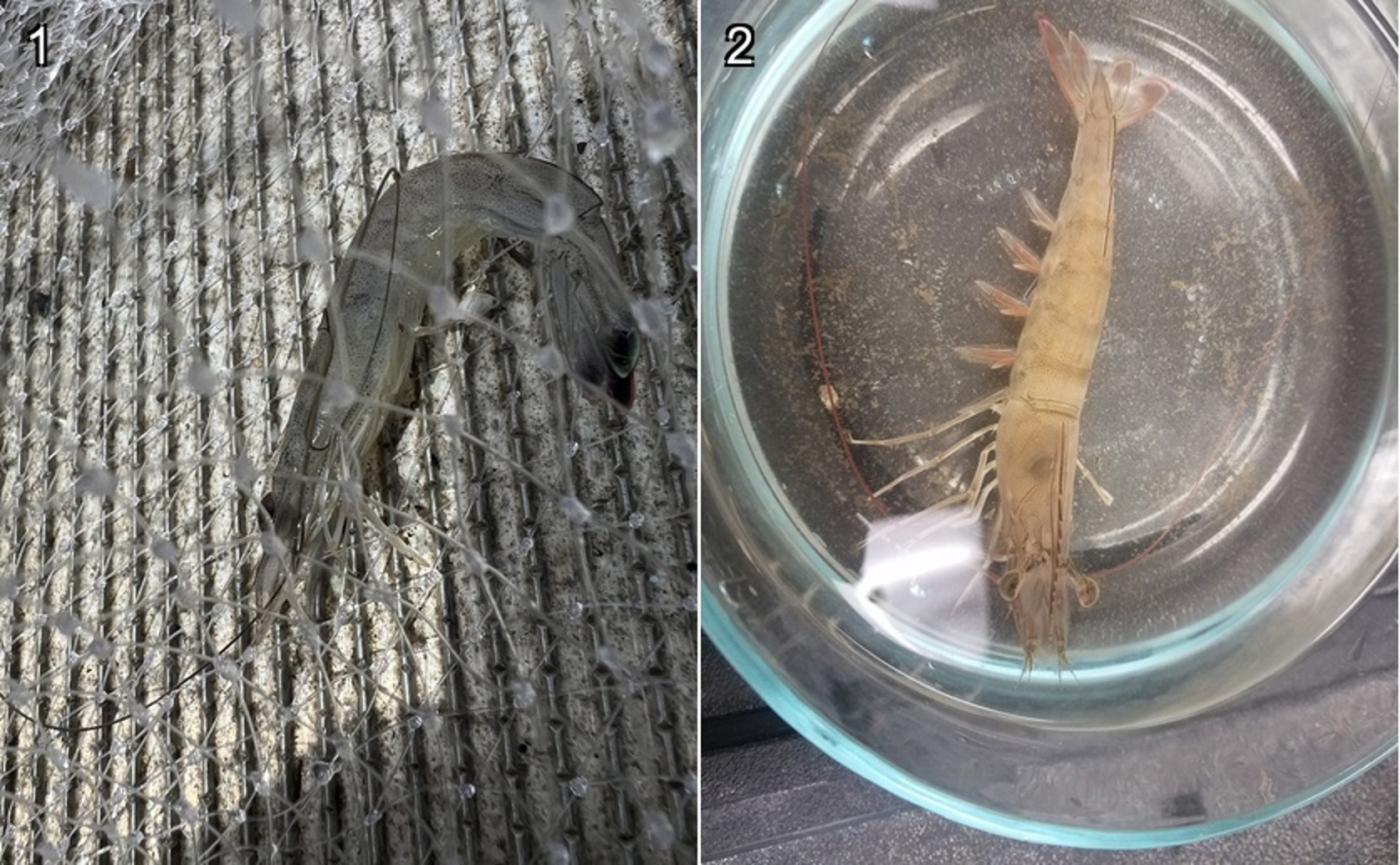
For both white shrimp (Penaeus setiferus) (1) and brown shrimp (Penaeus aztecus) (2), the probability of mortality decreased as body size increased, though only brown shrimp showed evidence that mortality is also influenced by population density.

Composite: Natural Science News / CC BY. [Sources]
Adapted from photos by:

Key Findings

  • The study took place in the North Inlet-Winyah Bay National Estuarine Research Reserve, focusing on brown shrimp and white shrimp in estuarine nurseries
  • Brown and white shrimp use nursery habitats at different times but overlap briefly, leading to high competition and cannibalism risks
  • Smaller shrimp have higher mortality rates, and the presence of other shrimp species affects growth and survival differently for brown and white shrimp
The study of habitat partitioning in estuarine environments can offer valuable insights into the coexistence of closely related species. The North Inlet-Winyah Bay National Estuarine Research Reserve recently conducted a study[1] on two congeneric shrimp species, the brown shrimp (Penaeus aztecus) and the white shrimp (Penaeus setiferus), which share nursery habitats in the southeastern U.S. This research aimed to understand how these species utilize estuarine nurseries and how density-dependent (D-D) processes affect their growth and mortality. The study observed the periods of nursery habitat use for both shrimp species within a representative salt marsh estuary. It was noted that these species temporally partition much of their nursery habitat occupancy but experience a period of overlap. During these overlapping periods, the potential for biotic interactions, such as intra- and inter-specific competition and cannibalism, is high. Understanding these interactions is crucial because they can alter demographic rates, impacting the shrimp populations' sustainability and economic value. To explore these interactions, the researchers conducted a set of manipulative laboratory experiments. These experiments simulated three phases of nursery habitat use: brown shrimp only, brown and white shrimp overlap, and white shrimp only. The shrimp were maintained at ecologically relevant densities and tagged to monitor their growth trajectories. The results showed varying degrees of D-D effects between the species and across different response variables, such as length, mass, and mortality. One significant finding was that body size was a critical predictor of mortality for both shrimp species. Smaller shrimp exhibited higher mortality probabilities, suggesting that size plays a vital role in survival during nursery residency. Additionally, the study found that the effect of conspecific and congeneric density varied between the shrimp species for all three response metrics. This indicates that the presence of another species could influence growth and mortality differently for brown and white shrimp. The study's findings align with previous research on density-dependent processes in marine populations. For example, a study on penaeid shrimps in Laguna Madre, Mexico, found that shrimp density was related to the proximity to a tidal inlet, with higher densities observed in nearby seagrass beds[2]. This density adversely affected the condition of the shrimp, suggesting that intra- and interspecific competition for food items could occur predominantly within seagrass beds near the tidal inlet. Similarly, the current study indicates that high densities can lead to increased mortality, particularly for smaller shrimp. Moreover, the study on brown trout and Atlantic salmon in the Oir River, France, highlighted the contrasting effects of intra- and interspecific density on early life stages[3]. In that study, trout density negatively correlated with body size and winter survival, while salmon density positively correlated with trout migration. These findings underscore the importance of considering both intra- and interspecific density when studying population dynamics in coexisting species, a principle that is also evident in the shrimp study. The current study contributes to our understanding of how environmental conditions and biotic interactions shape the demographic rates of ecologically and economically important species. By documenting the periods of nursery habitat use and conducting controlled experiments, the researchers provided valuable insights into the D-D processes affecting brown and white shrimp. These findings can inform management strategies to ensure the sustainability of shrimp populations in estuarine environments. In conclusion, the research conducted by the North Inlet-Winyah Bay National Estuarine Research Reserve highlights the complex interactions between closely related shrimp species in estuarine nurseries. The study's results emphasize the importance of considering both intra- and interspecific density-dependent processes to understand population dynamics and ensure the sustainability of these valuable species.

EcologyAnimal ScienceMarine Biology

References

Main Study

1) Temporal habitat partitioning and resource competition between congenerics: Testing for density-dependent growth and mortality in estuarine shrimp.

Published 27th December, 2024

https://doi.org/10.1371/journal.pone.0316219


Related Studies

2) Density-dependent condition of juvenile penaeid shrimps in seagrass-dominated aquatic vegetation beds located at different distance from a tidal inlet.

https://doi.org/10.7717/peerj.10496


3) Intra- and interspecific densities shape life-history traits in a salmonid population.

https://doi.org/10.1007/s00442-018-4213-4


Related Articles

An unhandled error has occurred. Reload 🗙