
How Water Bugs Choose Their Food and Live Together
Jenn Hoskins
18th July, 2024


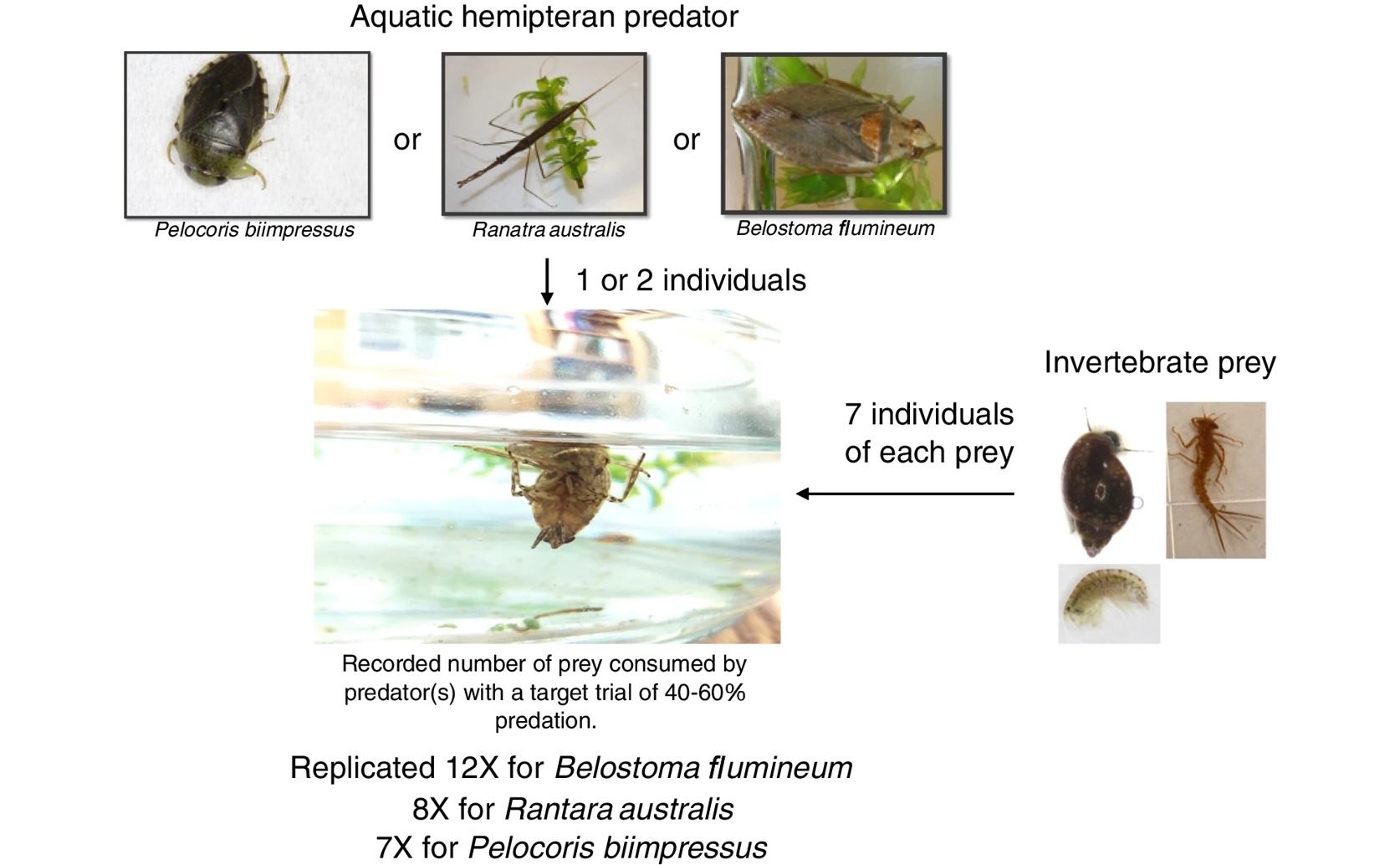
To determine the foraging preferences that may facilitate coexistence, individual aquatic hemipteran predators were placed in arenas with an equal number of amphipod (Hyalella sp.), damselfly naiad, and snail (Physa sp.) prey.
Key Findings
- Researchers at Southwestern Oklahoma State University studied three species of aquatic predatory insects to understand their foraging preferences
- Each predator species showed a distinct preference for different prey: B. flumineum preferred snails, P. biimpressus favored damselfly naiads, and R. australis chose amphipods
- These distinct foraging preferences suggest that differences in prey choice help these predators coexist by reducing direct competition for the same resources
EcologyAnimal ScienceMarine Biology
References
Main Study
1) Prey Preferences for Three Aquatic Hemipterans Provide Insights About Their Coexistence
Published 18th July, 2024
https://doi.org/10.1007/s10905-024-09855-w
Related Studies
2) The importance of niches for the maintenance of species diversity.
3) Who eats whom in a pool? A comparative study of prey selectivity by predatory aquatic insects.
4) Functional traits and niche-based tree community assembly in an Amazonian forest.
5) A niche for neutrality.
Journal: Ecology letters, Issue: Vol 10, Issue 2, Feb 2007
Related Articles
 19th April, 2024 | Greg Howard