Coconut Waste For Recycling Metals From Old Batteries

Jim Crocker
2nd July, 2025

Coconut Waste For Recycling Metals From Old Batteries

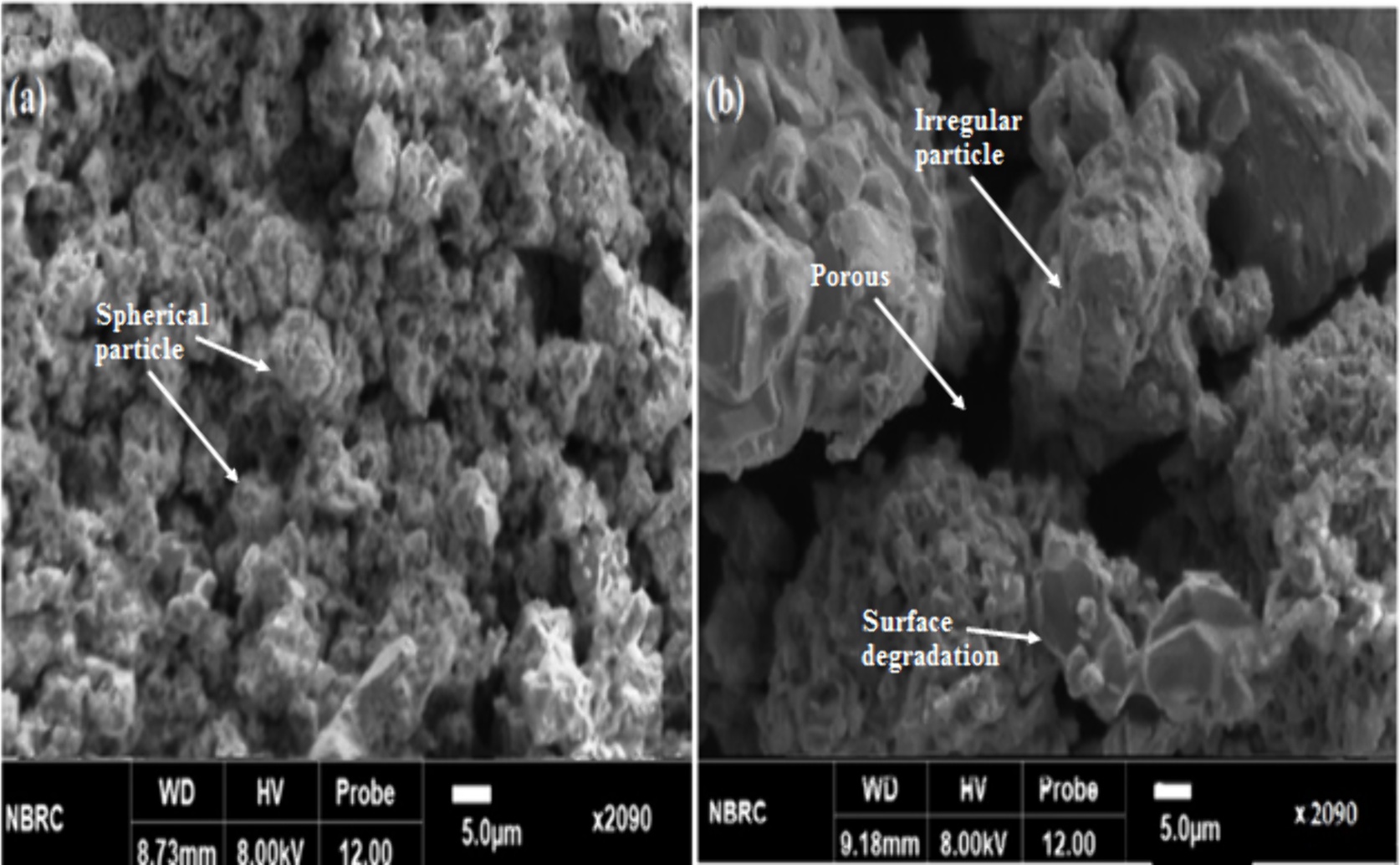
Scanning electron microscopy confirms the efficacy of the proposed green extraction method, revealing a distinct morphological transition from compact, spherical cathode particles before leaching (a) to a highly porous and irregular structure following treatment with mixed organic acids and coir peat (b), indicating successful metal dissolution.

Image adapted from: Fatima et al. / CC BY (Source)

Key Findings

  • Researchers in Pakistan and Oman developed an eco-friendly method to recover valuable metals from old lithium-ion batteries
  • This innovative process uses natural acids and coconut husk waste (coir peat) to efficiently extract 98% lithium, 84.6% cobalt, 85.6% nickel, and 79.8% manganese
The rapid global adoption of lithium-ion batteries (LIBs) for everything from mobile phones to electric vehicles has created a significant environmental challenge: what to do with them once they reach the end of their life? Improper disposal leads to hazardous waste and the loss of valuable critical metals like lithium, cobalt, nickel, and manganese, which are essential for new battery production. Recycling these materials is crucial for clean energy and sustainable industry growth, reducing the need for new mining and mitigating environmental pollution. Addressing this challenge, recent research from Government College University Faisalabad, King Faisal University, and University of Technology and Applied Sciences[1] has investigated an eco-friendly method for recovering these valuable metals from spent LIBs. This study focuses on a "hydrometallurgical" process, which means using liquids to dissolve and extract metals, as opposed to high-temperature "pyrometallurgical" methods. The key innovation lies in using biodegradable mixed organic acids, supported by a natural material called coir peat, to achieve efficient metal extraction. The research aimed to develop a simpler and more environmentally friendly recycling process. The first step involved optimizing various conditions for leaching, which is the process of dissolving the metals from the solid battery material into a liquid solution. They found optimal conditions using a specific concentration of battery material in the liquid (slurry density: 20 grams per liter), a moderate temperature of 55 degrees Celsius, a reaction time of 55 minutes, and a stirring speed of 460 revolutions per minute. The acids used were a 50:50 mixture of ascorbic acid and citric acid, both of which are organic acids, meaning they are carbon-based compounds often found in nature, making them more biodegradable and less harmful than strong mineral acids. A significant finding was the role of coir peat, a fibrous material derived from coconut husks, which was incorporated into the process as a "reductant." A reductant is a substance that helps metals dissolve by changing their chemical state, making them more soluble in the acid solution. While some prior studies have explored various chemical reductants like sodium metabisulphite[2], or even found ways to avoid reductants entirely with specific acid combinations[3], this study uniquely utilizes a natural, agro-waste material. The addition of coir peat remarkably enhanced the leaching efficiencies, achieving high recovery rates: 98% for lithium, 84.6% for cobalt, 85.6% for nickel, and 79.8% for manganese. This approach builds upon earlier efforts in sustainable battery recycling. For instance, previous work has shown the effectiveness of synergistic leaching using combinations of acids. One study[3] successfully used a mix of sulfuric acid and citric acid, achieving high recovery rates (up to 99% for lithium and 98% for cobalt) and noted that their optimized mixture could extract metals efficiently without the need for a reductant like hydrogen peroxide, highlighting a simpler, eco-friendlier process. Another study[4] proposed a mixed system of ascorbic acid and acetic acid, demonstrating very rapid leaching of metals (over 94% within just 10 minutes) and emphasizing the synergy between these organic acids. The current research continues this exploration of mixed organic acid systems, specifically combining ascorbic acid with citric acid, and further advances the eco-friendly aspect by introducing a natural, waste-derived reductant. While the 55-minute leaching time in this study is longer than the 10 minutes achieved in the ascorbic acid/acetic acid system[4], the use of coir peat represents a novel step towards even greater sustainability by utilizing agricultural waste. To understand how the process works at a fundamental level, the researchers performed "kinetic modeling," which helps determine the speed and mechanism of the chemical reactions. They found that the metal dissolution process was "chemically controlled," meaning the rate at which the metals dissolve is primarily determined by the chemical reactions occurring at the surface of the battery material, rather than how quickly the liquids mix or how fast substances diffuse. They also calculated the "apparent activation energies" for each metal, which is the minimum energy required for the chemical reaction to proceed. These values (43 kJ/mol for Li, 68 kJ/mol for Co, 47.8 kJ/mol for Ni, and 46 kJ/mol for Mn) provide insights into the energy requirements for the dissolution of each metal. The study also employed various characterization techniques to analyze the materials before and after leaching. "Scanning Electron Microscopy" (SEM) revealed changes in the surface of the cathode material, transforming from uniform spheres to uneven particles, indicating that the metals were indeed being dissolved. "Fourier-transform infrared spectroscopy" (FT-IR) and "X-ray diffraction" (XRD) confirmed structural changes in the cathode material, showing how the original crystalline structure was altered as metals were extracted. Finally, "UV-Vis spectroscopy" detected the formation of specific colored complexes of cobalt, manganese, and nickel in the solution, confirming that these metals had been successfully reduced and dissolved. This research highlights the significant potential of using biodegradable reagents and agro-waste materials in developing sustainable battery recycling methods. By combining organic acids with a natural reductant, it offers a promising pathway to recover valuable metals from spent LIBs in an environmentally responsible manner, contributing to a more circular economy for critical resources.

EnvironmentSustainabilityBiotech

References

Main Study

1) Valorization of coir peat in green extraction of valuable metals from spent lithium-ion batteries

Published 1st July, 2025

https://doi.org/10.1371/journal.pone.0326867


Related Studies

2) Hydrometallurgical recycling of lithium-ion batteries by reductive leaching with sodium metabisulphite.

https://doi.org/10.1016/j.wasman.2017.09.032


3) A greener method to recover critical metals from spent lithium-ion batteries (LIBs): Synergistic leaching without reducing agents.

https://doi.org/10.1016/j.jenvman.2024.121862


4) Rapid extraction of valuable metals from spent LiNixCoyMn1-x-yO2 cathodes based on synergistic effects between organic acids.

https://doi.org/10.1016/j.wasman.2023.04.020


Related Articles

An unhandled error has occurred. Reload 🗙