Turning Wastewater and Farm Waste into Clean Energy: A Microbial Solution

Jim Crocker
13th January, 2025

Turning Wastewater and Farm Waste into Clean Energy: A Microbial Solution

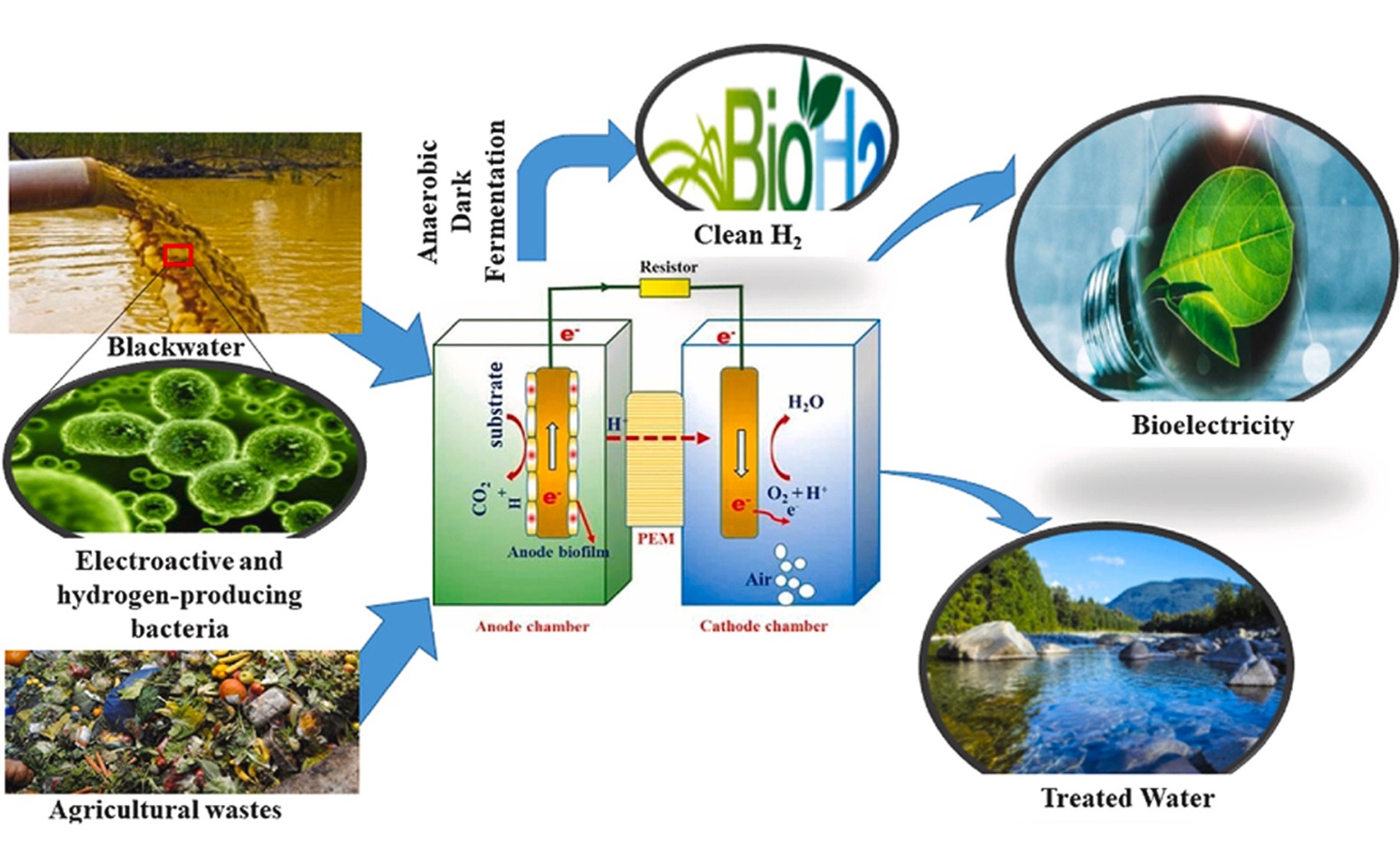
Graphical abstract from the study.

Image adapted from: Plakar et al. / CC BY (Source)

Key Findings

  • The study by the Federal University of Technology, Owerri, explored generating bioelectricity and biohydrogen from blackwater and agricultural waste using a dual-chamber Microbial Fuel Cell (MFC)
  • The highest voltage recorded was 1090 mV, significantly higher than previous studies, indicating improved efficiency
  • The MFC achieved high removal efficiencies for wastewater treatment, with 90.87% for Chemical Oxygen Demand (COD) and 76.67% for Biochemical Oxygen Demand (BOD)
The management of wastewater and agricultural wastes has traditionally involved separate treatment processes, which not only exacerbate pollution but also contribute to climate change through greenhouse gas emissions. Given the energy demands and financial burdens of traditional treatment facilities, there is a pressing need for technologies that can concurrently treat solid waste and generate energy. This study by the Federal University of Technology, Owerri, aimed to evaluate the feasibility of producing bioelectricity and biohydrogen through the microbial treatment of blackwater and agricultural waste using a dual-chamber Microbial Fuel Cell (MFC)[1]. Microbial Fuel Cells (MFCs) have been recognized for their potential to convert organic matter into electricity. Earlier studies have shown that MFCs can utilize waste biomass as a source of electrons for microbes capable of producing electrical current[2]. This study builds on such findings by exploring the simultaneous treatment of blackwater and agricultural waste, a novel approach that could streamline waste management processes and enhance energy recovery. The researchers focused on identifying optimal feedstock ratios and pH conditions, accompanied by biochemical assays to characterize the microbial community involved. The predominant microorganisms identified included Escherichia coli, Salmonella spp., and Pseudomonas aeruginosa. These microbes are known for their exoelectrogenic properties, meaning they can transfer electrons outside their cells, which is crucial for generating electricity in MFCs[3]. The study achieved significant results, with the highest open circuit voltage recorded at 1090 mV at a hydraulic retention time (HRT) of 6 days. This voltage is notably higher than values reported in earlier compost-based MFC studies, which observed maximum voltages around 350 mV[3]. This suggests that the dual-chamber design and the specific microbial community used in this study may offer improved efficiency. The researchers also reported maximum removal efficiencies for Chemical Oxygen Demand (COD) and Biochemical Oxygen Demand (BOD) at 90.87% and 76.67%, respectively. These metrics are critical as they indicate the effectiveness of the MFC in treating wastewater. The Columbic efficiency, which measures the efficiency of electron capture and transfer, was 40.17%, and the peak power density measured was 345 mW/m². These values are competitive with other renewable energy technologies and underscore the potential of MFCs in sustainable energy production[2][4]. In addition to electricity, the study also measured hydrogen production, with the highest hydrogen yield being 483 ppm/s. Hydrogen is a valuable byproduct, as it can be used in fuel cells or as a clean fuel alternative. The optimal feedstock ratio for the system was found to be 3:1:1 (300 g cassava peel, 100 g banana peel, and 100 g tomato waste), with ideal pH conditions at 9.35. This specific ratio and pH condition likely provide the best environment for microbial activity and waste degradation, leading to higher energy yields. This study underscores the potential for generating bioelectricity and biohydrogen from the microbial treatment of mixed blackwater and agricultural wastes in a single system, eliminating the need for separate treatment processes and external energy sources. By integrating the treatment of different waste streams, the system not only simplifies waste management but also enhances the sustainability of energy production. The findings contribute to the advancement of environmental engineering and management, bioenergy, microbial fuel cell technology, and affordable and clean energy solutions. Further research is needed to address challenges related to efficiency, scalability, system lifetimes, and reliability, but this study provides a promising foundation for future developments in the field[2][3][4].

EnvironmentSustainabilityBiotech

References

Main Study

1) Valorization of mixed blackwater/agricultural wastes for bioelectricity and biohydrogen production: A microbial treatment pathway.

Published 15th January, 2025 (future Journal edition)

https://doi.org/10.1016/j.heliyon.2024.e41126


Related Studies

2) Conversion of wastes into bioelectricity and chemicals by using microbial electrochemical technologies.

https://doi.org/10.1126/science.1217412


3) Microbial fuel cell (MFC) for bioelectricity generation from organic wastes.

https://doi.org/10.1016/j.wasman.2013.07.026


4) Recent advances on biomass-fueled microbial fuel cell.

https://doi.org/10.1186/s40643-021-00365-7


Related Articles

An unhandled error has occurred. Reload 🗙