How Proteins Change Shape: AI And X-Ray Views

Jenn Hoskins
29th June, 2025

How Proteins Change Shape: AI And X-Ray Views

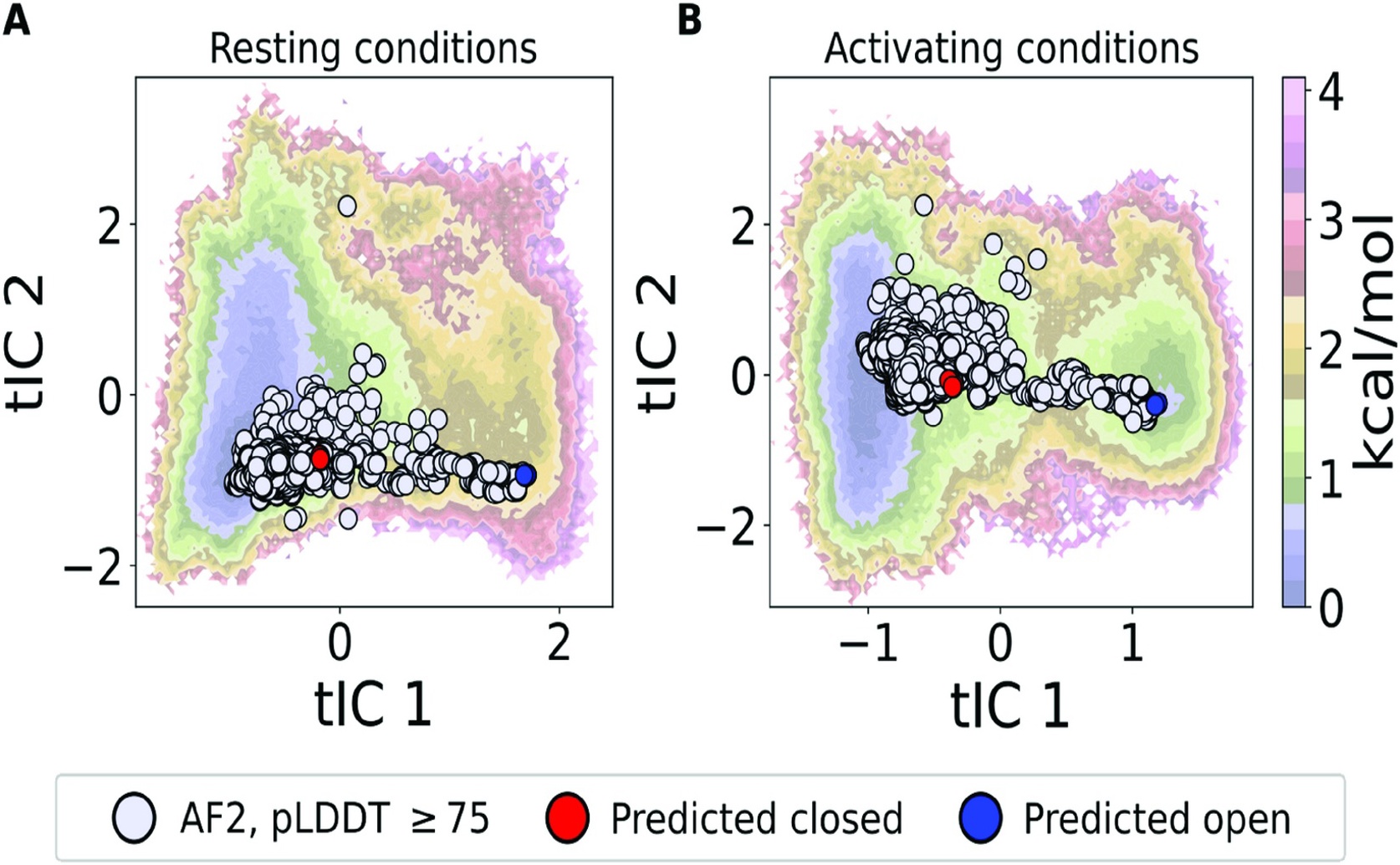
Projections of the AlphaFold-generated ensemble onto free energy landscapes derived from molecular dynamics simulations confirm that the predicted structures align with the energetic minima and transition pathways of the GLIC protein under deprotonated (a) and protonated (b) conditions.

Image adapted from: Lidbrink et al. / CC BY (Source)

Key Findings

  • Researchers at Science for Life Laboratory and the University of Kansas developed a new method combining AI (AlphaFold2) and SANS to rapidly map protein shape changes, focusing on the GLIC ion channel
  • This method accurately identified the GLIC channel's distinct "closed" and "open" states and precisely measured their populations under different conditions
  • Crucially, it mapped the entire dynamic pathway of shape transitions, including fleeting intermediate forms, thousands of times faster than traditional simulations
Proteins are not static, rigid structures; they are dynamic molecules that constantly change shape to perform their biological functions. This ability to adopt different forms, known as a protein's "conformational landscape," is crucial for life. For many proteins, especially those that are not rigid or have flexible parts, understanding this landscape fully means knowing all the shapes they can take, how stable each shape is under specific conditions, and how they transition from one shape to another. This has been a significant challenge in biology, as highlighted by the difficulties in fully characterizing the diverse shapes of flexible proteins[2]. One important class of proteins that undergo dramatic shape changes are ion channels, which act as gatekeepers on cell membranes, controlling the flow of charged particles (ions) into and out of cells. Their function relies on precisely regulated opening and closing, which involves large-scale conformational shifts. For example, the CorA channel, a primary magnesium ion channel in bacteria, is known to adopt different symmetric and asymmetric forms depending on magnesium levels, but fully understanding these flexible, often asymmetric, states and their role in activation has been difficult to achieve at high resolution[3]. Similarly, understanding the molecular mechanism of channel gating for other ion channels, like GLIC, in their natural environment has required extensive investigation[4]. Traditional methods for mapping these complex shape changes, often involving detailed computer simulations, can be incredibly time-consuming, sometimes taking orders of magnitude longer than practical. Now, researchers at Science for Life Laboratory and the University of Kansas have developed a powerful new approach that significantly accelerates the process of mapping these complex protein shape changes[1]. Their method combines a cutting-edge machine learning algorithm called AlphaFold2 (AF) with a biophysical technique known as Small-Angle Neutron Scattering (SANS). AlphaFold2 is widely recognized for its ability to accurately predict protein structures from their genetic sequences. SANS, on the other hand, is an experimental technique that provides information about the overall shape and size of molecules, like proteins, when they are dissolved in a solution. By integrating the predictive power of AlphaFold2 with the experimental insights from SANS data, the researchers can generate a comprehensive collection of possible protein shapes, along with their likelihood under specific conditions. This approach addresses the need for integrating biophysical experiments and computational models to determine conformational ensembles, as discussed in the broader context of flexible proteins[2]. The team applied this innovative method to GLIC, a proton-activated ion channel found in prokaryotes, which serves as an important model for understanding similar channels in humans[4]. Previous studies on GLIC have provided detailed structural information, including cryo-electron microscopy (cryo-EM) structures that show the channel in different states, such as closed and open forms, depending on the pH (acidity) of its environment[4]. Building on this existing knowledge, the new study used SANS data collected under both resting and activating conditions for GLIC. The results were striking. The combined AlphaFold2 and SANS approach successfully identified distinct "closed" and "open" states for the GLIC channel. These predicted shapes closely matched the actual structures observed in previous experimental studies using techniques like X-ray crystallography and cryo-EM[4]. More importantly, the method allowed the researchers to quantify how many closed channels would open up when activated, and these numbers aligned perfectly with both experimental measurements and very extensive, time-consuming computer simulations known as Markov state models. Crucially, the new method went beyond just identifying stable states. Without needing any prior structural information about the intermediate forms, the AlphaFold2 sampling also accurately captured the "intermediate conformations" – the transient shapes a protein takes as it transitions from one state to another. It even mapped out the entire "transition pathway" that GLIC follows as it opens. This is a significant leap forward because, traditionally, resolving these fleeting intermediate states and their pathways has been exceptionally difficult and computationally intensive. The new approach achieved this several orders of magnitude faster than conventional simulation-based methods. This breakthrough offers a highly efficient way to not only predict the stable shapes a protein can adopt but also to accurately map the dynamic pathways it takes to switch between these shapes. This capability is vital for understanding how proteins function, how they might malfunction in disease, and for designing new drugs that can precisely target specific protein states. By efficiently characterizing the complex conformational landscapes of proteins like ion channels, this research provides a powerful tool to overcome challenges previously encountered in characterizing highly flexible and asymmetric states[3], paving the way for deeper insights into biological processes.

BiotechBiochem

References

Main Study

1) Resolving the conformational ensemble of a membrane protein by integrating small-angle scattering with AlphaFold

Published 27th June, 2025

https://doi.org/10.1371/journal.pcbi.1013187


Related Studies

2) Conformational ensembles of intrinsically disordered proteins and flexible multidomain proteins.

https://doi.org/10.1042/BST20210499


3) Conformation-specific Synthetic Antibodies Discriminate Multiple Functional States of the Ion Channel CorA.

https://doi.org/10.1016/j.jmb.2023.168192


4) Cryo-EM structures of prokaryotic ligand-gated ion channel GLIC provide insights into gating in a lipid environment.

https://doi.org/10.1038/s41467-024-47370-w


Related Articles

An unhandled error has occurred. Reload 🗙