
Brain's Focus: How It Stays Sharp
Jim Crocker
23rd June, 2025


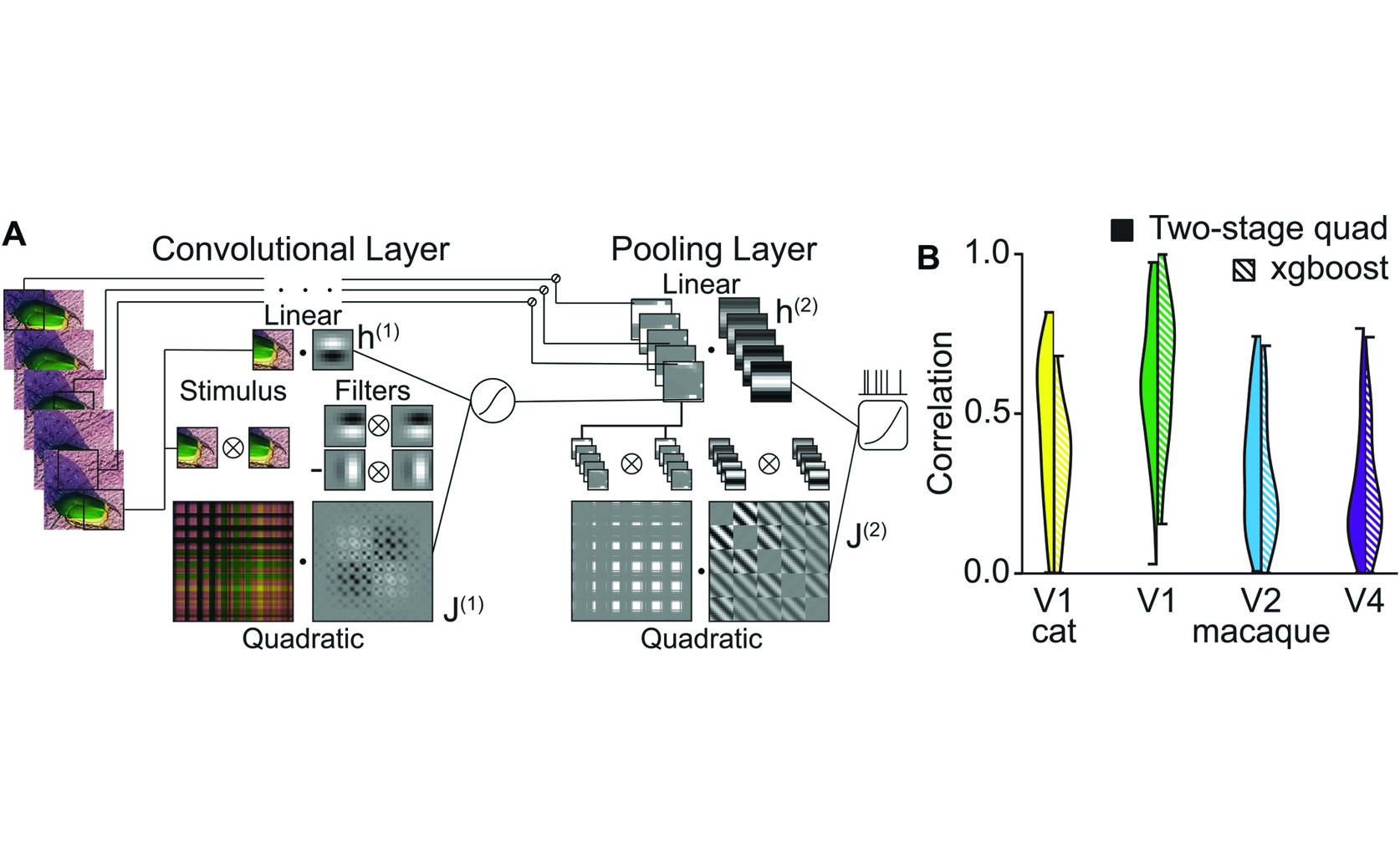
The proposed two-layer model, which incorporates quadratic computations (a), accurately accounts for neural responses to natural stimuli across visual areas V1, V2, and V4, achieving predictive performance comparable to a leading non-interpretable machine learning model (b).
Key Findings
- Scientists at The Salk Institute and collaborators found that the brain uses "quadratic computations" to process visual information, involving complex interactions between visual features
- These computations precisely balance and coordinate signals that excite and suppress neuron activity, allowing the brain to sharpen its focus on specific visual details
- This unique processing helps neurons become highly selective for specific features in natural images, explaining how our brains robustly recognize objects
References
Main Study
1) Computations that sustain neural feature selectivity across processing stages
Published 20th June, 2025
https://doi.org/10.1371/journal.pcbi.1013075
Related Studies
2) Cross-orientation suppression in visual area V2.
3) Normalization as a canonical neural computation.
4) Second order dimensionality reduction using minimum and maximum mutual information models.
Related Articles
 18th April, 2025 | Greg Howard