Solving A Malaria Outbreak: A Team Approach In A Village

Greg Howard
20th June, 2025

Solving A Malaria Outbreak: A Team Approach In A Village

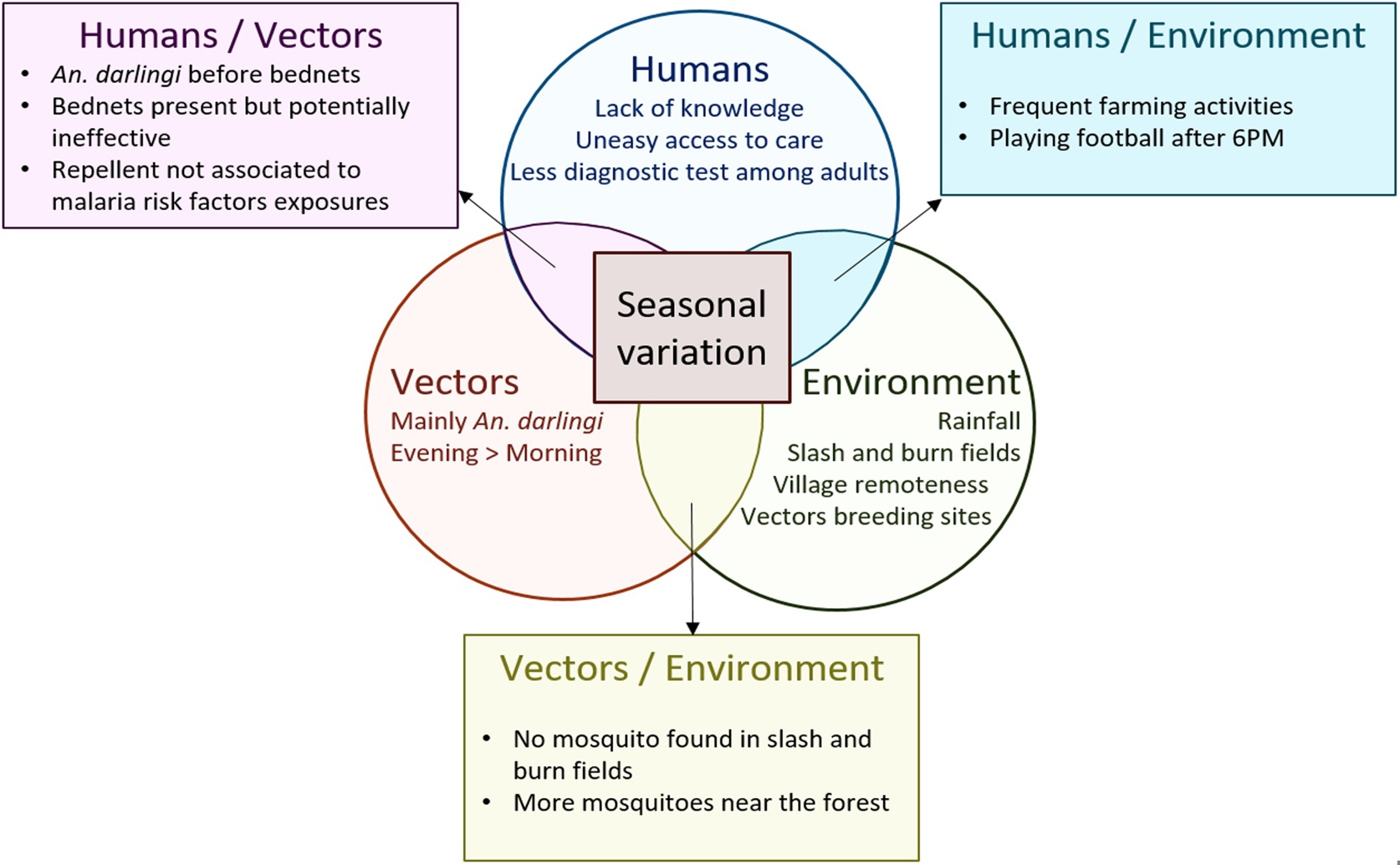
This "One Health" summary illustrates that malaria persistence in the village is driven by residents' exposure to the primary vector, Anopheles darlingi, during its peak evening and early morning biting activity when personal protection is inadequate.

Image adapted from: Tréhard et al. / CC BY (Source)

Key Findings

  • In Trois-Palétuviers, French Guiana, malaria remains a significant issue with high infection rates despite widespread bed net use
  • While 99% of residents use bed nets, 88% are ineffective due to improper washing and drying, and the main mosquito bites most actively before bedtime
  • This combination of ineffective protection and early mosquito activity leaves residents vulnerable, requiring better education and additional tools
The global push towards malaria elimination faces significant hurdles, particularly in isolated areas where the disease stubbornly persists despite broader control efforts. Understanding the specific local conditions—involving human behavior, the environment, and the mosquitoes that transmit the disease—is crucial for tailoring effective interventions. This challenge highlights the need for detailed, small-scale surveillance to uncover the precise factors driving ongoing transmission. A recent study[1] conducted by researchers from Aix-Marseille Univ, Inserm, IRD, and Institut Pasteur investigated these complex dynamics in Trois-Palétuviers, an isolated village in French Guiana bordering Brazil. The aim was to identify the specific situations that contribute to malaria's persistence in this recurrent high-transmission area. This work builds upon a broader understanding that while significant progress has been made in malaria control, leading to global dialogues on elimination, the development pipeline for new tools—including diagnostics, medicines, vaccines, and vector control products—remains critical[2]. The success of these tools, however, depends heavily on strategies that ensure their rapid and effective use by target populations, alongside robust surveillance and sustained commitment[2]. The researchers employed a comprehensive, "transdisciplinary" approach, meaning they looked at various interconnected factors: human behavior, environmental characteristics, and the mosquito population. They conducted two cross-sectional surveys in 2017 and 2018, collecting data on malaria prevalence using highly sensitive PCR tests, which detect the genetic material of the malaria parasite even at low levels of infection. They also gathered information on residents' behaviors and protective measures. To understand the mosquito population, known as entomological data, they used specialized traps to capture mosquitoes over several nights each month. The findings revealed a high burden of malaria in the village, with 51% of participants testing positive in 2017, although this figure significantly decreased to 16% in 2018. A striking observation was the widespread use of bed nets, with 99% of participants reporting their use. However, a critical issue emerged: 88% of these bed nets were found to be ineffective due to factors like inadequate drying and washing. This highlights a gap between tool availability and effective use. Previous research has consistently shown that individual bed net use is protective against malaria[3], and that proper use of such tools can reduce infection risk[4]. The current study’s findings suggest that merely providing bed nets is not enough; education on their proper maintenance and use is equally vital. Beyond bed nets, other protective measures were less commonly adopted, with 63% using indoor insecticides and only 32% using skin repellents. The study also focused on the primary mosquito vector in the region, Anopheles darlingi, which accounted for nearly all Anopheles mosquitoes caught (99.7%). These mosquitoes were active throughout the night, with peak abundance in the evening and early morning. This "before bedtime" activity of the mosquito is particularly significant, as it exposes residents to bites before they are protected by their bed nets. This aligns with findings from other regions, such as the Thai-Myanmar border, where outdoor activities and overnight trips were linked to increased malaria risk, emphasizing the importance of understanding human movement and exposure patterns[4]. Interestingly, Anopheles darlingi mosquitoes were not found in expected breeding sites like slash-and-burn fields. This unexpected absence points to the complex and often localized ecology of malaria transmission, emphasizing that environmental influences are not always straightforward and require continuous, nuanced surveillance. This complexity underscores the need for "micro-epidemiological" studies that examine fine-scale variations in malaria risk within villages or even between households, as the determinants of such variations are often poorly understood[3]. The transdisciplinary approach of this study directly addresses this by considering multiple interacting factors. The study concludes that the high risk of exposure to mosquito bites before residents are protected by their bed nets, combined with the ineffectiveness of many existing protective measures, likely contributes to malaria persistence in this isolated community. The findings underscore the importance of not just providing tools, but also ensuring their correct and consistent use through targeted education campaigns. Furthermore, the need for additional protective tools and a frequent distribution of bed nets is highlighted. This research provides critical insights for developing tailored public health interventions that account for local human behaviors, vector ecology, and environmental factors, essential for achieving malaria elimination in challenging, isolated settings.

MedicineHealthEcology

References

Main Study

1) Breaking down malaria outbreak: A multidisciplinary approach in a border village of French Guiana

Published 17th June, 2025

https://doi.org/10.1371/journal.pntd.0013096


Related Studies

2) Tools and Strategies for Malaria Control and Elimination: What Do We Need to Achieve a Grand Convergence in Malaria?

https://doi.org/10.1371/journal.pbio.1002380


3) Defining micro-epidemiology for malaria elimination: systematic review and meta-analysis.

https://doi.org/10.1186/s12936-017-1792-1


4) Human population movement and behavioural patterns in malaria hotspots on the Thai-Myanmar border: implications for malaria elimination.

https://doi.org/10.1186/s12936-019-2704-3


Related Articles

An unhandled error has occurred. Reload 🗙