Predicting Brain Cell Activity From Calcium Scans Using Smart Models

Jenn Hoskins
20th June, 2025

Predicting Brain Cell Activity From Calcium Scans Using Smart Models

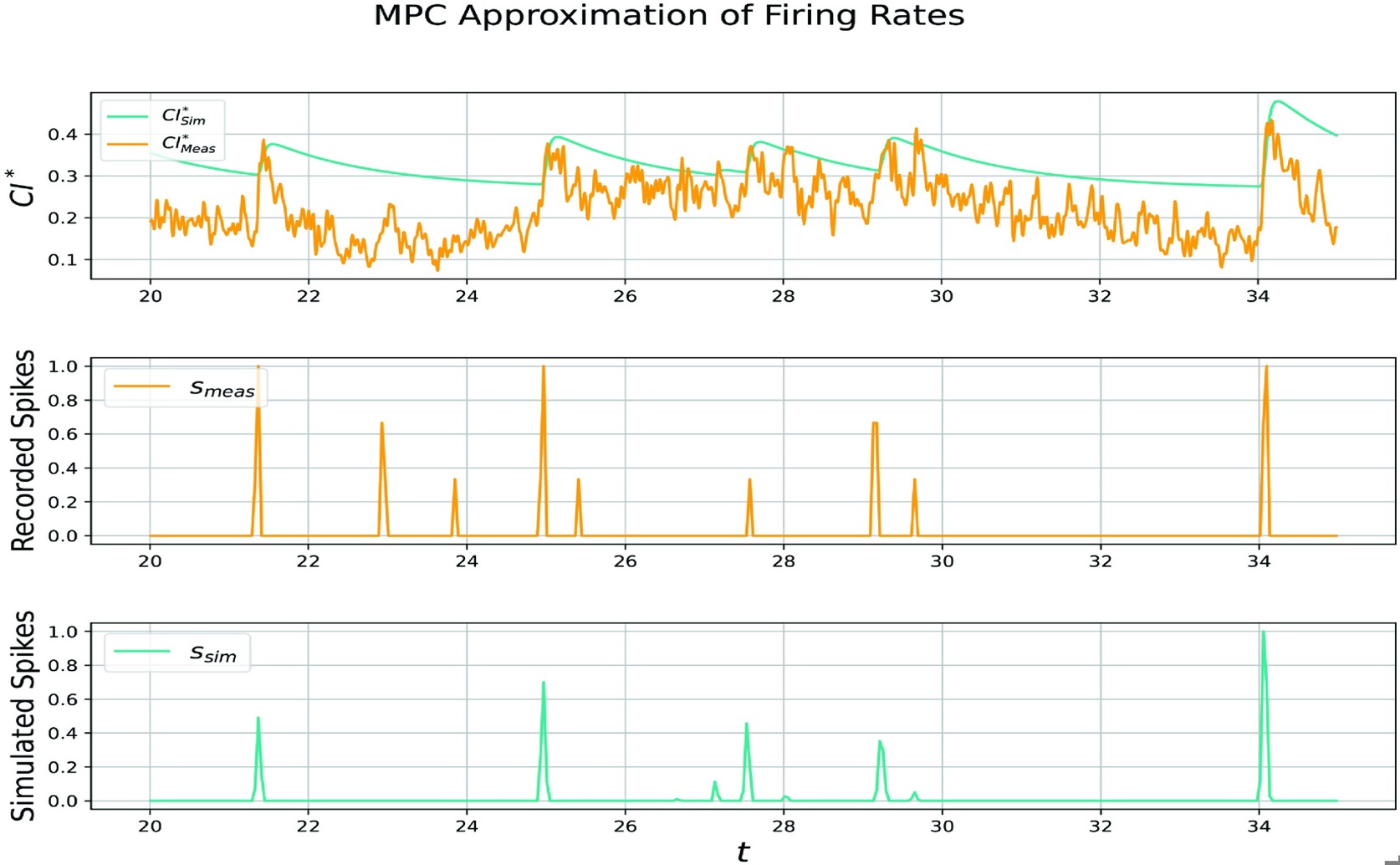
The model predictive control (MPC) approach successfully infers neuronal firing rates from a measured calcium fluorescence signal, producing a predicted spike train that visually approximates the ground-truth recording.

Image adapted from: Rondoni et al. / CC BY (Source)

Key Findings

  • Researchers at UC Santa Cruz and Edinburgh developed a new method to accurately convert slow brain signals from calcium imaging into precise, real-time neuron firing information
  • This novel algorithm uses a detailed biological model, allowing scientists to understand how neurons fire in real-time with minimal training data
  • The method performs comparably to leading techniques, offering a powerful, interpretable tool for clearer insights into brain activity and guiding future experiments
Understanding how the brain works often involves observing the activity of its fundamental units: neurons. Neurons communicate through brief electrical impulses called action potentials, or "spikes." Traditionally, neuroscientists have used electrophysiology to directly record these spikes with incredible precision[2]. However, this method often limits the number of neurons that can be observed simultaneously. In recent years, calcium imaging has emerged as a powerful alternative, allowing researchers to monitor the activity of hundreds or even thousands of neurons at once by tracking changes in calcium levels within them. These changes are detected using fluorescent indicators that glow brighter when calcium levels rise, signaling neuronal activity. While powerful, calcium imaging presents a significant challenge: the calcium signals are much slower than the rapid electrical spikes, effectively blurring the precise timing of neuronal firing. This slowness can obscure the exact relationship between an animal's movements or thoughts and the underlying neural activity. Therefore, converting these slow calcium signals back into precise spike times is a crucial, yet non-trivial, problem, often referred to as a "deconvolution problem"[3]. A new study from the University of California Santa Cruz and The University of Edinburgh[1] introduces a novel approach to tackle this challenge. Their research focuses on accurately and rapidly inferring the true firing rate of neurons from calcium imaging data. Many existing methods for this task often rely on complex, non-mechanistic models, such as neural networks. While effective, these models typically require vast amounts of data for training, don't reveal the underlying biological processes, and often cannot operate in real-time. This new work aims to overcome these limitations. The researchers developed an algorithm that leverages principles from chemical reaction networks (CRN) combined with a control theoretic approach. Instead of treating the neuron as a "black box," their method builds a detailed, deterministic ordinary differential equation (ODE) model of the actual chemical exchanges happening inside the neuron. This includes how calcium enters the cell during a spike, how it's buffered, and how it's eventually removed. By modeling these biophysical dynamics, the algorithm gains a deep understanding of how calcium fluorescence relates to spiking activity, similar in spirit to earlier efforts that used biophysical models to infer hidden signals from noisy calcium data[4]. A key component of their approach is Model Predictive Control (MPC). In simple terms, MPC is like a smart system that uses the detailed ODE model to predict how the calcium signal will evolve over time based on hypothetical spike trains. It then continuously adjusts its predictions to find the most likely sequence of actual spikes that would produce the observed calcium fluorescence. This control-theoretic framework allows the algorithm to be highly responsive and adaptive. This mechanistic approach offers several significant advantages over previous methods, including those that have achieved state-of-the-art performance like MLspike[5] or fast L0 optimization algorithms[3]. Firstly, because the model is based on the actual chemical processes within the neuron, it is highly "interpretable." This means scientists can understand why the algorithm infers a spike at a particular time, rather than just getting an output from a complex, opaque system. This interpretability is crucial for scientific discovery. Secondly, the computational efficiency of this new method is a major breakthrough. It can perform these complex calculations in real-time. This capability enables "online experimentation," where researchers can get immediate feedback on neuronal firing rates as an experiment is happening. This is a substantial improvement, as the need for fast algorithms to deconvolve calcium traces has been a persistent challenge in the field[3]. The effectiveness of this new architecture was demonstrated using "ground truth" datasets from the `spikefinder` challenge, a benchmark platform for evaluating spike inference algorithms, which has also been used to validate other advanced methods[3]. By performing well on these standardized datasets, the algorithm shows it can compete with, and in some cases, improve upon existing state-of-the-art methods in terms of accurately correlating inferred spikes with actual neuronal firing. Ultimately, this research provides a powerful, interpretable, and real-time tool for extracting precise neuronal firing information from calcium imaging data. By computationally addressing the inherent slowness and noise of calcium signals, it allows neuroscientists to gain a clearer picture of brain activity, potentially guiding future experimental designs and deepening our understanding of how neural circuits function in real-time.

BiotechAnimal Science

References

Main Study

1) Predicting neuronal firing from calcium imaging using a control theoretic approach

Published 19th June, 2025

https://doi.org/10.1371/journal.pcbi.1012603


Related Studies

2) Computational processing of neural recordings from calcium imaging data.

https://doi.org/10.1016/j.conb.2018.11.005


3) Fast nonconvex deconvolution of calcium imaging data.

https://doi.org/10.1093/biostatistics/kxy083


4) Spike inference from calcium imaging using sequential Monte Carlo methods.

https://doi.org/10.1016/j.bpj.2008.08.005


5) Accurate spike estimation from noisy calcium signals for ultrafast three-dimensional imaging of large neuronal populations in vivo.

https://doi.org/10.1038/ncomms12190


Related Articles

An unhandled error has occurred. Reload 🗙