Leptospirosis Exposure: Prevalence and Key Risk Factors

Jenn Hoskins
9th June, 2025

Leptospirosis Exposure: Prevalence and Key Risk Factors

Analysis of various potential risk factors for Leptospira seroprevalence in Bor County cattle revealed that only age was significant, with adult animals being 1.43 times more likely to be seropositive than young ones.

Image adapted from: Kasiano et al. / CC BY (Source)

Key Findings

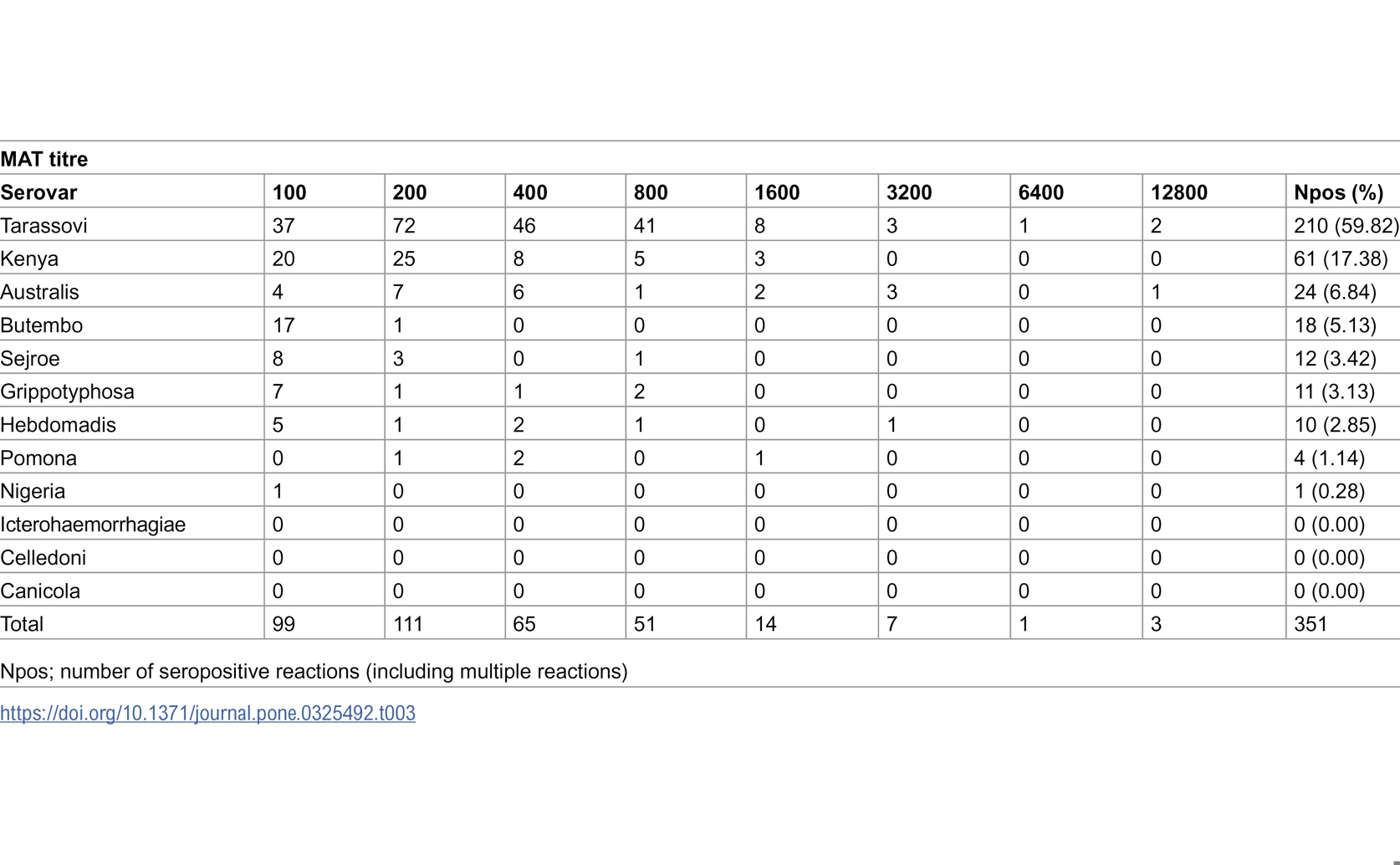
  • In Bor County, South Sudan, researchers found nearly 67% of cattle carried leptospirosis antibodies, with about 22% showing high levels that suggest recent infection
  • Adult cattle were 1.43 times more likely to be infected, indicating they could silently spread the disease linked to unexplained abortions and economic losses
Leptospirosis is a bacterial disease that affects both humans and animals. It is caused by bacteria of the genus Leptospira and is often spread through the urine of infected animals. In livestock, the disease may not always show obvious symptoms but can lead to reproductive problems such as abortions and lower production efficiency. These issues can have serious economic effects, especially in regions that depend on livestock for their livelihood. The recent study from South Sudan[1], involving experts from Makerere University, University of Bahr El Ghazal, International Institute of Tropical Agriculture, and Universita degli Studi di Parma, looks closely at the role of leptospirosis in cattle abortions in Bor County. The study was initiated after unexplained abortions in cattle started to increase in the region. Researchers collected blood samples from 357 cattle in four cattle camps between January 22 and February 15, 2023. The aim was to determine how many cattle had been exposed to Leptospira and to identify associated risk factors. To do this, they used a standard laboratory test called the microscopic agglutination test (MAT). This test detects antibodies – proteins produced by the immune system – that react to Leptospira bacteria. A higher level of antibodies, measured as a higher MAT titer, can suggest a recent or ongoing infection. Results from the study revealed that nearly 67% of the sampled cattle were seropositive, meaning they showed signs of past or present exposure to the bacteria using a cutoff titer of 100. Even more interesting was that about 22% of the seropositive cattle had very high antibody levels (MAT titers of 800 or more), which suggests that these animals had been infected recently. The most common types of Leptospira found belonged to the serogroups L. borgpetersenii Tarassovi and L. borgpetersenii Ballum. These serogroups have been noted in other studies[2] to be widespread in Africa and linked to various animal hosts. The study also looked at potential risk factors for infection. Using a statistical method called robust Poisson regression, the researchers found that the age of cattle was a significant factor. Adult cattle were 1.43 times more likely to be exposed than younger ones. This information could be important for farmers and veterinarians, as older animals might act as maintenance hosts – animals that carry the disease longer without showing overt symptoms – perpetuating the transmission cycle of leptospirosis in the herd. Earlier research has often shown a broad scope of leptospirosis impact on both human and animal populations across regions. For instance, a systematic review in Sub-Saharan Africa detailed the wide variation in leptospirosis prevalence among humans and animals, stressing the need for more research, particularly in human cases[2]. In another study from Egypt[3], researchers found a high seroprevalence among people who work closely with animals and showed that rats, dogs, and cows were important reservoirs of the bacteria. A study in Brazil[4] further supported the idea that leptospirosis is closely linked to reproductive disorders in cattle and pointed to environmental risk factors such as the presence of rodents and even dogs around pasture areas. Recent findings from one health studies underscore how changes in climate and interactions among people, animals, and the environment may contribute to the resurgence of the disease[5]. The South Sudan study builds on these findings by providing region-specific data that may explain the increase in cattle abortions observed in Bor County. The methods of the South Sudan study were straightforward and clear. By collecting blood samples and administering questionnaires to cattle owners or herdsmen, the researchers gathered both biological and contextual data. They chose MAT because it is one of the most common techniques for diagnosing leptospirosis, especially in field studies. In simple terms, MAT involves mixing a dilution of the animal’s serum with different types of Leptospira bacteria and then observing whether the antibodies in the serum cause the bacteria to clump together – a process called agglutination. It is essential to use a panel of different serovars (variations within a species of bacteria) because leptospirosis can be caused by many different strains. The significant seropositivity rate detected in cattle, combined with the high rates found in older animals, points toward an endemic situation in the region. An endemic disease is one that is consistently present in a particular geographic area. In this case, the high prevalence indicates that leptospirosis may be one of the underlying causes of the recent increase in cattle abortions. This study supports findings from previous research that the disease often goes underrecognized in livestock, even though it contributes substantially to reproductive losses and thereby affects the economic conditions of communities dependent on farming[2][4]. What is notable about the South Sudan study is how it ties together previous global and regional observations. While earlier work in Sub-Saharan Africa[2] and Egypt[3] highlighted the presence of leptospirosis across different species including humans, the current research provides specific insight into its impact on cattle in a country where livestock farming is crucial to the economy. In addition, the focus on risk factors such as age aligns with research from Brazil, showing that environmental and management practices (like animal access to shared pastures) can influence infection rates[4]. The recent reemphasis on the One Health approach, which underlines the interconnectedness of human, animal, and environmental health[5], is exemplified in the current study by its comprehensive approach to investigating not only the presence of the bacteria but also the risk factors in the local context. The findings from this study indicate that more work is needed. Particularly, further investigations may be required to confirm leptospirosis in cases of abortion among cattle and to develop targeted prevention and control measures. Given that cattle can be maintenance hosts for the bacteria, control measures might include improved management practices to reduce exposure and possibly vaccination strategies where available. In summary, the South Sudan study offers important regional data on leptospirosis in cattle, reinforcing the idea that the disease is a significant concern for livestock production and public health in areas with endemic transmission. Its findings build on earlier work from Africa, Egypt, Brazil, and global One Health studies, highlighting the need for continued surveillance and improved prevention strategies to mitigate the economic and health impacts of leptospirosis.

AgricultureAnimal Science

References

Main Study

1) Leptospira seroprevalence and associated risk factors among cattle in Bor County, South Sudan

Published 6th June, 2025

https://doi.org/10.1371/journal.pone.0325492


Related Studies

2) Leptospirosis in Sub-Saharan Africa: a systematic review.

https://doi.org/10.1016/j.ijid.2014.06.013


3) Leptospirosis in animals and human contacts in Egypt: broad range surveillance.

https://doi.org/10.1590/0037-8682-0102-2015


4) Bovine leptospirosis: Prevalence, associated risk factors for infection and their cause-effect relation.

https://doi.org/10.1016/j.micpath.2017.03.032


5) A global one health perspective on leptospirosis in humans and animals.

https://doi.org/10.2460/javma.22.06.0258


Related Articles

An unhandled error has occurred. Reload 🗙