How Enclosure Design Shapes Behavior and Welfare

Greg Howard
7th June, 2025

How Enclosure Design Shapes Behavior and Welfare

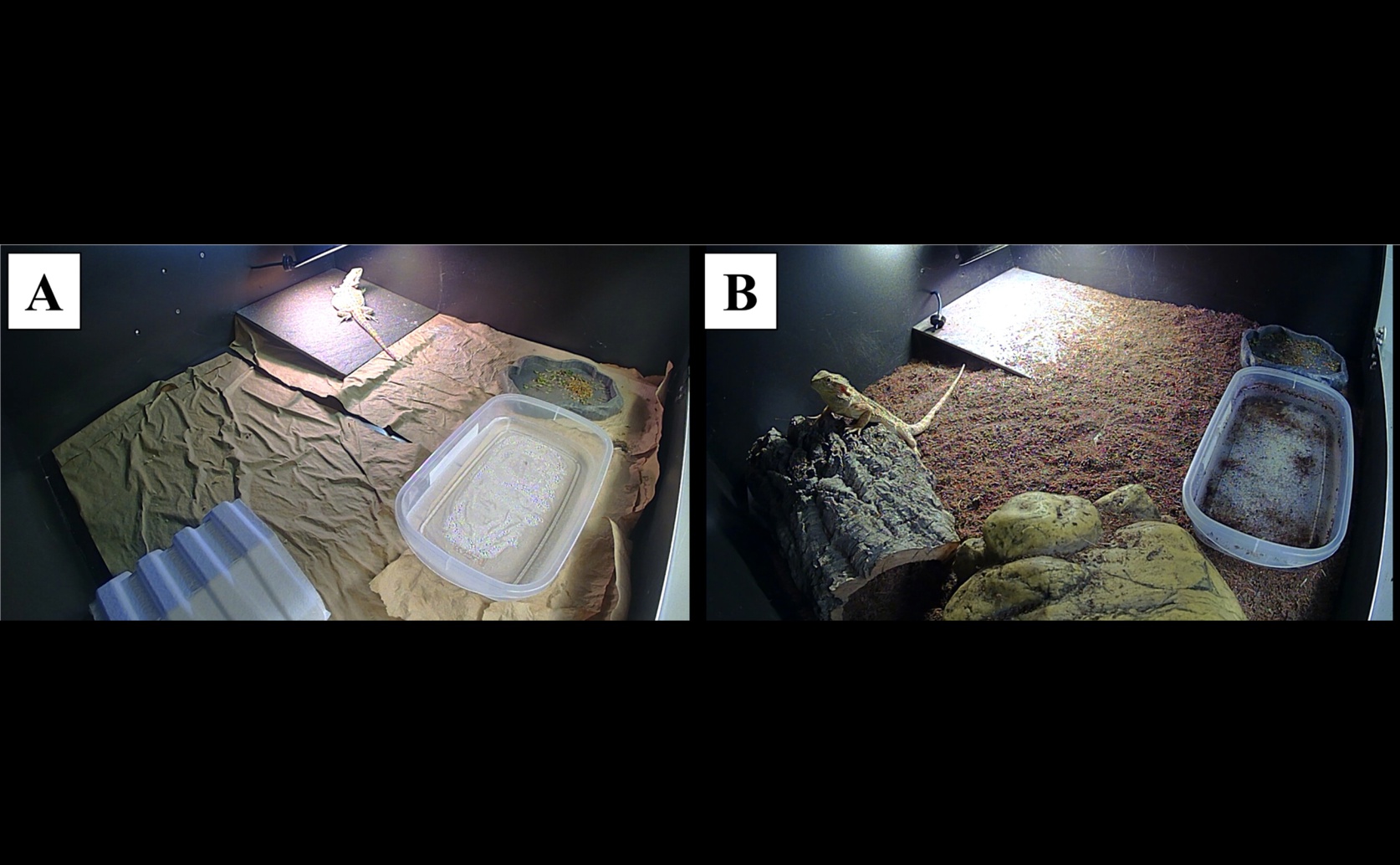
Although the naturalistic enclosure (b) included loose substrate and climbing structures lacking in the standard enclosure (a), the study concluded that this added structural complexity alone was insufficient to significantly enhance the welfare or modify the behavior of the bearded dragons (Pogona vitticeps).

Image adapted from: Denommé et al. / CC BY (Source)

Key Findings

  • At Brock University and University Centre Sparsholt, researchers found that enclosures with natural features provided a wider range of temperatures for captive bearded dragons
  • However, overall activity levels, space use, and behavioral cues stayed similar in both enclosure types—with only female dragons showing a slight reduction in stress signals in naturalistic setups
[1] A recent study conducted by researchers at Brock University and University Centre Sparsholt investigated whether naturalistic-style enclosures offer benefits compared to standard ones for captive-bred bearded dragons (Pogona vitticeps). The study set out to determine if enclosures designed with elements intended to mimic natural habitats could better support the lizards’ natural behaviors and overall welfare. The study was motivated by ongoing discussions about the best methods for ensuring animal welfare. Past research has examined various aspects of welfare, ranging from physical health and natural behavior to psychological wellbeing[2]. In parallel, work on habitat complexity has stressed that an enriched physical environment can facilitate more natural interactions and behaviors among species[3]. Another line of investigation has used behavioral ecology to adapt captive environments that match species’ individual adaptations, suggesting that a balance of space, safety, and enrichment is essential[4]. The current study sought to integrate these perspectives by comparing a naturalistic-style enclosure with a more traditional, standard setup. In the study, the researchers evaluated several factors. First, they examined whether the naturalistic enclosures offered thermal heterogeneity—meaning a range of temperatures across different parts of the enclosure. Lizards in the wild often select areas with varying temperatures depending on their current needs, and offering such variability in captivity is considered important. The study confirmed that naturalistic enclosures indeed provided better thermal heterogeneity than standard ones. Next, the research team observed the lizards’ behavior over the course of a day. They aimed to see if the naturalistic enclosures allowed the lizards to be active at times similar to their wild counterparts, if the lizards used the space more evenly, and if they could express a broader range of natural behaviors. However, the results were less conclusive. The lizards in both enclosure types spent most of the day inactive and tended to remain in one area of the enclosure. Behaviors thought to indicate stress or relaxation were exhibited similarly in each environment. Physiological measures of stress were also assessed by comparing heterophil to lymphocyte (H:L) ratios—a commonly used indicator of chronic stress in reptiles. Notably, lower H:L ratios, which would suggest a lower stress level, were found only in female lizards housed in naturalistic enclosures. The inconclusive differences in behavior and welfare indicators suggest that simply adding structural complexity to an enclosure may not be enough to improve welfare. It appears that the basic needs of bearded dragons were met in both types of environments, or that any benefits from the naturalistic elements were possibly limited by factors such as enclosure size or the specific design details that did not fully address the lizards’ behavioral motivations. The study highlights several important points. First, while a more naturalistic environment can enhance some physical attributes of an enclosure, such as thermal variability, this does not automatically translate into significant improvements in the animals’ behavior or physiological stress. This finding creates a bridge to earlier research emphasizing that animal welfare encompasses more than just physical enrichment. Research stressing the importance of psychological wellbeing[2] and behavioral ecology approaches for environmental design[4] suggests that understanding the species-specific motivations and natural histories is crucial. For example, previous work on habitat complexity has shown positive effects on the welfare of zoo animals by focusing on both the structure of the habitat and the behavioral interactions it supports[3]. The current study, however, indicates that for bearded dragons, additional complexity may need to be combined with other factors such as increased space or tailored enrichment activities to truly enhance welfare. Further investigation is needed to understand whether the similar overall behavior observed between enclosure types is due to inherent characteristics of the species or limitations in the study design, such as the timeline for data collection. It might be that bearded dragons are less sensitive to certain environmental enrichments, or that the conditions in standard enclosures are already sufficiently meeting their needs. Alternatively, it is possible that the apparent benefits in thermal heterogeneity and the reduction in stress markers for females require more time to manifest across all behavioral and physiological indices. Overall, the study underscores the complexity of designing optimal captive environments. It reinforces the idea that successful enclosure design must take into account not only the physical structure and thermal properties but also the natural history and behavioral incentives of the species. Drawing on earlier findings[2][3][4], researchers are reminded that while naturalistic elements have potential, they must be integrated with a clear understanding of an animal’s needs throughout its life. For decision-makers in animal care, both in zoos and in other captive settings, such research signals that future enclosure designs would benefit from a multi-faceted approach—one that combines structural complexity with targeted behavioral enrichment to effectively address the welfare of the animals in care.

Animal Science

References

Main Study

1) Influence of enclosure design on the behaviour and welfare of Pogona vitticeps

Published 5th June, 2025

https://doi.org/10.1371/journal.pone.0322682


Related Studies

2) Choice, control, and animal welfare: definitions and essential inquiries to advance animal welfare science.

https://doi.org/10.3389/fvets.2023.1250251


3) Review of the Effects of Enclosure Complexity and Design on the Behaviour and Physiology of Zoo Animals.

https://doi.org/10.3390/ani13081277


4) Behavioral ecology of captive species: using behavioral adaptations to assess and enhance welfare of nonhuman zoo animals.

https://doi.org/10.1080/10888705.2013.827917


Related Articles

An unhandled error has occurred. Reload 🗙