
Exploring Multiple Factors Shaping Space Use in Ecological Networks
Jenn Hoskins
7th June, 2025


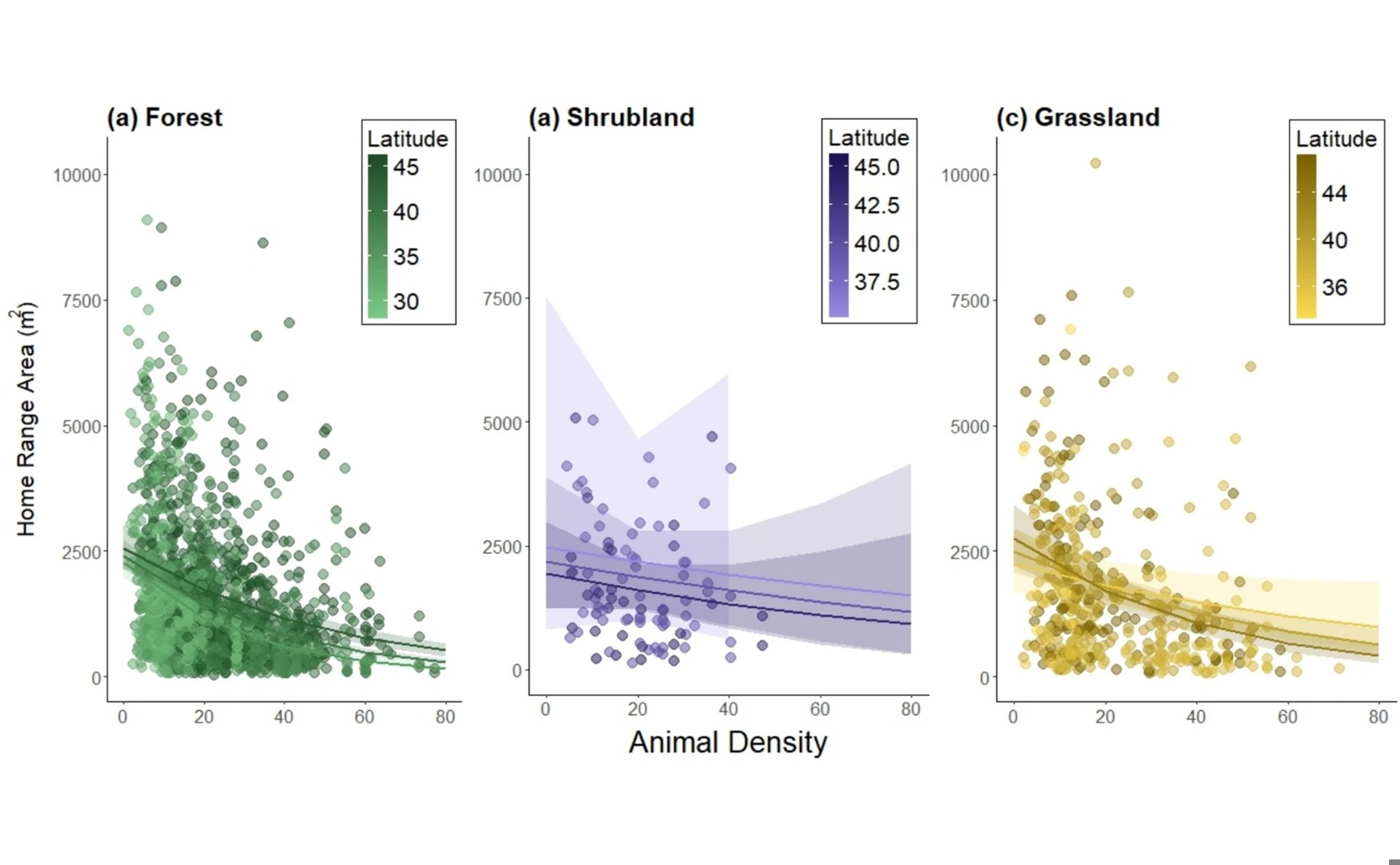
The analysis reveals a significant three-way interaction where the combined effects of population density and latitude on the home range area of deer mice (Peromyscus) vary distinctly across forest (a), shrubland (b), and grassland (c) habitats.
Key Findings
- At UCLA, researchers analyzing 10 years of data from 36 North American sites found that male deer mice roam over larger areas than females, and better-conditioned males expand their range more
- They also discovered that mice occupy smaller areas in dense populations and that habitat and latitude affect space use—with forested areas leading to smaller ranges and grasslands to larger ones
References
Main Study
1) Uncovering multiple influences on space use by deer mice using large ecological networks
Published 4th June, 2025
https://doi.org/10.1007/s00442-025-05731-2
Related Studies
2) Effects of sampling regime on the mean and variance of home range size estimates.
Journal: The Journal of animal ecology, Issue: Vol 75, Issue 6, Nov 2006
3) Environmental drivers of global variation in home range size of terrestrial and marine mammals.
4) Are there general mechanisms of animal home range behaviour? A review and prospects for future research.
Related Articles
 14th May, 2025 | Jim Crocker