Key Protein Ubinuclein 2 Is Essential for Development and X Regulation

Jenn Hoskins
4th June, 2025

Key Protein Ubinuclein 2 Is Essential for Development and X Regulation

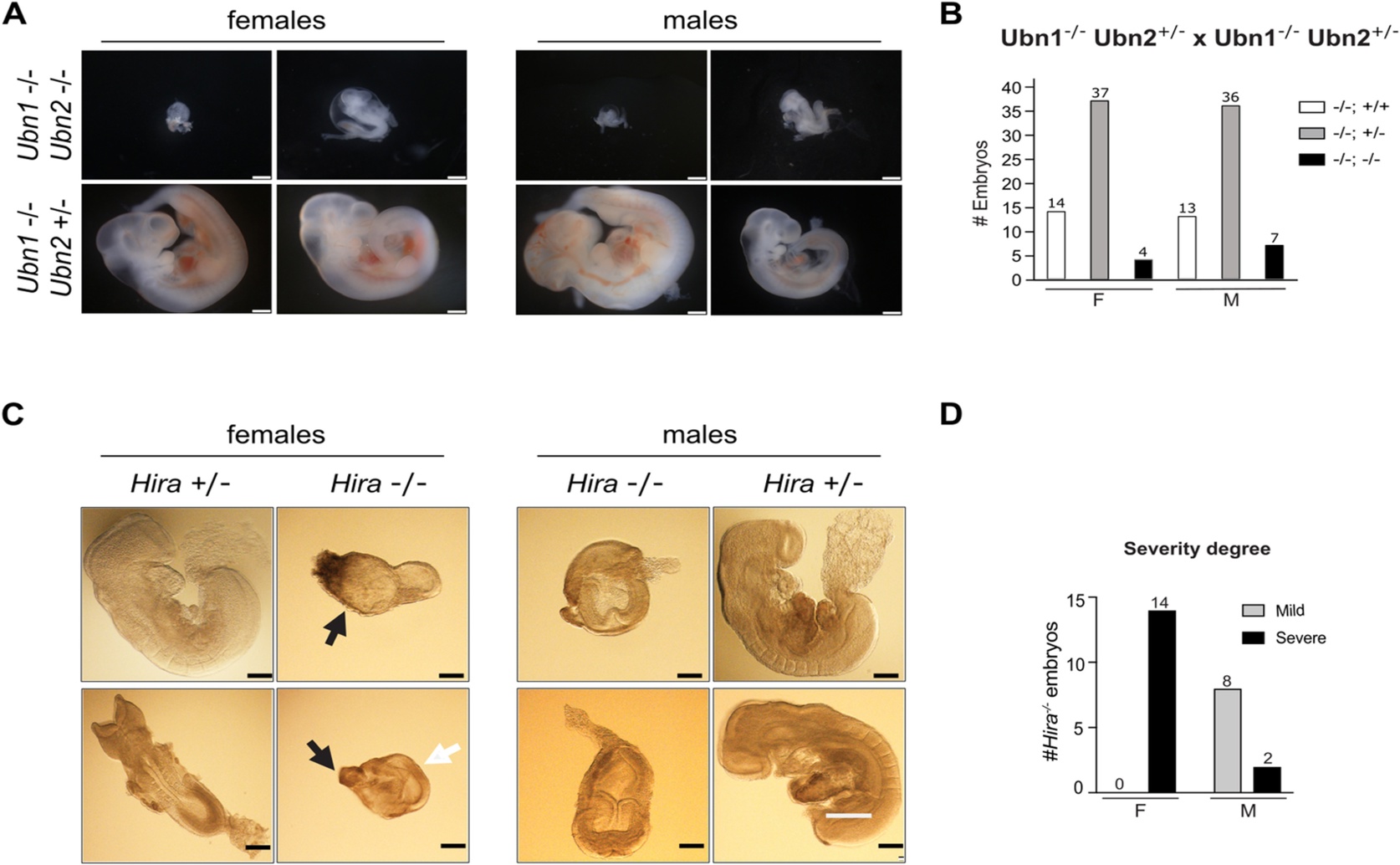
Embryonic developmental arrest was observed in Ubn1 and Ubn2 double mutant embryos with a skewed sex ratio favoring males (a, b), mirroring the sex-correlated phenotypic severity in Hira mutant embryos where females displayed significantly more severe defects than males (c, d), consistent with the HIRA complex having a critical female-specific function likely related to X chromosome inactivation.

Image adapted from: Monfort et al. / CC BY (Source)

Key Findings

  • In a study led by Swiss and international researchers using mice, removing the Ubn1 gene was harmless, but altering Ubn2 caused early embryonic death—especially in females
  • Mutating both Ubn1 and Ubn2 disrupted the normal silencing of one X chromosome, as cells failed to add the repressive H3K27me3 mark needed for proper gene regulation
[1] A recent study by researchers from the Swiss Federal Institute of Technology, Zurich; Friedrich Miescher Institute; University College London; and Cornell University has shed light on how the HIRA complex controls a key process in gene regulation in mice. The HIRA complex is known to help deposit a protein called histone H3.3 into chromatin—the material that makes up chromosomes—in a way that does not depend on DNA replication. Because histones package DNA and help control the activity of genes, understanding how they work is important for grasping how cells develop and maintain their functions. Histones exist in several forms, and one variant, H3.3, is particularly special because it can be incorporated into chromatin throughout the cell cycle, not just during DNA copying. Early studies have shown that the proper deposition of H3.3 is essential for maintaining chromatin structure and gene expression[2][3][4]. These studies used different approaches to tease apart how histone chaperones such as HIRA help to regulate both the addition of new histones and the recycling of old ones. In the context of these earlier findings, the new study offers fresh insight into the role of the HIRA complex, especially regarding a process called X inactivation. X inactivation is a crucial mechanism in female mammals. Because females have two X chromosomes while males have one, one of the X chromosomes in females is largely shut down during early development to balance gene expression between the sexes. A long noncoding RNA called Xist triggers this shutdown by recruiting proteins that modify histone marks on the X chromosome. One important modification is the addition of three methyl groups to a specific part of histone H3, referred to as trimethyl lysine 27. This chemical change, known as H3K27me3, is a signal to keep genes turned off. In the present study, the researchers focused on two genes within the HIRA complex: Ubn1 and Ubn2. They created mutations in these genes in mice to explore how the absence of each protein would affect development and gene regulation. The results were surprising in several ways. Mice with a mutation in Ubn1 were both viable and fertile, meaning that they could grow up and reproduce normally despite the mutation. In contrast, mice with a Ubn2 mutation experienced embryonic lethality—a failure to develop properly before birth—with a notable trend of more male embryos surviving. When both Ubn1 and Ubn2 were mutated at the same time, all embryos failed to develop normally, with many showing developmental arrest and a further reduced number of female embryos surviving. Further analysis revealed that these mutations affected the initiation of X inactivation in mouse embryonic stem cells. In a normally developing female embryo, Xist expression leads to widespread changes in the chromatin state that result in gene silencing on the inactive X chromosome. However, in cells with mutations in Ubn1, Ubn2, or the HIRA gene itself, the process was compromised. Specifically, the study found that the early and essential switch—from an “open” chromatin state marked by acetyl group additions to a “closed” state marked by the addition of three methyl groups at lysine 27—was impaired. Although Xist was still able to remove acetyl groups, it could not properly establish the repressive H3K27me3 modification on genes located on the X chromosome. This finding supports the idea that the proper function of the HIRA complex is necessary for the maintenance of epigenetic states, echoing earlier work that highlighted the importance of HIRA in histone H3.3 deposition and chromatin remodeling[2][4]. Those previous studies revealed how HIRA and its associated proteins help balance the incorporation of both new and recycled histone H3.3 molecules to fine-tune chromatin states. The current study extends these observations by linking the function of the HIRA complex to the specific process of X inactivation—a critical step in early mammalian development. By showing that defects in the HIRA complex perturb the addition of a key repressive mark (H3K27me3) during X inactivation, the study helps to explain a mechanism behind the different viability outcomes observed between male and female embryos when components of the HIRA complex are mutated. Given that X inactivation is only required in cells with two X chromosomes, it is not surprising that female embryos are more severely affected by these mutations. Thus, the study not only clarifies the role of Ubn1 and Ubn2 but also highlights a previously unappreciated female-specific function for the HIRA complex. The methods used in this research included creating specific gene mutations in mice and analyzing the consequences at both the organismal and cellular levels, particularly through experiments with mouse embryonic stem cells. Researchers closely observed changes in histone modifications during the early steps of X inactivation. The careful use of gene expression analyses and chromatin immunoprecipitation (a technique that allows scientists to study the association between proteins and DNA) provided a detailed picture of how the absence of key HIRA complex proteins disrupts the establishment of normal chromatin environments. Overall, the study contributes an important piece of the puzzle regarding chromatin organization and gene regulation. It bridges findings from earlier research on histone dynamics and deposition[2][3][4][5] with new insights into X inactivation, emphasizing that the HIRA complex has distinct and essential roles during embryonic development, particularly in establishing the repressed state of the X chromosome in female cells.

GeneticsAnimal Science

References

Main Study

1) Ubinuclein 2 is essential for mouse development and functions in X chromosome inactivation

Published 2nd June, 2025

https://doi.org/10.1371/journal.pgen.1011711


Related Studies

2) Two HIRA-dependent pathways mediate H3.3 de novo deposition and recycling during transcription.

https://doi.org/10.1038/s41594-020-0492-7


3) HIRA vs. DAXX: the two axes shaping the histone H3.3 landscape.

https://doi.org/10.1038/s12276-023-01145-3


4) Placing the HIRA histone chaperone complex in the chromatin landscape.

https://doi.org/10.1016/j.celrep.2013.03.026


5) Distinct factors control histone variant H3.3 localization at specific genomic regions.

https://doi.org/10.1016/j.cell.2010.01.003


Related Articles

An unhandled error has occurred. Reload 🗙