Sudden Shifts Cause On-Off Patterns And Gradual Changes In Cells

Jenn Hoskins
5th June, 2025

Sudden Shifts Cause On-Off Patterns And Gradual Changes In Cells

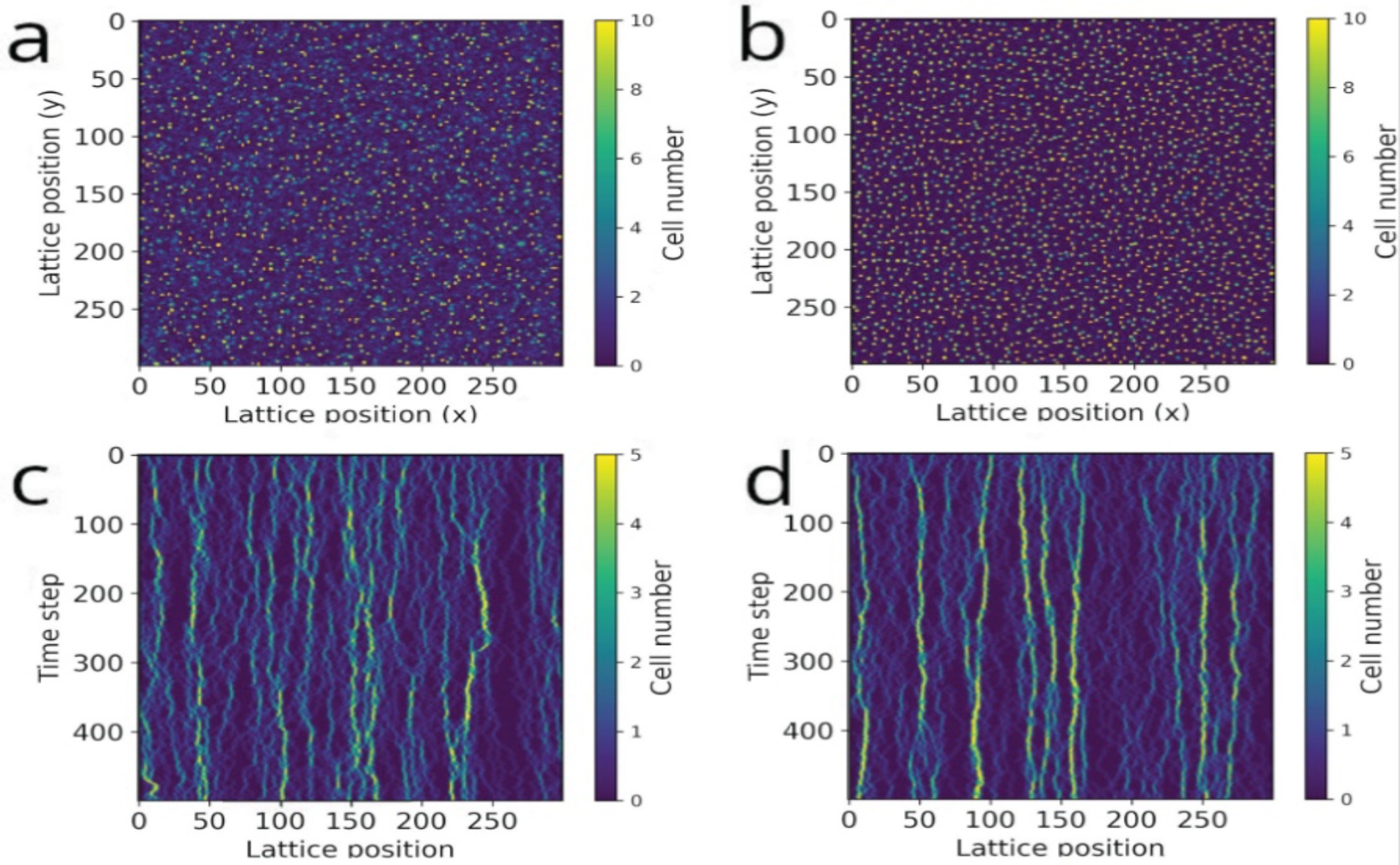
Simulations extending the model to two dimensions (a, b) and incorporating volume exclusion constraints (c, d) demonstrate the robustness of the study's key findings, confirming that heavy-tailed jumps consistently induce the formation of dynamic cellular aggregates across varying geometries and physical limits.

Image adapted from: Josué Manik Nava-Sedeño / CC BY (Source)

Key Findings

  • At Universidad Nacional Autónoma de México and the University of Adelaide, researchers discovered that cancer cells can move as connected groups using both short steps and rare long leaps
  • They found that strong cell adhesion and high cell density initially form stable clusters, but even a small increase in long leaps gradually disrupts these patterns
Recent research has challenged long-held views about how cancer cells migrate and spread, adding nuance to our understanding of metastasis. Traditionally, the epithelial-mesenchymal transition (EMT) has been seen as essential for enabling individual cancer cells to break away and invade new tissues. However, new work from Universidad Nacional Autónoma de México and the University of Adelaide[1] demonstrates that cancer cells can remain connected to one another and still metastasize efficiently. Moreover, cancer cells may use unusual migration patterns—all without undergoing a full EMT. In this study, researchers explore the collective movement of cells that interact through adhesion (the natural tendency of cells to stick together) and that display jump lengths following heavy-tailed distributions. This type of distribution, in which a few long jumps alternate with many short ones, is commonly observed in Lévy walks. Lévy dynamics are known from ecological studies, where predators use them to find scarce prey, and have been reported in some cancer cells as well[2]. The new research extends such findings by investigating how these patterns play out in groups of cells rather than just individual cells. The researchers developed a multi-speed lattice-gas cellular automaton model, a computational framework that simulates how cells hop between discrete positions (sites) on a lattice. By simplifying the behavior of migrating cells into discrete steps while incorporating realistic factors like cell adhesion, the model helps to capture the essential dynamics without getting lost in unnecessary detail. The study considers three specific migration scenarios: • Classic single-jump migration: Here, each cell moves exactly one site per time step, representing a “healthy” control where cells move in a regular, predictable fashion. • Block migration: In this scenario, cells moving together as a group take a single jump collectively. While the cells maintain their contact over the duration of the jump, the length of the jump is random and distributed according to a power law. This scenario mimics situations in which leader cells guide clusters of cells across tissues by maintaining strong intercellular junctions. • Cell-wise migration: Each cell in a group can perform jumps independently of the others. This case portrays environments where cell junctions are dynamic enough to occasionally allow single cells to break away from the collective movement. The model reveals that in the classic scenario, the stability of the cell migration pattern depends sharply on factors like overall cell density and adhesion strength. When these factors exceed a certain threshold, the regular migration pattern is disrupted abruptly. In contrast, when cells are allowed to perform jump lengths drawn from a heavy-tailed distribution, the transition from orderly collective motion to disordered movement becomes gradual. Increasing the probability of long jumps disrupts the collective order step by step. This means that even small increases in the likelihood of long, sporadic jumps can slowly change the collective behavior of the cells. Another interesting observation is related to spatial patterns. When jumps are mostly short, the patterns formed by the cells are stable, meaning they tend to persist over time. When long jumps are common, however, these patterns become unstable, and the overall organization of the cell group deteriorates. At intermediate levels of long jump probability, the patterns reach a metastable state—a temporary organization that survives for a considerable time before eventually dissipating. Such findings help to explain why some clusters of cancer cells, despite being connected, can eventually break apart and invade new areas. These results build on earlier findings about cancer cell migration. For example, previous work noted that metastatic cancer cells often move using patterns that include clusters of small steps punctuated by long flights, a signature characteristic of Lévy walks[2]. This study adds the element of collective behavior and cell adhesion into the mix. Similarly, research on brain cancer spheroids has shown that even within a seemingly homogeneous group, a small subpopulation of super-spreading cells can display persistent directional motion that far exceeds that of typical cells[3]. The current study expands on these observations by offering a mechanistic explanation of how varying movement styles can emerge from differences in the probability of long jumps and the strength of cell-to-cell adhesion. Through its computational and analytical approach, the study provides new insights into cancer metastasis. It suggests that even when cancer cells remain connected—bypassing the complete loss of adhesion that was traditionally associated with EMT—they can still adopt migration strategies that allow them to colonize distant tissues. This gradual order-disorder transition offers a more complex view of cell migration, where both individual cell behavior and collective interactions are important in driving metastasis. Overall, the work from Universidad Nacional Autónoma de México and the University of Adelaide represents a significant step forward in understanding the diverse mechanisms by which cancer cells migrate. By linking cellular adhesion, Lévy-like movement, and collective behavior, the study not only confirms earlier observations[2][3] but also provides a framework for unraveling the conditions under which metastasis can occur without a full EMT.

Biotech

References

Main Study

1) Heavy-tailed jumps induce intermittent patterns and gradual transitions in interacting cell populations

Published 2nd June, 2025

https://doi.org/10.1371/journal.pcsy.0000048


Related Studies

2) Lévy-like movement patterns of metastatic cancer cells revealed in microfabricated systems and implicated in vivo.

https://doi.org/10.1038/s41467-018-06563-w


3) Single-cell tracking reveals super-spreading brain cancer cells with high persistence.

https://doi.org/10.1016/j.bbrep.2021.101120


Related Articles

An unhandled error has occurred. Reload 🗙