
Sequence vs Structure: Grouping Antibodies in Simulated Data
Jenn Hoskins
2nd June, 2025


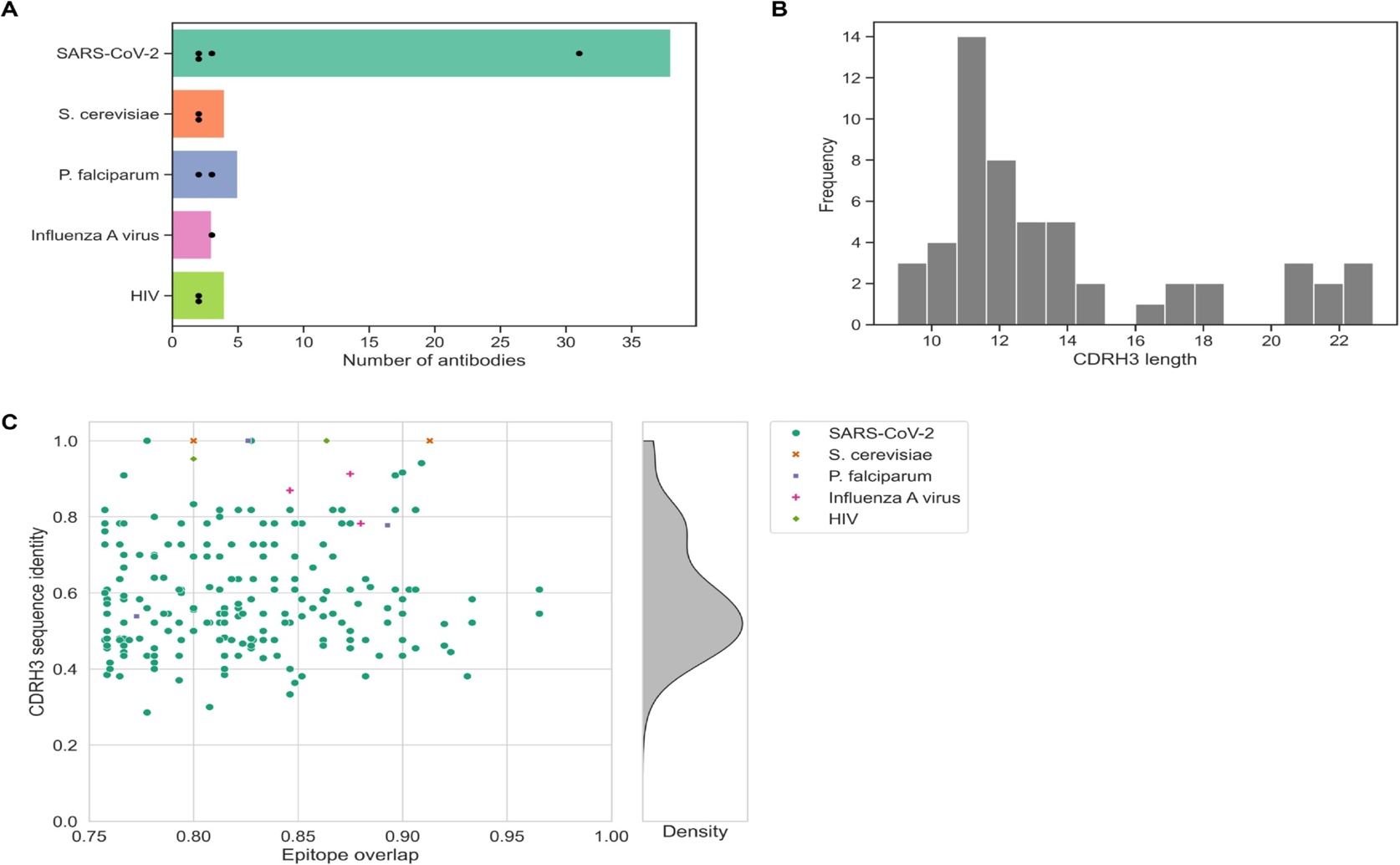
The constructed dataset establishes a diverse ground truth for evaluating clustering algorithms by including antibody pairs with varying CDRH3 lengths (b) and antigen targets, primarily SARS-CoV-2 (a), while crucially demonstrating the existence of functionally converged antibodies that share high epitope overlap despite low sequence identity (c).
Key Findings
- In a study from Amsterdam and partner institutions, adding 3D structural details to antibody clustering revealed new, functionally related groups beyond traditional sequence methods
- The new structure-based methods grouped antibodies with similar functions even when their sequences differed, though SPACE2 is limited by its need for identical CDR lengths
References
Main Study
1) Comparison of sequence- and structure-based antibody clustering approaches on simulated repertoire sequencing data
Published 30th May, 2025
https://doi.org/10.1371/journal.pcbi.1013057
Related Studies
2) The analysis of clonal expansions in normal and autoimmune B cell repertoires.
3) Current strategies for detecting functional convergence across B-cell receptor repertoires.
Related Articles
 6th May, 2025 | Greg Howard