T7 Enzyme Activates Hidden Genes in a Symbiotic Microbe

Jim Crocker
31st May, 2025

T7 Enzyme Activates Hidden Genes in a Symbiotic Microbe

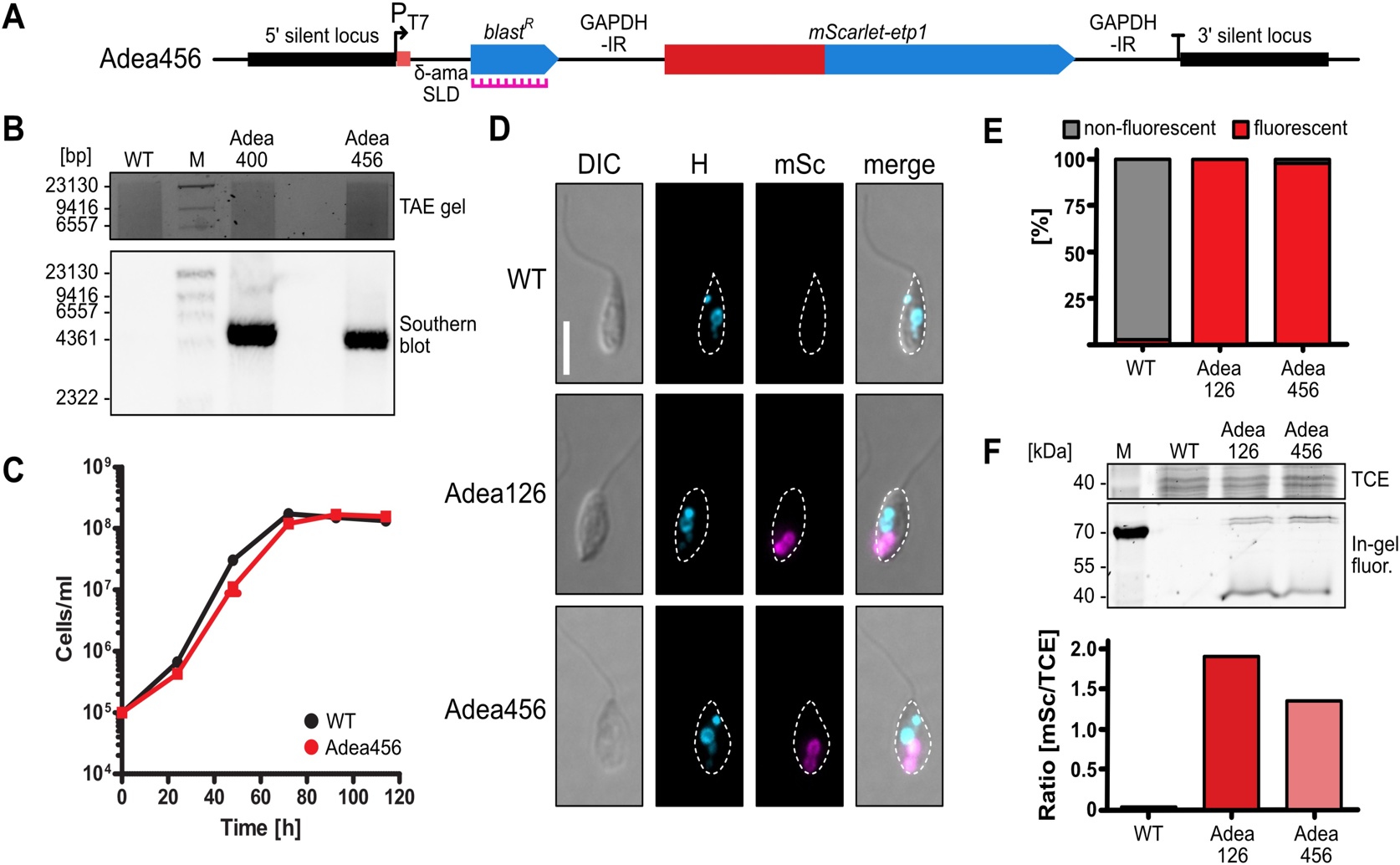
The novel T7 RNA polymerase-based system successfully drove the expression of mScarlet-ETP1 from the rDNA spacer (a, b) at levels comparable to the established endogenous system (d–f) without affecting the growth of Angomonas deanei (c).

Image adapted from: Kröninger et al. / CC BY (Source)

Key Findings

  • At Heinrich Heine University Düsseldorf and the Centre de Recherche en Biologie cellulaire de Montpellier, researchers developed a system to control gene activation in the protozoan A. deanei
  • They identified a silent DNA region on chromosome 13 that safely accepts new genes without disturbing the cell’s normal functions
  • They also added extra drug resistance markers, allowing more flexible and multiple genetic modifications in this endosymbiosis model
Recent research into how single-celled eukaryotes integrate bacteria into their systems has taken a significant step forward with a study from Heinrich Heine University Düsseldorf and the Centre de Recherche en Biologie cellulaire de Montpellier[1]. This work focuses on Angomonas deanei, a trypanosomatid that harbors a β-proteobacterial endosymbiont. The study addresses a long-standing challenge in the field: the need for a conditional gene expression system that allows researchers to control when and how specific genes are activated or silenced. Such control is crucial for dissecting gene function, especially for genes that are essential or may have toxic effects if misregulated. Endosymbiosis—the stable integration of one organism within another—has been a gateway for major evolutionary developments in eukaryotic life. In the case of A. deanei, the bacterium inside the cell contributes metabolites necessary for host survival, a phenomenon that has been studied at various levels previously. For example, earlier genome analyses have shown that bacterial endosymbionts in related trypanosomatids preserve specific genes to support host metabolism, even after millions of years of coevolution[2]. Additionally, studies exploring the coordination of cell division between the host and its endosymbiont have revealed a tightly regulated process that ensures each daughter cell of the protozoan receives one bacterium, underlining the importance of synchrony in endosymbiotic integration[3]. Furthermore, investigations into the recruitment of host proteins to the bacterial partner have provided insights into how these interactions deepen beyond simple metabolite exchange, suggesting mechanisms that mirror the evolution of organelles in eukaryotes[4]. The current study extends the genetic toolkit available for A. deanei by developing an expression system that operates independently of the host’s normal gene-regulating machinery. Ordinarily, gene expression in such organisms is driven by RNA polymerase II (POLII), but in trypanosomatids, this mode of transcription relies on a process known as read-through transcription. Because read-through transcription can inadvertently affect the expression of neighboring genes (a phenomenon known as polar effects), creating a conditional system that avoids these side effects has been challenging. To overcome these obstacles, the study introduced three key innovations. First, the researchers implemented two new drug resistance markers. These markers enable scientists to select for modified cells more effectively, thereby broadening the potential for multiple genetic modifications in a single strain. Second, they identified a transcriptionally silent stretch of DNA upstream of the ribosomal DNA (rDNA) array on chromosome 13. A transcriptionally silent locus is a region that naturally does not produce RNA transcripts; this makes it an ideal “landing pad” for introducing new genetic circuits without interfering with the cell’s normal operations. Third, the team engineered an ectopic expression system—a system where genes are inserted at a location in the genome other than their normal site—that depends on the T7 RNA polymerase. This enzyme is of bacteriophage origin and operates independently of endogenous eukaryotic RNA polymerases. In this study, T7 RNA polymerase was expressed from the δ-amastin locus, and subsequently used to drive expression of transgenes inserted at the silent rDNA spacer locus. The researchers demonstrated that this new system produces levels of gene expression comparable to those achieved with the previously available POLII-dependent system from the γ-amastin locus. This finding is important because it confirms that the new ectopic system can be as effective as older methods while avoiding some of their limitations. In particular, expressing genes through T7 RNA polymerase means that the transgene’s activity is decoupled from the complex and unusual transcription system of trypanosomatids, thereby reducing unwanted polar effects. This is a significant step forward for research into endosymbiosis, as it enables more precise manipulation of both host and symbiont genes. The conditional system introduced in this study is expected to open new avenues for investigating the molecular details of endosymbiosis. For instance, previous work has shown that proteins produced by the host can target and interact with the bacterial endosymbiont, influencing its division and function[4]. Building on such findings, the new expression system could allow researchers to finely control the levels of these proteins, explore their roles dynamically, and even examine what happens when their expression is shut off. This could deepen our understanding of how the symbiotic relationship is maintained and how the host and bacterial partner coevolve. Moreover, the study’s development of additional drug resistance markers is a valuable asset for genetic manipulation in A. deanei, expanding the range of experiments that can be performed. In previous related research, genetic modifications were somewhat restricted by the limited number of resistance markers available[5]. By increasing these genetic tools, scientists now have the ability to introduce multiple modifications, paving the way to study complex genetic interactions that underlie endosymbiosis. Overall, the innovative approach presented by researchers at Heinrich Heine University Düsseldorf and the Centre de Recherche en Biologie cellulaire de Montpellier represents a significant advancement in the field of protozoan genetics and endosymbiosis research. By establishing an ectopic conditional expression system that functions independently of the host’s natural transcription machinery, the study not only extends the experimental repertoire for A. deanei but also provides a robust platform to interrogate the intricate host-symbiont relationship. This work ties together previous findings on endosymbiont genome evolution, host-symbiont metabolic integration, and cell cycle coordination[2][3][4], while addressing earlier technical limitations[5]. The new genetic tools are expected to accelerate progress in understanding how symbiotic associations evolve and function, shedding light on the fundamental processes that have shaped eukaryotic life.

BiotechGenetics

References

Main Study

1) T7 RNA polymerase-based gene expression from a transcriptionally silent rDNA spacer in the endosymbiont-harboring trypanosomatid Angomonas deanei

Published 30th May, 2025

https://doi.org/10.1371/journal.pone.0322611


Related Studies

2) Genome evolution and phylogenomic analysis of Candidatus Kinetoplastibacterium, the betaproteobacterial endosymbionts of Strigomonas and Angomonas.

https://doi.org/10.1093/gbe/evt012


3) The bacterium endosymbiont of Crithidia deanei undergoes coordinated division with the host cell nucleus.

https://doi.org/10.1371/journal.pone.0012415


4) Host-symbiont interactions in Angomonas deanei include the evolution of a host-derived dynamin ring around the endosymbiont division site.

https://doi.org/10.1016/j.cub.2022.11.020


5) Importance of Angomonas deanei KAP4 for kDNA arrangement, cell division and maintenance of the host-bacterium relationship.

https://doi.org/10.1038/s41598-021-88685-8


Related Articles

An unhandled error has occurred. Reload 🗙