How an Online Course Boosted School Water, Sanitation, and Hygiene

Greg Howard
28th May, 2025

How an Online Course Boosted School Water, Sanitation, and Hygiene

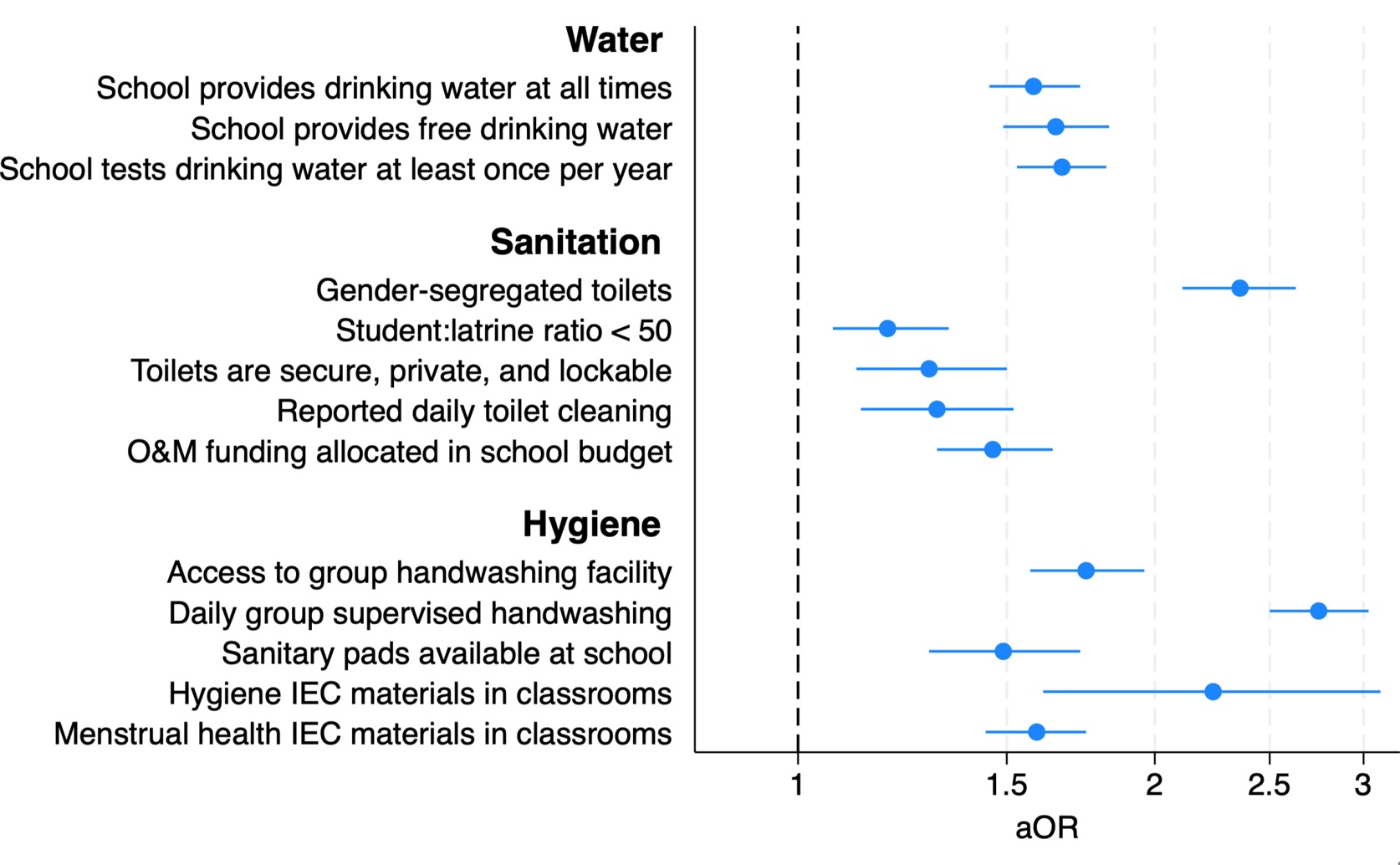
Schools with staff participating in the Massive Open Online Course (MOOC) demonstrated consistently higher odds of improvement across all 13 water, sanitation, and hygiene indicators—including infrastructure, maintenance, and hygiene behaviors—compared to schools without participating staff.

Image adapted from: Rahaman et al. / CC BY (Source)

Key Findings

  • In the Philippines, schools with staff who completed an online WASH training showed significant health and facility improvements
  • These schools provided more reliable clean water, better-maintained toilets, and enhanced handwashing programs
  • The training empowered staff to effectively manage and sustain sanitation and hygiene initiatives, benefiting student health
Access to clean water, proper sanitation, and good hygiene (collectively known as WASH) is essential for maintaining health, especially in school environments where children spend a significant portion of their time. In many low-resource settings, improving WASH services in schools poses significant challenges, impacting students' health and educational outcomes. Addressing these issues, the Department of Education (DepEd) of the Philippines, supported by GIZ GmbH and UNICEF, has implemented a national WASH in Schools (WinS) program aimed at enhancing WASH standards across the country’s educational institutions[1]. The WinS program adopts a stepwise approach to achieve national WASH standards and promote the integration of WASH practices within the education sector. Central to this initiative is the annual monitoring of WASH service levels in schools, which provides critical data to set targets and allocate resources effectively. Since 2019, the program has included a Massive Open Online Course (MOOC) designed for school staff. This online platform offers standardized guidance on implementing WinS initiatives, ensuring consistency and quality across all participating schools. In a recent analysis conducted by researchers at the London School of Hygiene and Tropical Medicine, the effectiveness of the WinS program was evaluated using data from 27,795 schools collected during the 2017/2018 baseline and the 2021/2022 endline periods. Among these, 5,939 schools had at least one teacher enrolled in the MOOC. The study employed logistic regression models to examine the relationship between MOOC participation and changes in specific WASH indicators, as well as composite measures reflecting national progress. The findings revealed that schools with staff participating in the MOOC showed significant improvements in several key areas. There was notable enhancement in school infrastructure, better maintenance of existing facilities, and more robust promotion of hygiene programs. These improvements suggest that the MOOC effectively equipped school staff with the necessary knowledge and tools to implement and sustain WASH initiatives. This aligns with previous research indicating that school-based hygiene programs can lead to sustained improvements in hygiene knowledge and reductions in certain illnesses[2]. Furthermore, the study’s results complement findings from a systematic review that explored the impacts of water and sanitation in schools[3]. The review highlighted that increased access to water facilities and adequate sanitation can lead to higher water intake, reduced absenteeism due to health issues, and lower incidence of diarrheal diseases. The current study extends these insights by demonstrating that structured training for school staff, such as the MOOC, can play a crucial role in achieving these health benefits by ensuring that WASH facilities are not only available but also properly maintained and utilized. Interestingly, the study also touches on the varied impact of WASH interventions depending on the availability of water sources near schools, as seen in earlier research conducted in Kenya[4]. While schools with nearby water sources showed limited improvements when only hygiene promotion and water treatment were provided, those with additional water-supply improvements experienced significant reductions in diarrheal diseases. This underscores the importance of a comprehensive approach to WASH, where infrastructure improvements are coupled with education and maintenance efforts. The inclusion of the MOOC in the WinS program represents an innovative strategy to bridge the gap between policy and practice. By providing uniform implementation guidance online, the program ensures that all schools, regardless of their geographical location, have access to the same quality of information and support. This is particularly important in a country like the Philippines, where schools may vary widely in terms of resources and existing WASH infrastructure. Moreover, the study highlights the role of continuous monitoring in the success of WASH programs. Regular data collection and analysis allow for the identification of gaps and the allocation of resources where they are most needed. This data-driven approach ensures that the WinS program remains responsive to the evolving needs of schools and can adapt strategies accordingly. The positive outcomes associated with MOOC participation suggest that training and education are critical components of effective WASH interventions. By empowering school staff with knowledge and skills, the WinS program not only improves physical infrastructure but also fosters a culture of hygiene and sanitation awareness among students. This holistic approach is essential for creating sustainable health improvements and enhancing the overall educational environment. In conclusion, the national WinS program in the Philippines, supported by DepEd, GIZ GmbH, and UNICEF, demonstrates the effectiveness of combining infrastructure improvements with comprehensive training for school staff. The addition of the MOOC has proved to be a valuable tool in promoting and maintaining high WASH standards in schools, leading to better health outcomes for students. These findings contribute to the broader understanding of how structured WASH interventions can enhance both health and educational achievements, building on previous research and offering a model that can be replicated in other low-resource settings[2][3][4].

EnvironmentHealth

References

Main Study

1) Assessing the effect of a Massive Open Online Course (MOOC) on school water, sanitation, and hygiene improvements in the Philippines

Published 27th May, 2025

https://doi.org/10.1371/journal.pwat.0000287


Related Studies

2) Impact of a hygiene curriculum and the installation of simple handwashing and drinking water stations in rural Kenyan primary schools on student health and hygiene practices.

https://doi.org/10.4269/ajtmh.2012.11-0494


3) Water and sanitation in schools: a systematic review of the health and educational outcomes.

https://doi.org/10.3390/ijerph9082772


4) The impact of a school-based water supply and treatment, hygiene, and sanitation programme on pupil diarrhoea: a cluster-randomized trial.

https://doi.org/10.1017/S0950268813001118


Related Articles

An unhandled error has occurred. Reload 🗙