Finding Insertion Sites for Mobile DNA in Bacterial Chromosomes

Jenn Hoskins
19th May, 2025

Finding Insertion Sites for Mobile DNA in Bacterial Chromosomes

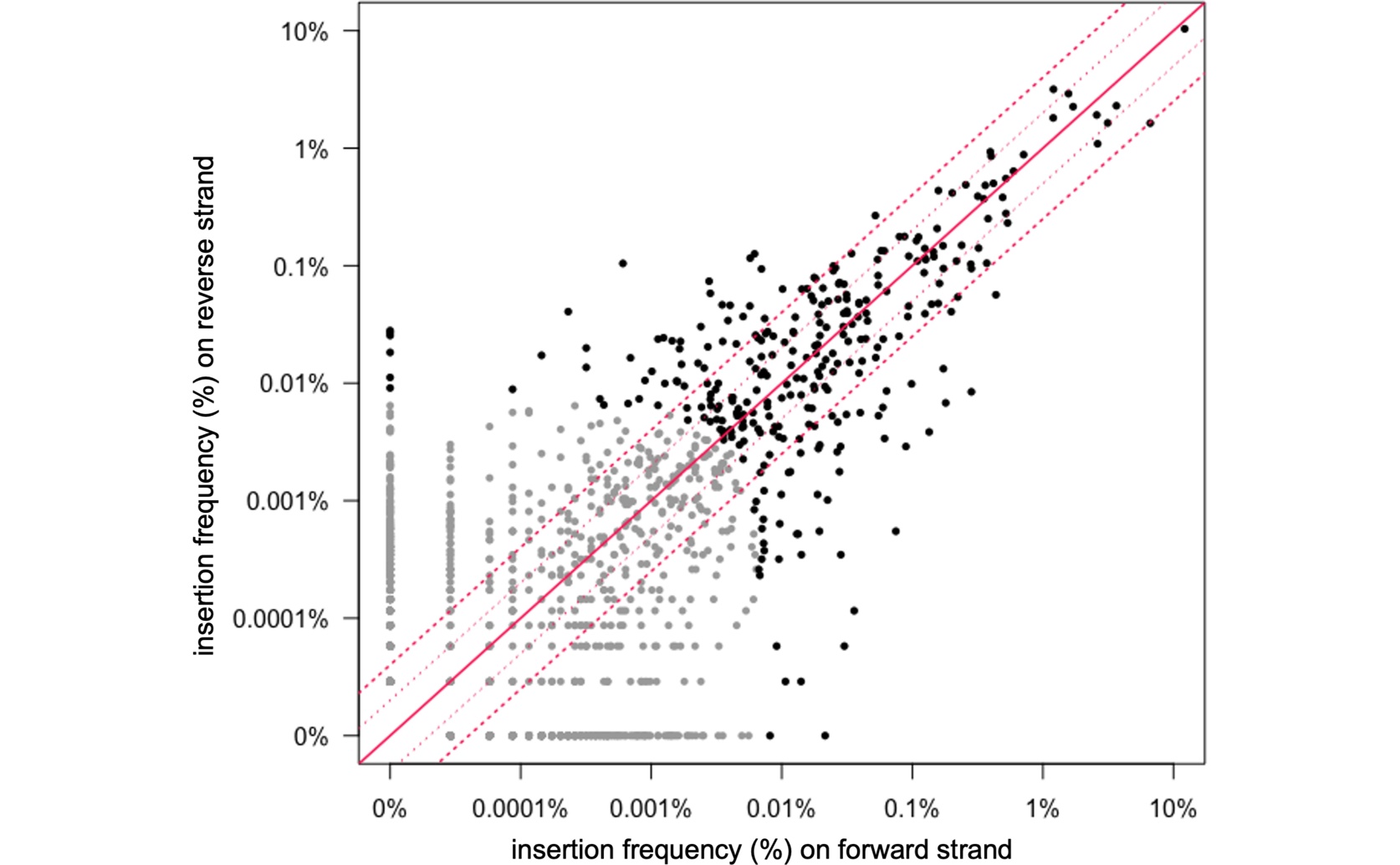
This comparison of insertion frequencies in forward versus reverse orientations demonstrates that Tn916 integrates with similar frequency in both directions for the vast majority of the top 303 sites (black dots), indicating a general lack of orientation bias during integration into the Bacillus subtilis chromosome.

Image adapted from: Bean et al. / CC BY (Source)

Key Findings

  • Researchers at MIT and Tulane found that the gene element Tn916 can attach to many specific spots in the DNA of the bacteria Bacillus subtilis
  • Most Tn916 insertions occur in a few favored locations, especially in DNA regions rich in certain bases, aiding the spread of traits like antibiotic resistance
  • The presence of the Rok protein does not significantly affect where Tn916 inserts, demonstrating its adaptability in transferring genes
Integrative and conjugative elements (ICEs) are mobile genetic pieces found in many bacteria, playing a crucial role in transferring genes horizontally between organisms[2]. This gene transfer can lead to significant changes in microbial traits, including the development of antibiotic resistance. A recent study conducted by researchers at the Massachusetts Institute of Technology and Tulane University[1] focused on one particular ICE, Tn916, which is prevalent in several Gram-positive bacteria such as Enterococcus, Staphylococcus, Streptococcus, and Clostridioides. Unlike many other ICEs that typically insert themselves into a single, specific location within a bacterial genome, Tn916 has the unique ability to integrate into multiple sites. This flexibility makes Tn916 a highly effective vehicle for spreading genes across different bacterial populations[3]. The study aimed to map where Tn916 inserts itself within the chromosome of Bacillus subtilis, a model Gram-positive bacterium. Using advanced genomic techniques, the researchers identified approximately 105 independent insertion events of Tn916 within the Bacillus subtilis genome. These insertions were spread across 1,554 different chromosomal locations. However, the distribution was not uniform. About 99% of these insertions occurred in just 303 specific sites, and a significant 65% were concentrated in only ten sites. Notably, one region between the genes ykuC and ykyB, referred to as kre, was a hotspot for Tn916 integration, accounting for roughly 22% of all insertions. The preference of Tn916 for AT-rich regions—areas of DNA with a higher proportion of adenine and thymine bases—was evident. The researchers identified a consensus motif of approximately 16 base pairs that is AT-rich, similar to patterns previously observed in Clostridioides difficile. This motif likely serves as a recognition site facilitating the insertion of Tn916 into the host genome. Another important aspect of the study was examining the orientation of Tn916 insertions relative to the host chromosome and the direction of gene transcription. In most cases, Tn916 inserted in both directions with similar frequencies, indicating no strong preference for orientation. However, there were a few exceptions where orientation bias was observed, suggesting possible interactions with the host's genetic machinery. The study also explored the relationship between Tn916 insertion sites and the nucleoid-associated protein Rok in Bacillus subtilis. Rok is similar to H-NS in Gram-negative bacteria and plays a role in regulating horizontally acquired genes. Some of the Tn916 insertion sites overlapped with regions bound by Rok. Interestingly, whether Rok was present or absent did not significantly affect where Tn916 chose to insert, indicating that Rok does not strongly influence the insertion specificity of Tn916. This research builds on previous findings about the Tn916 family of ICEs, which are known for their ability to carry antibiotic resistance genes and other beneficial traits[3][4]. The versatility of Tn916 in integrating into multiple genomic sites enhances its role in the dissemination of these traits across various bacterial species, contributing to the growing concern of antibiotic resistance in healthcare settings[4]. Understanding the insertion preferences and mechanisms of Tn916 provides valuable insights into how antibiotic resistance genes spread and how they might be controlled. Furthermore, the study contributes to the broader field of horizontal genomics, which examines the movement of genes across different organisms through mobile genetic elements like ICEs, plasmids, and transposons[5]. By mapping the insertion sites of Tn916, the researchers have added to the knowledge of the mobilome—the collective set of mobile genetic elements in a genome—and how these elements interact with host genomes. The identification of specific insertion hotspots and the lack of strong orientation bias in Tn916 insertions highlight the adaptability and efficiency of this ICE in gene transfer. These findings could inform future strategies to mitigate the spread of antibiotic resistance by targeting the mechanisms that allow ICEs like Tn916 to integrate into bacterial genomes. Overall, the study from MIT and Tulane University advances our understanding of how mobile genetic elements like Tn916 contribute to bacterial evolution and the spread of antibiotic resistance. By elucidating the patterns and preferences of ICE integration, researchers can better predict and potentially interrupt the pathways through which harmful genes disseminate among pathogenic bacteria.

GeneticsBiochem

References

Main Study

1) Identification of insertion sites for the integrative and conjugative element Tn916 in the Bacillus subtilis chromosome

Published 16th May, 2025

https://doi.org/10.1371/journal.pone.0318964


Related Studies

2) Integrative and Conjugative Elements (ICEs): What They Do and How They Work.

https://doi.org/10.1146/annurev-genet-112414-055018


3) A modular master on the move: the Tn916 family of mobile genetic elements.

https://doi.org/10.1016/j.tim.2009.03.002


4) Tn916-like genetic elements: a diverse group of modular mobile elements conferring antibiotic resistance.

https://doi.org/10.1111/j.1574-6976.2011.00283.x


5) Mobile genetic elements: the agents of open source evolution.

Journal: Nature reviews. Microbiology, Issue: Vol 3, Issue 9, Sep 2005


Related Articles

An unhandled error has occurred. Reload 🗙