Genetic Changes Linked to Common Environments in Yeast

Jenn Hoskins
13th May, 2025

Genetic Changes Linked to Common Environments in Yeast

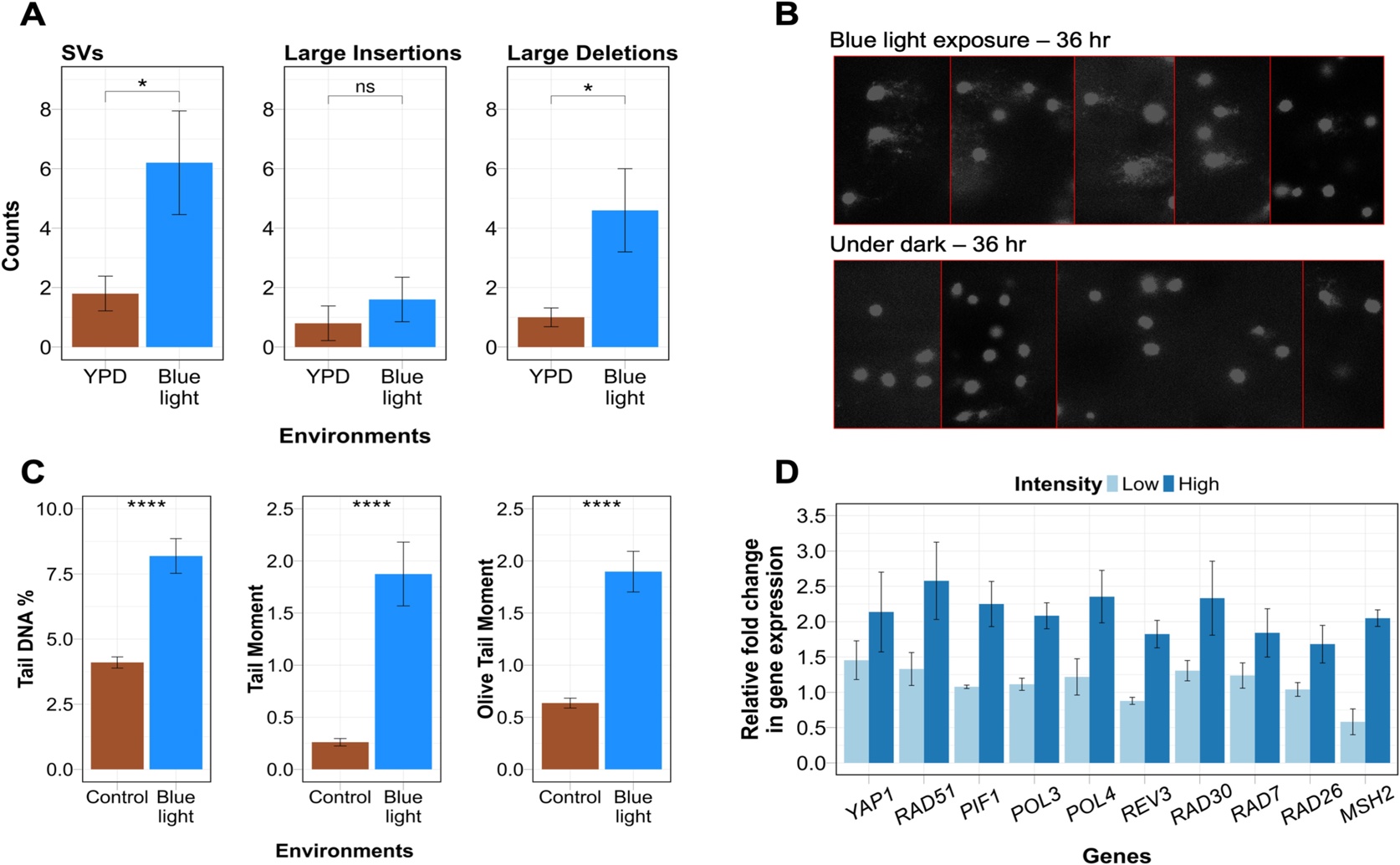
Chronic blue light exposure in Baker’s yeast (Saccharomyces cerevisiae) compromised genomic integrity by significantly increasing large deletions (a) and inducing physical DNA strand breaks (b, c), which triggered a corresponding dose-dependent upregulation of oxidative stress and DNA repair genes (d).

Image adapted from: Vijayan et al. / CC BY (Source)

Key Findings

  • Researchers in India and France found that various environmental stresses significantly increase genetic changes in yeast cells
  • Exposure to blue light caused large sections of yeast DNA to become identical, leading to high genetic instability
  • Low sugar conditions resulted in smaller genetic alterations, showing that different stresses affect genes in unique ways
Loss of heterozygosity (LOH) is a key genetic event where a cell loses one allele of a gene, resulting in both alleles being identical. This process plays a crucial role in various biological phenomena, including cancer development and evolutionary adaptation. Understanding how environmental factors influence LOH can provide significant insights into disease mechanisms and genome evolution. A recent study conducted by researchers at IISER Thiruvananthapuram, India, University of Strasbourg, France[1], investigated the impact of different environmental conditions on LOH in a diploid hybrid yeast strain. In human cancers, LOH is a common oncogenic mechanism, particularly in retinoblastomas, where it leads to the inactivation of tumor-suppressor genes[2]. Previous research has shown that LOH can occur through mechanisms such as chromosomal nondisjunction and mitotic recombination[2]. Additionally, studies in yeast have demonstrated that LOH is a frequent event during asexual reproduction, often facilitating adaptation by revealing beneficial recessive alleles[3][4]. These foundational studies underscore the importance of LOH in both disease progression and evolutionary processes, paving the way for further exploration into how environmental factors influence this genetic event. The study by IISER Thiruvananthapuram and collaborators aimed to elucidate how various ubiquitous environmental stresses affect the frequency and nature of LOH events. Using mutation accumulation (MA) lines of a diploid hybrid yeast strain (S288c/YJM789), the researchers exposed the cells to different conditions, including blue light, low glucose (calorie restriction), oxidative stress (H₂O₂), high temperature (37°C), ethanol, and salt (NaCl). By comparing these environments to a control condition (YPD), the study sought to determine how each stressor influences the rate and extent of LOH. The findings revealed a significant increase in LOH frequency across all environmental conditions compared to the control. Notably, the extent of the genome affected by LOH varied depending on the specific environmental stress. For instance, under calorie restriction, the LOH tracts were considerably shorter, whereas exposure to blue light led to rapid genome homozygosity, affecting larger genomic regions. This variability suggests that different environmental factors induce distinct types of genetic damage and activate different cellular repair pathways, resulting in unique LOH patterns. A particularly noteworthy result was the identification of a unique mutational signature associated with blue light exposure. This signature included not only LOH but also small insertions and deletions (indels), large deletions, and transversion mutations (such as G:C > T:A and G:C > C:G). The transversion mutations are likely caused by the photooxidation of guanine bases under blue light, highlighting how specific environmental conditions can lead to particular types of mutations. Methodologically, the researchers employed whole-genome sequencing to analyze the genetic changes in the yeast strains. This approach allowed them to detect both interstitial LOH events, which result in short stretches of homozygosity, and terminal LOH events, where the homozygosity extends to the chromosome ends[4]. By categorizing these events, the study provided a comprehensive view of how different stressors impact the yeast genome. The increased LOH observed under all environmental conditions aligns with previous findings in diploid yeast strains, where LOH is a common outcome during mutation accumulation under stress[3][4]. Furthermore, the study’s observation that environmental stresses can accelerate LOH corroborates earlier research indicating that LOH events, such as those seen in retinoblastomas[2], are crucial in driving disease progression by enabling the loss of functional tumor-suppressor genes. Moreover, the study’s discovery that different environmental factors lead to distinct LOH tract lengths and mutation signatures expands on previous work by offering a more detailed understanding of how environmental conditions influence genetic stability at the molecular level. This knowledge could inform future research on how specific stresses contribute to genetic instability in various organisms, including humans. Overall, the study highlights the pervasive impact of environmental conditions on genetic stability through LOH, emphasizing the importance of considering environmental factors in both medical research and evolutionary biology. By building on earlier findings[2][3][4], the research from IISER Thiruvananthapuram and University of Strasbourg provides valuable insights into the mechanisms by which the environment can shape genetic outcomes.

GeneticsBiochem

References

Main Study

1) Loss of Heterozygosity associated with ubiquitous environments in yeast

Published 12th May, 2025

https://doi.org/10.1371/journal.pgen.1011692


Related Studies

2) Mitotic recombination map of 13cen-13q14 derived from an investigation of loss of heterozygosity in retinoblastomas.

Journal: Proceedings of the National Academy of Sciences of the United States of America, Issue: Vol 96, Issue 6, Mar 1999


3) Loss of Heterozygosity and Its Importance in Evolution.

https://doi.org/10.1007/s00239-022-10088-8


4) Genome-wide mapping of spontaneous genetic alterations in diploid yeast cells.

https://doi.org/10.1073/pnas.2018633117


Related Articles

An unhandled error has occurred. Reload 🗙