Widespread Gene Change Alters How the Body Uses Sugar and Fat

Jim Crocker
14th May, 2025

Widespread Gene Change Alters How the Body Uses Sugar and Fat

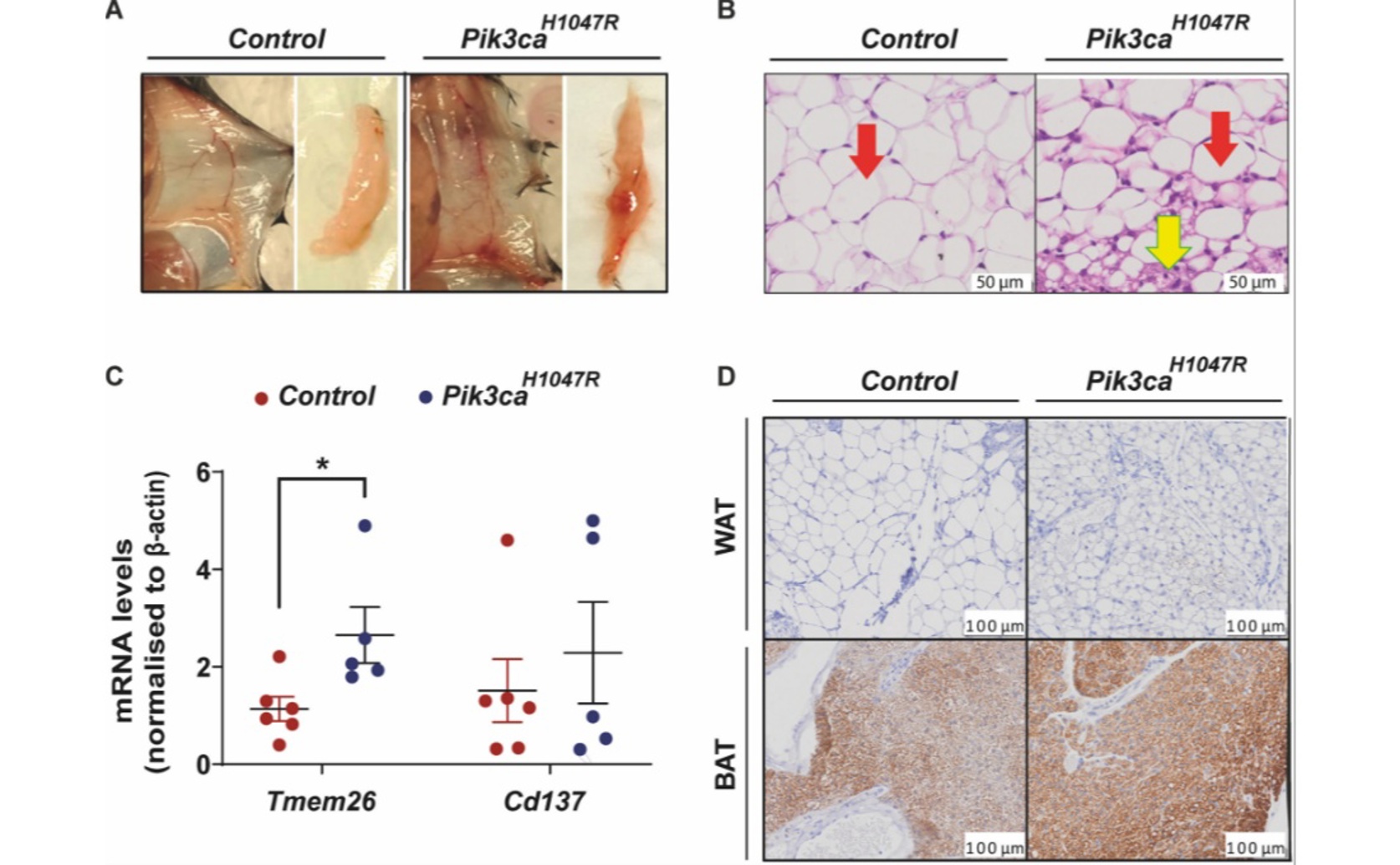
Ubiquitous expression of the Pik3caH1047R mutation reprograms lipid metabolism by stimulating white adipose tissue browning, indicated by gross morphology (a) and the histological presence of beige adipocytes (b) with elevated Tmem26 and Cd137 levels (c), despite a lack of significant UCP1 protein expression (d).

Image adapted from: Caiazzo et al. / CC BY (Source)

Key Findings

  • Researchers at the University of Texas found that a common cancer gene mutation in mice causes low blood sugar and early death
  • The mutation makes tissues absorb more sugar and blocks the liver from producing glucose, while also reducing insulin release
  • It also leads to increased fat breakdown and transforms fat tissue to burn more energy
Mutations in the PIK3CA gene, which encodes the p110α catalytic subunit of phosphoinositide 3-kinase (PI3K), are among the most frequent alterations found in human cancers and overgrowth syndromes[1]. PI3K plays a crucial role in various cellular processes, including growth, proliferation, and metabolism, by transducing signals from receptor tyrosine kinases and G protein-coupled receptors[2]. Understanding how mutations in this gene affect cellular functions is essential for developing targeted therapies and managing associated metabolic disorders. The recent study conducted by researchers at the University of Texas Health Science Center at Houston investigated the systemic effects of a specific PIK3CA mutation, Pik3caH1047R, in mice. This mutation leads to the continuous activation of the PI3K pathway, which is a common feature in many cancers. The study aimed to explore how this persistent activation influences glucose homeostasis, the balance of glucose levels in the blood, which is vital for energy regulation in the body. In their experiments, the researchers introduced the Pik3caH1047R mutation into mice and observed several significant metabolic changes. They found that mice with this mutation had reduced survival rates, enlarged organs (organomegaly), low blood sugar levels (hypoglycaemia), and decreased insulin production (hypoinsulinemia). These findings indicate that the mutation disrupts normal glucose metabolism, which could have implications for both cancer progression and metabolic health. One of the key discoveries of the study was that the Pik3caH1047R mutation impairs the rise in blood glucose levels following oral glucose intake. Normally, when glucose is consumed, the body responds by increasing blood sugar levels, which signals the pancreas to release insulin. Insulin then facilitates the uptake of glucose by tissues, helping to lower blood sugar levels to a normal range. However, in the mutated mice, this response was blunted, suggesting that the mutation interferes with the body’s ability to manage glucose effectively. Further analysis revealed that the mutation stimulates glucose uptake in peripheral tissues, such as muscle and fat, while simultaneously inhibiting the liver’s production of glucose (gluconeogenesis) and reducing insulin secretion from the pancreas. Additionally, the mutation increased the breakdown of fats (lipolysis) in adipose tissue and promoted the browning of white adipose tissue, which is associated with increased energy expenditure. These metabolic disruptions are linked to the PI3K/AKT/mTOR signaling pathway, a central regulator of cell growth and metabolism[3][4]. PI3K activation leads to the activation of AKT, which in turn stimulates mTOR, promoting cell growth and survival. However, excessive activation of this pathway, as seen with the Pik3caH1047R mutation, can lead to uncontrolled cell growth and cancer. The study’s findings highlight how systemic PI3K activation not only drives tumor development but also impacts metabolic processes, contributing to metabolic disorders. Previous research has shown that targeting the PI3K pathway with specific inhibitors can be effective in combating cancer by slowing tumor progression[4]. These inhibitors are categorized into dual PI3K/mTOR inhibitors, pan-PI3K inhibitors, and isoform-specific inhibitors, each designed to block different aspects of the pathway[4]. The current study builds on this knowledge by demonstrating the widespread effects of PI3K activation beyond cancer, emphasizing the importance of precise targeting to minimize metabolic side effects. Moreover, the study connects with earlier findings that detailed the roles of different PI3K isoforms in various diseases[2]. By focusing on the p110α isoform encoded by PIK3CA, the research provides specific insights into how mutations in this gene alter metabolic functions. This specificity is crucial for developing targeted therapies that can effectively address the mutated pathway in cancer while mitigating unwanted metabolic consequences. The researchers employed a combination of genetic manipulation and metabolic assays to elucidate the effects of the Pik3caH1047R mutation. By creating a mouse model with ubiquitous expression of the mutation, they were able to observe its systemic impact on glucose homeostasis and fat metabolism. This comprehensive approach allowed them to link genetic alterations directly to physiological outcomes, providing a clearer picture of how PI3K mutations drive both cancer and metabolic dysfunctions. In summary, the study from the University of Texas Health Science Center at Houston advances our understanding of how PIK3CA mutations disrupt glucose balance and fat metabolism in mice. By revealing the broader metabolic implications of PI3K pathway activation, the research underscores the need for targeted therapies that address both cancer progression and metabolic health. This work integrates previous insights into the PI3K/AKT/mTOR pathway, offering a more holistic view of its role in disease and paving the way for more effective and nuanced treatment strategies.

HealthGeneticsBiochem

References

Main Study

1) Ubiquitous expression of an activating mutation in the Pik3ca gene reprograms glucose and lipid metabolism in mice

Published 12th May, 2025

https://doi.org/10.1371/journal.pone.0322544


Related Studies

2) Synergy in activating class I PI3Ks.

https://doi.org/10.1016/j.tibs.2014.12.003


3) PI3K/AKT signaling pathway and cancer: an updated review.

https://doi.org/10.3109/07853890.2014.912836


4) Targeting PI3K in cancer: mechanisms and advances in clinical trials.

https://doi.org/10.1186/s12943-019-0954-x


Related Articles

An unhandled error has occurred. Reload 🗙