Leaders and Helpers Living Together Rely on Friends Differently in Challenges

Jenn Hoskins
12th May, 2025

Leaders and Helpers Living Together Rely on Friends Differently in Challenges

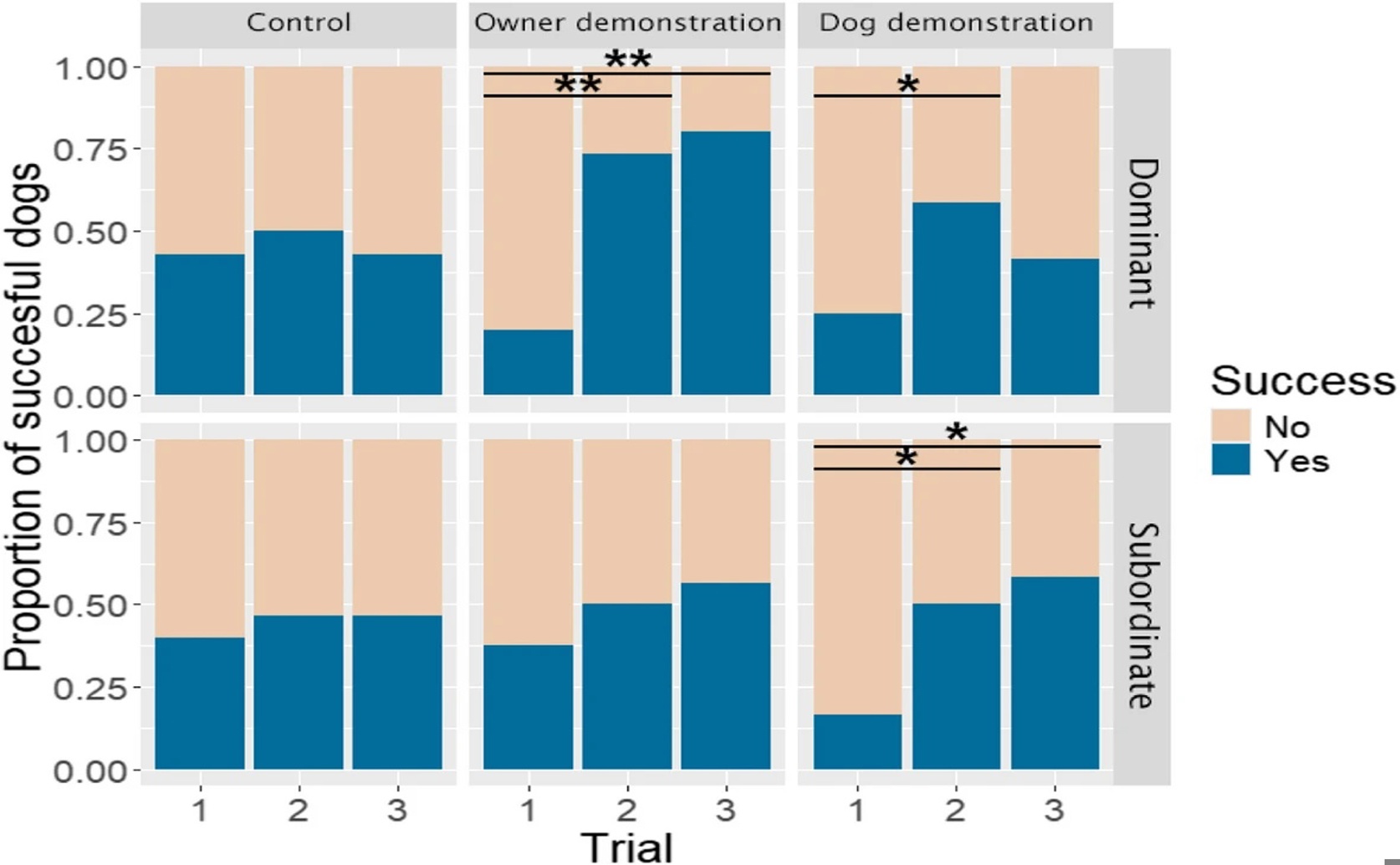
Consistent with the study's "owner as a resource" hypothesis, dominant dogs (Canis familiaris) significantly increased their success rates after observing their owners, whereas subordinate dogs failed to learn from humans and only improved after watching a dominant conspecific demonstrator.

Image adapted from: Pongrácz et al. / CC BY (Source)

Key Findings

  • *In Budapest, dominant dogs learned more effectively from their owners than subordinate dogs.*
  • *Subordinate dogs only improved their learning when observing a dominant household dog, not their owners.*
  • *A dog’s social rank within the household significantly influences how and from whom they learn.*
Understanding how dogs learn from their social environment is crucial for improving training methods and enhancing human-dog relationships. While previous research has highlighted dogs' ability to cooperate with humans and other dogs[2][3], the role of social hierarchy within dog groups remains less explored. A recent study conducted by researchers at Eötvös Loránd University in Budapest, Hungary[1], delves into how a dog’s rank within a household influences its ability to learn from different types of demonstrators, specifically owners and cohabiting dogs. The study aimed to investigate whether dominant and subordinate dogs in multi-dog households learn differently when observing their owner versus another dog. This research builds on earlier findings that suggest social dynamics, such as rank and affiliation, significantly impact dogs' cooperative behaviors[2]. Additionally, it considers the hypothesis that domestication has equipped dogs with enhanced socio-cognitive skills for interacting with humans and other dogs[3], and that the dog-owner relationship plays a critical role in dogs' social learning performance[4]. To explore these questions, the researchers employed the detour paradigm, a well-established method for assessing problem-solving and social learning in dogs. They also utilized the dog-rank assessment questionnaire (DRA-Q) to determine the hierarchical status of each dog within its household. By pairing dogs with either their owner or a cohabiting dog as the demonstrator, the study provided a more ecologically valid setting compared to previous experiments that used unfamiliar humans or dogs. The findings revealed significant differences based on the dogs' social rank. Dominant dogs were more effective at learning from their owners compared to subordinate dogs. In contrast, subordinate dogs only showed improved performance when the task was demonstrated by a dominant cohabiting dog, not by their owners. This suggests that within-group hierarchy plays a crucial role in how dogs prioritize their learning sources. Furthermore, dominant dogs demonstrated greater improvements in detour speed when learning from their owners, highlighting the owner's influence as a primary resource for these dogs. These results challenge some previous notions about domestication and cooperation in dogs. For instance, study[2] proposed that domestication led dogs to become more cooperative with humans, but the current findings indicate that this cooperation may be more nuanced and influenced by social hierarchy. While dogs are adept at working with humans, their ability to learn from other dogs depends significantly on their rank within the group. This aligns with study[3], which found that dogs possess advanced socio-cognitive skills, but these skills are exercised differently depending on social contexts and relationships. Moreover, the study underscores the importance of considering the dog-owner relationship in understanding dogs' social behaviors, echoing the findings of study[4]. The fact that subordinate dogs did not learn effectively from their owners suggests that the quality and dynamics of the dog-owner relationship can influence learning outcomes. This aspect adds another layer to how social factors within a household shape a dog’s ability to learn and adapt. The methodology of using familiar demonstrators—owners and cohabiting dogs—adds ecological validity to the study, making the findings more applicable to real-world settings. By moving away from unfamiliar demonstrators, the researchers were able to capture the everyday social interactions that influence dogs' learning processes. This approach provided deeper insights into how dogs navigate their social hierarchies to optimize learning from the most relevant sources in their environment. In summary, the study from Eötvös Loránd University highlights the complex interplay between social hierarchy and learning in dogs. Dominant dogs leverage their position to learn more effectively from their owners, while subordinate dogs rely on dominant peers for successful learning. These findings not only refine our understanding of dog social behavior but also have practical implications for training practices. Recognizing the role of hierarchy can help in designing training programs that cater to different dogs’ social standings, thereby enhancing their learning efficiency and strengthening human-dog relationships. This research also prompts a reevaluation of domestication theories that emphasize increased cooperative tendencies in dogs compared to their wild counterparts. Instead, it suggests that dogs' social ecologies, including their interactions within multi-dog households, play a significant role in shaping their cooperative and learning behaviors. By integrating these insights with previous studies[2][3][4], the study offers a more comprehensive view of the factors influencing dogs' social learning and cooperation, paving the way for future research to further unravel the complexities of canine social dynamics.

Animal Science

References

Main Study

1) Done deal—cohabiting dominant and subordinate dogs differently rely on familiar demonstrators in a detour task

Published 9th May, 2025

https://doi.org/10.1186/s12915-025-02232-9


Related Studies

2) Importance of a species' socioecology: Wolves outperform dogs in a conspecific cooperation task.

https://doi.org/10.1073/pnas.1709027114


3) Behavioural coordination of dogs in a cooperative problem-solving task with a conspecific and a human partner.

https://doi.org/10.1007/s10071-013-0676-1


4) Grumpy Dogs Are Smart Learners-The Association between Dog-Owner Relationship and Dogs' Performance in a Social Learning Task.

https://doi.org/10.3390/ani11040961


Related Articles

An unhandled error has occurred. Reload 🗙