Costs of Wind Energy Permitting Compliance Actions

Jenn Hoskins
7th May, 2025

Costs of Wind Energy Permitting Compliance Actions

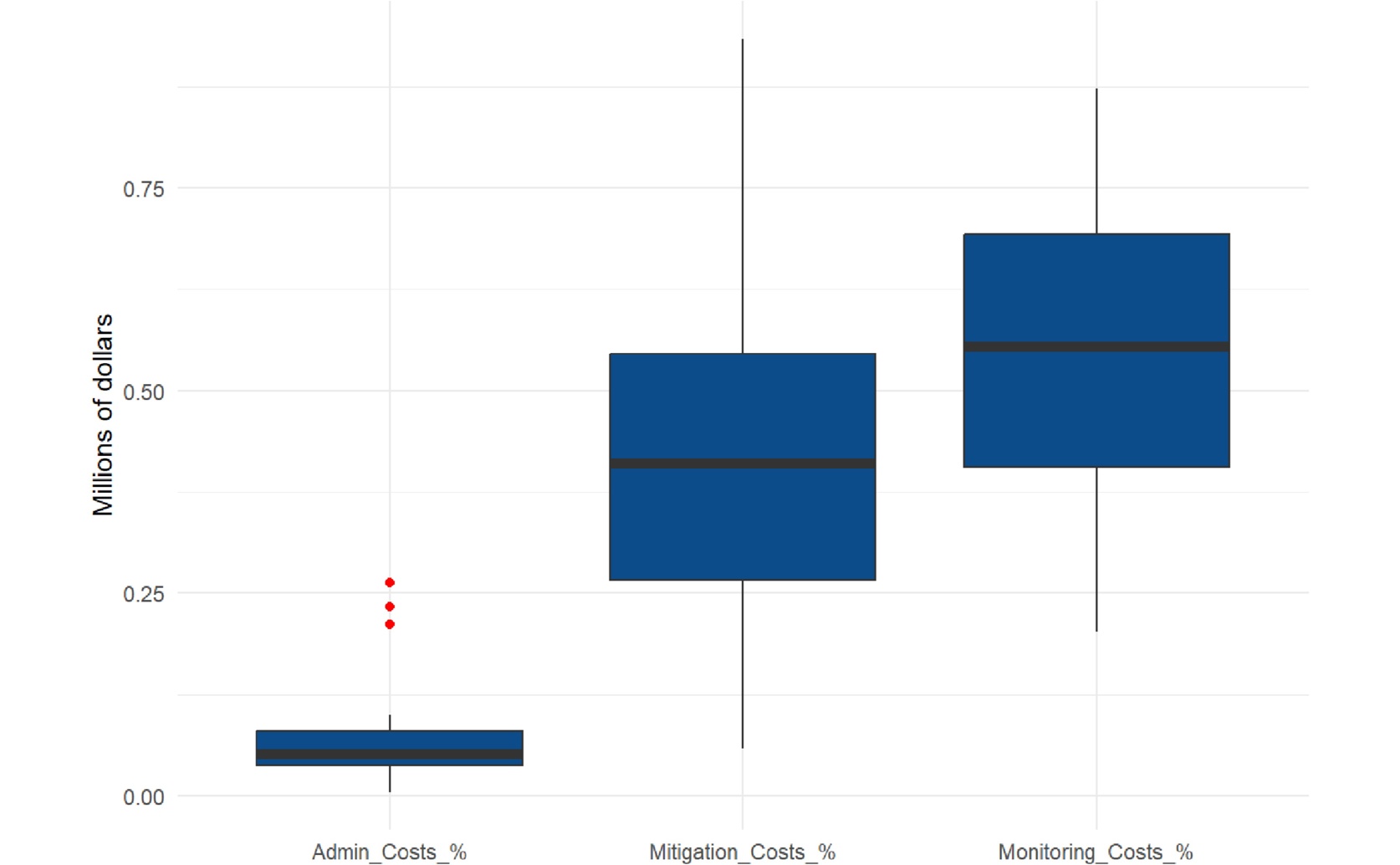
Proportions of total reported costs by category.

Image adapted from: Newman et al. / CC BY (Source)

Key Findings

  • In North America, wind companies spend about $4.68 million on plans to protect endangered bats when building wind farms
  • Over half of these costs go to monitoring bat deaths, highlighting the financial strain of compliance
  • Researchers created a tool to help companies estimate future costs, aiding better financial and environmental planning
The expansion of wind energy in North America is a key component in the transition to cleaner energy sources. However, this growth brings regulatory challenges, particularly concerning the protection of bat species endangered by white-nose syndrome. The overlap between increasing wind capacity and the habitats of several endangered bats necessitates careful planning to comply with environmental laws. A recent study conducted by the Electric Power Research Institute and the Chinese Academy of Sciences[1] addresses the financial implications for wind energy operators aiming to comply with the Endangered Species Act (ESA). The ESA requires companies to submit a Habitat Conservation Plan (HCP) and an Incidental Take Permit (ITP) to the U.S. Fish and Wildlife Service when their operations may impact endangered species. These documents detail the wind project, estimate unavoidable fatalities of protected species, and outline measures to minimize and compensate for these impacts. One significant barrier to compliance identified in the study is the lack of detailed cost information. The process of obtaining an ITP is lengthy and perceived as financially burdensome, which may discourage companies from seeking voluntary compliance. Additionally, there is no standardized database or method for estimating the costs associated with meeting ESA requirements, making it difficult for companies to plan and allocate resources effectively. To address this gap, the researchers analyzed 25 publicly available HCPs published through 2022. They found that the median total cost for an HCP is approximately $4.68 million USD. Breaking down these costs, compensatory mitigation—actions taken to offset the impact on wildlife—accounts for a median of $1.64 million, while fatality monitoring—tracking and reporting species fatalities—costs a median of $3.15 million. This discrepancy highlights that ongoing monitoring is a substantial part of the regulatory burden. The study also developed a general linear model to estimate project-specific costs, providing a tool for wind energy operators to better anticipate future expenses related to ESA compliance. By identifying variables that influence these costs, such as project size and location, the model offers a framework for more accurate budgeting and planning. Prior research has extensively documented the impact of wind turbines on wildlife. For example, one study[2] examined bird and bat fatalities at wind facilities, finding that factors like turbine size and species affected the distance carcasses fell from turbines. Larger turbines required a greater search radius to detect fatalities, and collisions with turbine poles, not just blades, were significant for some bird species. Another study[3] focused on bat collision mortality, revealing that migratory tree-roosting bats are particularly vulnerable and that areas with higher grassland cover see fewer bat fatalities. These findings emphasize the need for informed placement and design of wind facilities to mitigate wildlife impacts. The current study builds on this foundation by shifting the focus to the economic aspects of compliance. Understanding the costs involved is crucial for balancing the benefits of wind energy with the necessity of protecting endangered species. The median cost figures provided by the Electric Power Research Institute and the Chinese Academy of Sciences offer valuable insights for policymakers and industry stakeholders. They highlight the financial commitment required to minimize environmental impacts and ensure that wind energy development proceeds responsibly. Moreover, the study’s linear model for estimating compliance costs can aid in creating more transparent and predictable regulatory frameworks. By anticipating the financial requirements, companies can better integrate conservation efforts into their project planning, potentially reducing delays and fostering a more cooperative relationship with regulatory bodies. Incorporating earlier findings, such as the influence of landscape openness on bat mortality[3], can also inform cost-effective strategies. For instance, selecting sites with higher grassland cover may not only reduce bat fatalities but also lower the costs associated with compensatory mitigation and monitoring. Similarly, understanding species-specific collision patterns[2] can help tailor mitigation measures to be both effective and financially feasible. Overall, this analysis provides a comprehensive view of the economic dimensions of ESA compliance for the wind industry. By quantifying the costs and offering a method to estimate them, the study supports more informed decision-making. This approach ensures that the growth of wind energy can proceed in a manner that respects and protects endangered species, aligning environmental sustainability with economic viability.

EnvironmentWildlifeSustainability

References

Main Study

1) The costs of wind energy permitting compliance actions for regulated bats in the US

Published 5th May, 2025

https://doi.org/10.1371/journal.pone.0322005


Related Studies

2) An evaluation of bird and bat mortality at wind turbines in the Northeastern United States.

https://doi.org/10.1371/journal.pone.0238034


3) Factors associated with bat mortality at wind energy facilities in the United States.

https://doi.org/10.1016/j.biocon.2017.09.014


Related Articles

An unhandled error has occurred. Reload 🗙