Creating Small Antibodies to Target COVID Spike Protein with AI and Modeling

Jim Crocker
22nd April, 2025

Creating Small Antibodies to Target COVID Spike Protein with AI and Modeling

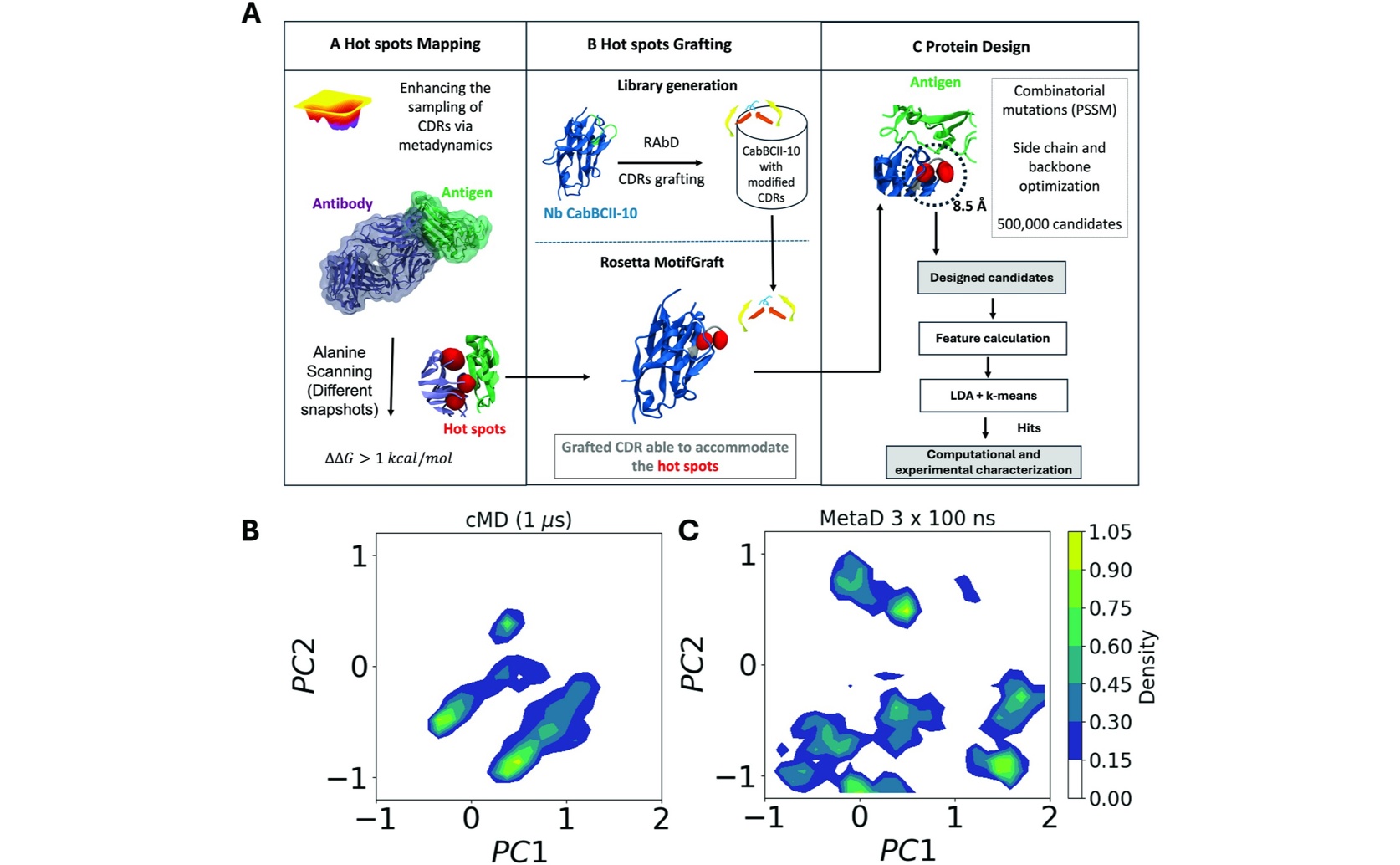
This figure outlines the computational pipeline used to design a high-affinity nanobody (A) and demonstrates that metadynamics simulations explore a substantially larger conformational space (C) compared to conventional molecular dynamics (B), justifying their use for identifying key binding interactions.

Image adapted from: Ferraz et al. / CC BY (Source)

Key Findings

  • *Brazilian researchers designed a new nanobody targeting COVID-19’s spike protein using advanced computer methods.*
  • *The nanobody, Nb Ab.2, binds strongly to the virus’s spike protein, effectively neutralizing it.*
  • *This innovative approach can be used to create nanobodies for other viruses, advancing future treatments.*
Developing effective treatments for viral infections is a critical area of medical research, especially in the wake of the COVID-19 pandemic. One promising approach involves designing proteins called nanobodies, which can specifically bind to parts of a virus, potentially neutralizing it and preventing infection. A recent study conducted by researchers at the Federal University of Pernambuco, Recife, Brazil[1] has made significant strides in this field by using advanced computational techniques to design a high-affinity nanobody targeting the spike protein of SARS-CoV-2, the virus responsible for COVID-19. Nanobodies are a unique type of antibody derived from camelids, such as llamas and alpacas. Unlike traditional antibodies, nanobodies are smaller and more stable, making them easier to produce and modify for therapeutic purposes. Antibody therapeutics, including nanobodies, are rapidly expanding and providing major health benefits across various therapeutic areas[2]. The ability to design nanobodies that can effectively target specific viral proteins is essential for developing treatments, diagnostics, and vaccines. The main challenge in designing effective nanobodies lies in ensuring they bind tightly and specifically to their target. Traditional methods of antibody discovery, such as animal immunization and large-scale screening, can be time-consuming and do not always yield antibodies with the desired properties[3]. To overcome these limitations, the researchers employed a complementarity-determining region (CDR) grafting approach enhanced by computer simulations and machine learning. This method allows for the precise design of nanobodies that target specific regions, or epitopes, of the virus's spike protein. In their study, the team focused on the spike protein's receptor-binding domain (RBD), which is crucial for the virus to attach to and enter human cells. By designing a nanobody, named Nb Ab.2, that binds strongly to the RBD, the researchers aimed to neutralize the virus effectively. The use of machine learning in this process builds on the potential for artificial intelligence to revolutionize antibody discovery and engineering[2], although its full impact is still emerging. Once designed, Nb Ab.2 was synthesized and tested for its ability to bind to the purified RBD protein and to virus-like particles that mimic the actual virus. The nanobody demonstrated high affinity, with binding strengths measured at 9 nanomolar (nM) for the purified protein and 60 nM for the virus-like particles. These measurements indicate a strong and specific interaction between Nb Ab.2 and the spike protein, suggesting its potential effectiveness in neutralizing the virus. To ensure that Nb Ab.2 maintained its structural integrity and proper folding, the researchers conducted circular dichroism analyses. This technique confirmed that the nanobody retained its intended shape, which is crucial for its binding functionality. Additionally, molecular dynamics simulations provided insights into the internal dynamics of Nb Ab.2, helping the team understand how the nanobody interacts with the spike protein at a molecular level. The success of Nb Ab.2 highlights the effectiveness of the computational pipeline developed by the researchers. This pipeline can be applied to design high-affinity nanobodies targeting different viral proteins, offering a versatile tool for developing diagnostics and prophylactic measures against various viral threats. The ability to tailor nanobodies for specific targets is particularly valuable, as it allows for rapid responses to emerging viruses or variants. This study also connects with earlier research on broadly neutralizing antibodies (bNAbs) and nanobodies for HIV-1 treatment[4]. Just as bNAbs target the HIV-1 envelope glycoprotein to suppress the virus and eliminate infected cells, Nb Ab.2 targets the SARS-CoV-2 spike protein to neutralize the virus. The advancements in nanobody design and engineering showcased in this study build upon the foundational work of enhancing antibody potency and breadth, as well as leveraging Fc-mediated effector functions for in vivo efficacy. Furthermore, the use of antibody display technologies, such as phage display, has been instrumental in isolating antigen-specific antibodies with therapeutic potential[5]. While the current study emphasizes computational design, integrating these traditional methods with advanced computational techniques could further enhance the discovery and optimization of effective nanobodies. Overall, the development of Nb Ab.2 represents a significant advancement in the field of antibody therapeutics. By combining CDR grafting with machine learning and computer simulations, the researchers have created a robust method for designing nanobodies with high specificity and affinity. This approach not only addresses the urgent need for effective COVID-19 treatments but also paves the way for future applications against a wide range of viral infections.

MedicineBiotech

References

Main Study

1) Design of nanobody targeting SARS-CoV-2 spike glycoprotein using CDR-grafting assisted by molecular simulation and machine learning

Published 21st April, 2025

https://doi.org/10.1371/journal.pcbi.1012921


Related Studies

2) Designing antibodies as therapeutics.

https://doi.org/10.1016/j.cell.2022.05.029


3) Computational design of antibodies.

https://doi.org/10.1016/j.sbi.2018.04.007


4) Anti-HIV-1 Nanobody-IgG1 Constructs With Improved Neutralization Potency and the Ability to Mediate Fc Effector Functions.

https://doi.org/10.3389/fimmu.2022.893648


5) Antibody display technologies: selecting the cream of the crop.

https://doi.org/10.1515/hsz-2020-0377


Related Articles

An unhandled error has occurred. Reload 🗙