
How Land Use Affects Ecosystems in Northern Lakes
Jim Crocker
18th April, 2025


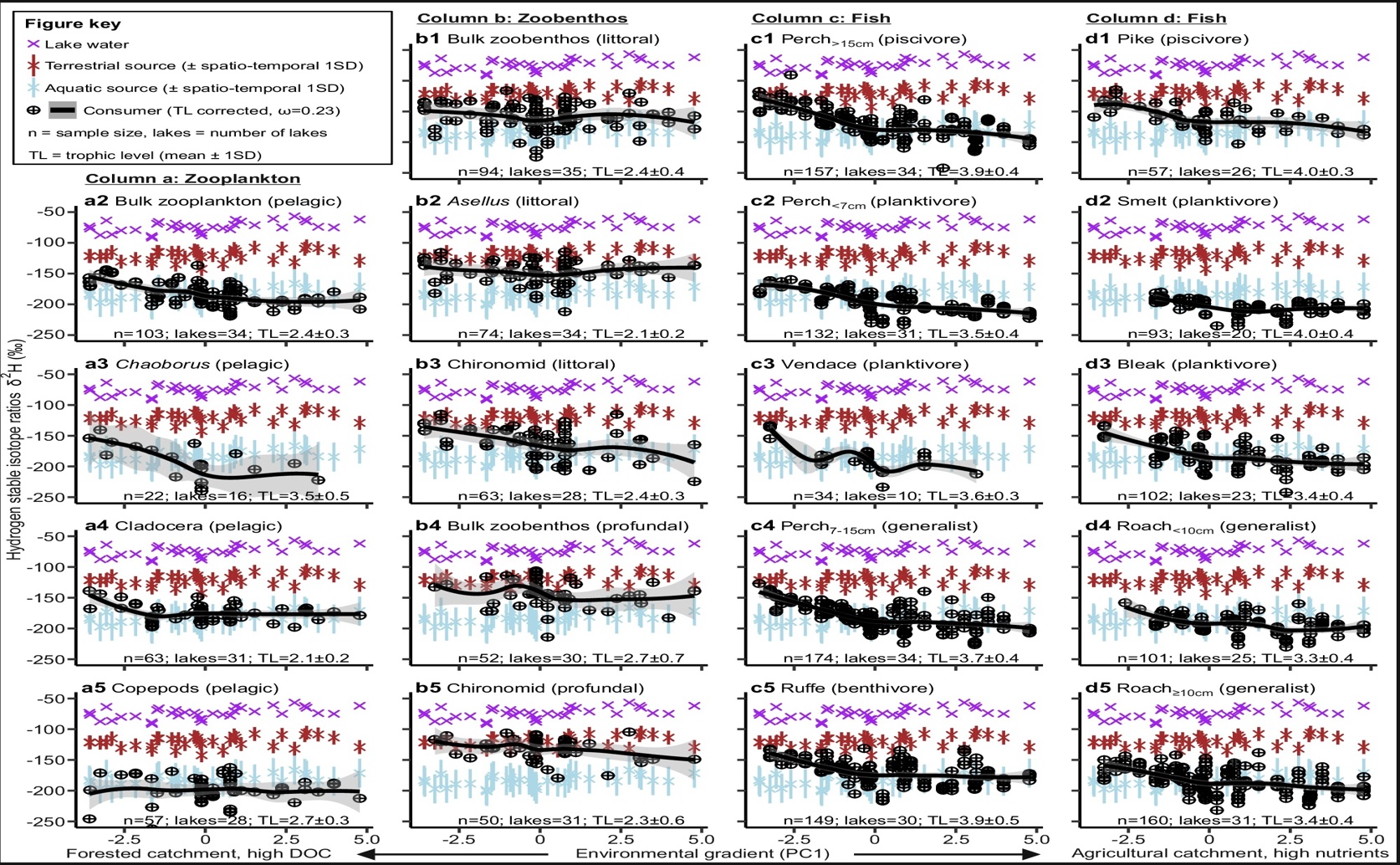
The decreasing trend in hydrogen stable isotope (δ2H) values for zooplankton (a), zoobenthos (b), and fish (c, d) across the gradient from forested to agricultural landscapes provides the key evidence that consumer reliance on terrestrial organic matter diminishes with increasing agriculture.
Key Findings
- A University of Jyväskylä study in Finland found that lake bottom species heavily depend on organic matter from surrounding forests
- This reliance decreases as nearby land shifts from forests to agricultural use
- Changes in land use impact how energy flows in lakes, affecting the health and diversity of aquatic life
References
Main Study
1) The role of land use in terrestrial support of boreal lake food webs
Published 15th April, 2025
https://doi.org/10.1038/s41467-025-58505-y
Related Studies
2) Threats and opportunities for freshwater conservation under future land use change scenarios in the United States.
3) Lakes in the era of global change: moving beyond single-lake thinking in maintaining biodiversity and ecosystem services.
4) Ecology and extent of freshwater browning - What we know and what should be studied next in the context of global change.
5) Global change-driven effects on dissolved organic matter composition: Implications for food webs of northern lakes.
Related Articles
 27th June, 2024 | Jim Crocker