Different Patterns of Plants and Insects in Various Agricultural Habitats

Jenn Hoskins
18th December, 2024

Different Patterns of Plants and Insects in Various Agricultural Habitats

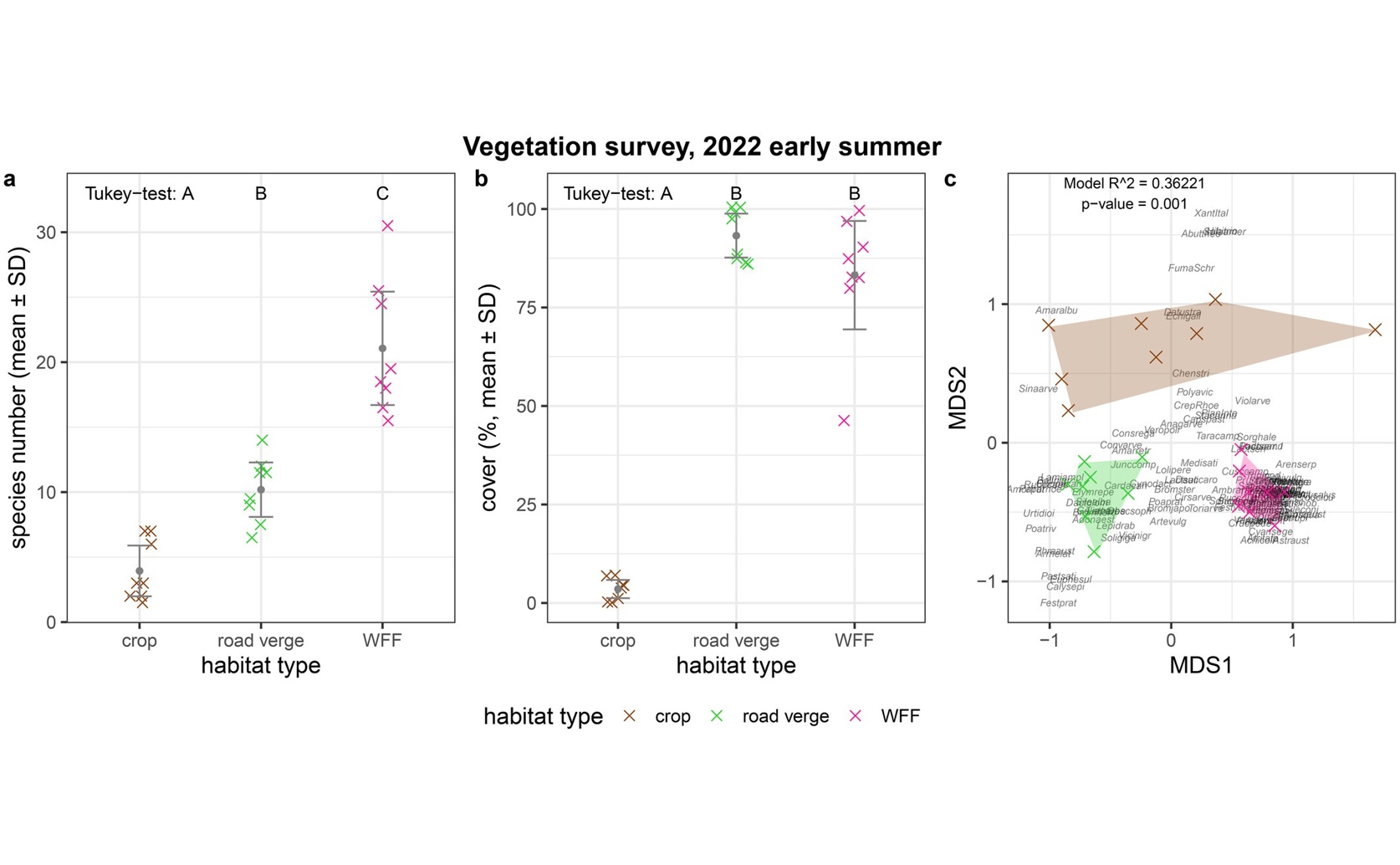
Sown wildflower fields established the most species-rich (a) and compositionally distinct (c) plant communities compared to road verges and crop fields, creating a unique foundational habitat that underpins the contrasting patterns of biodiversity observed across different functional groups in this agricultural landscape.

Image adapted from: Vajna et al. / CC BY (Source)

Key Findings

  • The study in Central Hungary compared wildflower fields, road verges, and crop fields to see how different arthropod groups respond
  • Crop fields had the fewest species and individual numbers, making them the least supportive habitat
  • Road verges had the most spiders, while wildflower fields had the highest numbers of bees and plants, showing the importance of diverse habitats for different species
The rapid decline of semi-natural grasslands poses a significant threat to biodiversity in agricultural landscapes. These grasslands play a crucial role in supporting various arthropod groups, which in turn contribute to ecosystem services such as pollination and pest control. To address this issue, a new study conducted by the Lendület Ecosystem Services Research Group in Hungary aimed to assess how different arthropod groups respond to newly established wildflower fields (WFF) compared to semi-natural road verges and adjacent crop fields in Central Europe[1]. The study focused on three main habitats: sown wildflower fields, semi-natural road verges, and conventionally managed crop fields. Researchers selected eight landscapes in Central Hungary and analyzed the species and individual numbers of primary producers (plants), pollinators (bees and hoverflies), and predators (spiders) in each habitat. They used generalized linear mixed models (GLMM) to analyze species and individual numbers and non-metric multidimensional scaling to evaluate assemblage composition for each taxon. The findings revealed distinct assemblages for each studied group across the three habitats, indicating clear separation among them. Crop fields were found to be the poorest in both species and individual numbers. In contrast, road verges harbored the highest abundance of spiders, while wildflower fields had the most bees and plants. No clear pattern emerged for hoverflies, suggesting variability in their habitat preferences. These results align with previous studies that highlight the importance of habitat diversity for supporting various functional groups. For instance, floral plantings like flower strips have been shown to enhance pest control services in adjacent fields[2]. However, the effectiveness of these plantings can vary, particularly concerning pollination services and crop yield. Similarly, the study on leafhopper communities in calcareous grassland fragments emphasized the need for well-connected and larger habitats to support specialist species[3]. This underscores the importance of connectivity and habitat size in maintaining biodiversity. The current study also builds on earlier research on hoverfly flower visitation patterns. Hoverflies, although less studied than bees, are significant pollinators and exhibit preferences influenced by flower traits such as color and morphology[4]. The variability in hoverfly patterns observed in the new study may be attributed to these species-specific preferences and their opportunistic behavior. In conclusion, the study suggests that the design of future restorations in Central European farmlands should target a diversity of habitat types to support a wide range of functional groups. This approach can help mitigate the rapid decline of semi-natural grasslands and enhance biodiversity in agricultural landscapes. By incorporating findings from previous studies, the research provides a comprehensive understanding of how different arthropod groups respond to habitat restoration efforts, offering valuable insights for future conservation strategies.

AgricultureEnvironmentEcology

References

Main Study

1) Contrasting Patterns of Plants, Bees, Hoverflies and Spiders in Different Habitats in a Central European Agricultural Landscape.

Published 17th December, 2024

https://doi.org/10.1002/ece3.70711


Related Studies

2) The effectiveness of flower strips and hedgerows on pest control, pollination services and crop yield: a quantitative synthesis.

https://doi.org/10.1111/ele.13576


3) Increasing connectivity enhances habitat specialists but simplifies plant-insect food webs.

https://doi.org/10.1007/s00442-020-04830-6


4) Flower visitation by hoverflies (Diptera: Syrphidae) in a temperate plant-pollinator network.

https://doi.org/10.7717/peerj.6025


Related Articles

An unhandled error has occurred. Reload 🗙