Engineering Cell Communication with CRISPR for Bio Computing

Jenn Hoskins
18th April, 2025

Engineering Cell Communication with CRISPR for Bio Computing

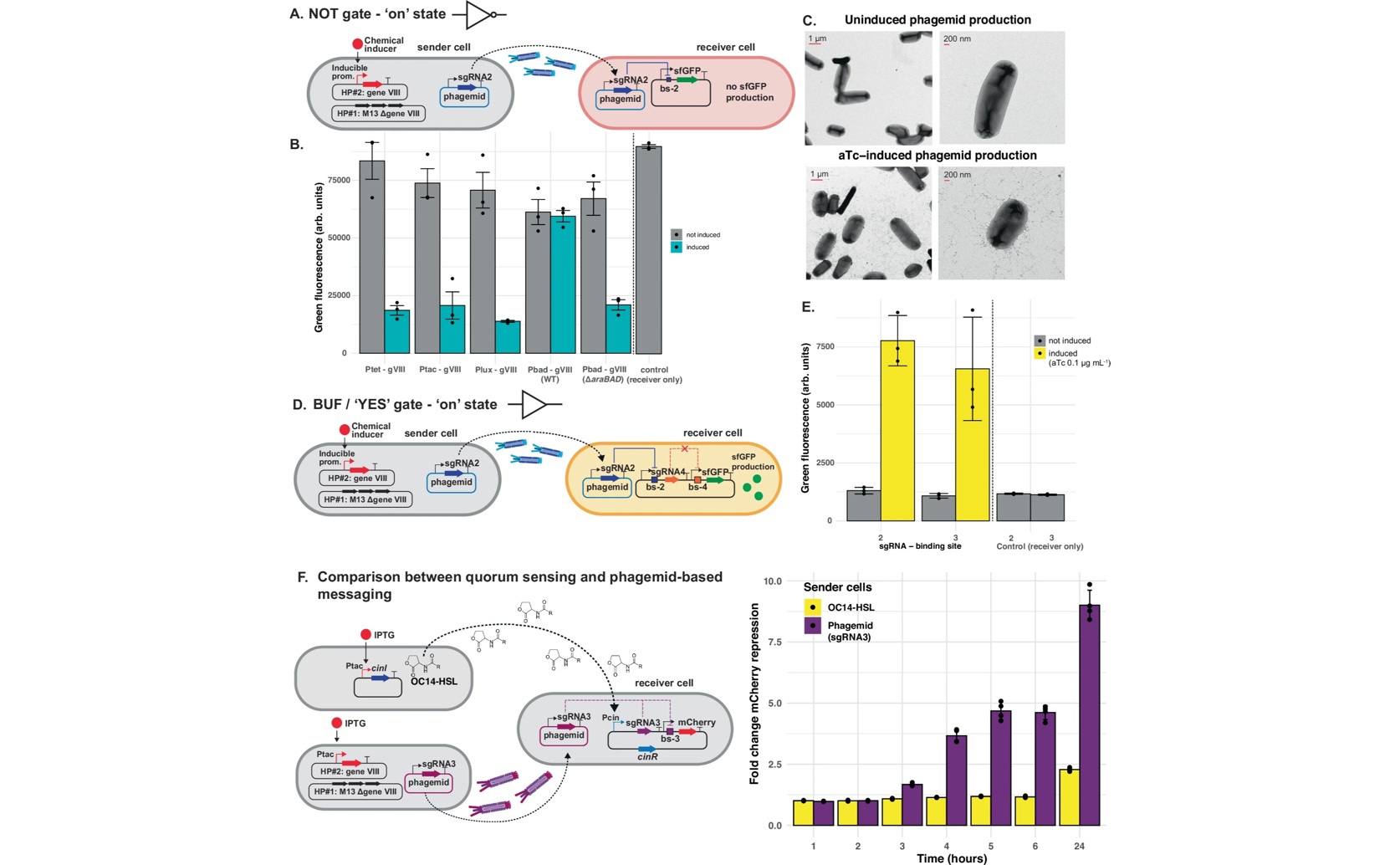
Chemical inducers successfully control M13 phagemid production and transfer between Escherichia coli cells (c), enabling the construction of inducible single-input logic gates (b, e) and demonstrating a communication system that is significantly more rapid and potent than one based on quorum sensing (f).

Image adapted from: Kusumawardhani et al. / CC BY (Source)

Key Findings

  • Researchers at the University of Lausanne developed living cell teams that communicate effectively for advanced functions
  • They engineered viruses to send specific RNA messages between cells, enabling precise control of gene activity
  • This system allows cells to perform complex computations, paving the way for innovative medical and biotechnological applications
Synthetic biology is revolutionizing medicine by enabling the creation of living cells engineered to perform specific therapeutic functions. Traditional therapies often rely on drugs that can lack precision, leading to side effects and limited effectiveness. The study conducted by researchers at the University of Lausanne[1] introduces a novel approach to enhance the capabilities of synthetic biology through multicellular consortia, where different specialized cells work together to process information and execute complex tasks. One of the significant challenges in developing synthetic microbial consortia is establishing reliable communication between different cell types. Without effective "wires" for intercellular communication, coordinating the activities of multiple cells becomes difficult, limiting the complexity of tasks these systems can perform. Previous research has laid the groundwork for this field. For instance, study[2] highlighted the potential of genetically engineered cells equipped with synthetic gene circuits to control therapeutic activities with high precision. Additionally, studies[3],[4], and[5] explored various aspects of genetic logic and memory, developing methods to implement complex logic functions within single cells and across cellular networks. The University of Lausanne’s study addresses the communication bottleneck by integrating phagemid-mediated intercellular communication with CRISPR-based gene regulation. Phagemids are a type of viral vector derived from bacteriophages, which are viruses that infect bacteria. In this context, phagemids are used to transfer single guide RNAs (sgRNAs) from sender cells to receiver cells. These sgRNAs play a crucial role in the CRISPR interference system, a powerful tool for regulating gene expression with high specificity. Once the sgRNAs are transferred to the receiver cells, they guide the CRISPR machinery to target specific genes, effectively turning them on or off. This method allows for precise control over gene expression in response to signals received from other cells within the consortium. By using this approach, the researchers were able to construct logical operations, or logic gates, which are fundamental building blocks for computing systems. Specifically, they developed one-, two-, and four-input logic gates, enabling the consortium to perform complex information processing tasks. This advancement builds upon previous studies in several ways. Study[2] demonstrated the potential of synthetic gene circuits in controlling therapeutic activities, while studies[3] and[4] provided methods for implementing logical functions and memory within cells. The current study extends these concepts by enabling communication between multiple cells, allowing for distributed information processing across a consortium rather than being confined to a single cell. Furthermore, study[5] explored the layering of orthogonal logic gates to create more extensive genetic programs. The integration of phagemid-mediated communication with CRISPR-based regulation in the University of Lausanne’s research enhances the scalability and complexity of synthetic biological systems. The researchers employed M13 phagemids to encode and transfer sgRNAs between cells. This method ensures high sensitivity in communication, as the transfer of sgRNAs can be tightly regulated and precisely targeted. In the receiver cells, the CRISPR interference system uses these sgRNAs to modulate the expression of specific genes, allowing the cells to respond appropriately to the signals received. This setup enables the construction of logic gates that can perform operations based on multiple inputs, much like electronic circuits in computers. By successfully constructing one-, two-, and four-input logic gates, the study demonstrates the feasibility of creating complex biocomputing systems within synthetic microbial consortia. These logic gates can be combined to form intricate networks capable of sophisticated information processing, making them suitable for various applications. For example, in biocomputing, such systems could perform computations based on biological signals. In biosensing, engineered consortia could detect and respond to environmental changes with high specificity. In biomanufacturing, these systems could regulate metabolic pathways to produce valuable compounds efficiently. The integration of phagemid-mediated communication with CRISPR-based gene regulation represents a significant step forward in synthetic biology. It not only overcomes the challenge of establishing reliable intercellular communication but also leverages the precision and versatility of CRISPR technology to control gene expression dynamically. This approach opens up new possibilities for designing sophisticated biological systems that can perform complex tasks in a controlled and predictable manner. Moreover, the study’s methodology aligns with the advancements outlined in previous research. The use of synthetic gene circuits for precise therapeutic control[2], the implementation of Boolean logic functions within cells[3], the development of genetic logic gates for transcriptional control[4], and the layering of orthogonal logic gates to build larger circuits[5] all contribute to the foundation upon which this new study builds. By combining these elements, the University of Lausanne researchers have created a robust framework for developing multicellular consortia capable of advanced information processing. In conclusion, the study from the University of Lausanne advances the field of synthetic biology by enabling complex information processing in multicellular consortia through innovative intercellular communication and gene regulation techniques. This breakthrough paves the way for the development of more sophisticated biocomputing systems, enhancing the potential applications of synthetic biology in medicine, environmental monitoring, and industrial biotechnology. As researchers continue to build on these findings, the integration of diverse synthetic gene circuits and communication mechanisms will likely lead to even more powerful and versatile biological systems.

BiotechGenetics

References

Main Study

1) Engineering intercellular communication using M13 phagemid and CRISPR-based gene regulation for multicellular computing in Escherichia coli

Published 15th April, 2025

https://doi.org/10.1038/s41467-025-58760-z


Related Studies

2) Engineering living therapeutics with synthetic biology.

https://doi.org/10.1038/s41573-021-00285-3


3) Synthetic circuits integrating logic and memory in living cells.

https://doi.org/10.1038/nbt.2510


4) Amplifying genetic logic gates.

https://doi.org/10.1126/science.1232758


5) Genetic programs constructed from layered logic gates in single cells.

https://doi.org/10.1038/nature11516


Related Articles

An unhandled error has occurred. Reload 🗙