Protein Study Shows ATG1 Helps Plants Survive Drought

Greg Howard
24th February, 2025

Protein Study Shows ATG1 Helps Plants Survive Drought

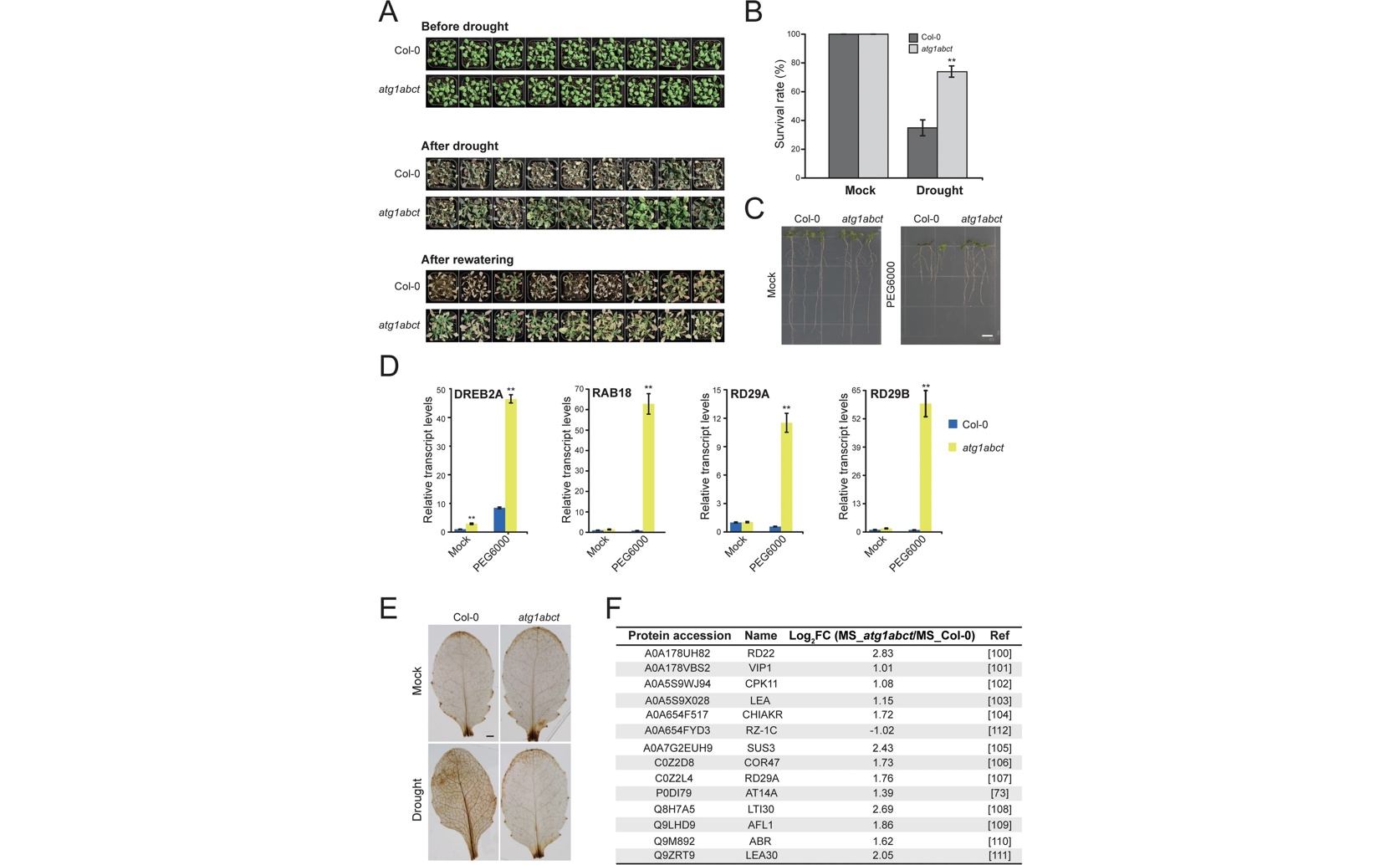
Consistent with the study's proteomic identification of drought-related proteins (f), the atg1abct mutant of Arabidopsis thaliana displayed enhanced drought tolerance compared to wild-type controls, as evidenced by improved survival rates (a, b) and growth under stress (c), the upregulation of key drought-responsive genes (d), and reduced reactive oxygen species accumulation (e).

Image adapted from: Cheng et al. / CC BY (Source)

Key Findings

  • Researchers at the Chinese Academy of Sciences studied the ATG1 protein in the plant Arabidopsis thaliana
  • They discovered that ATG1 is involved in important cell metabolism processes and helps plants manage stress
  • Plants lacking ATG1 showed greater resistance to drought and had lower levels of damaging molecules
Autophagy, a fundamental cellular process, plays a crucial role in maintaining cellular health by degrading and recycling damaged or unnecessary components. This pathway is highly conserved across eukaryotic organisms, including plants, where it not only ensures cellular homeostasis under normal conditions but also aids in responding to various stresses[2]. Autophagy-related (ATG) proteins are central to this process, orchestrating the formation of autophagic vesicles and regulating complex survival mechanisms, especially when plants encounter adverse environments[2][3]. A recent study conducted by researchers at the Chinese Academy of Sciences[1] has shed new light on the role of one such ATG protein, ATG1, in the autophagy pathway of the model plant Arabidopsis thaliana. Traditionally, ATG1 has been recognized as a key initiator of autophagy, acting as a gatekeeper that stimulates the formation of autophagic structures essential for the degradation process. However, the study aimed to explore whether ATG1 has additional functions beyond its established role in classical autophagy. To investigate this, the research team performed a comprehensive proteomics analysis comparing the wild-type Col-0 Arabidopsis plants with mutants lacking functional ATG1 (referred to as atg1abct mutants). Proteomics, the large-scale study of proteins, allowed the researchers to identify and quantify changes in protein expression and modifications associated with the absence of ATG1. The analysis revealed that ATG1 is involved in previously unrecognized metabolic pathways, specifically in inositol trisphosphate and fatty acid metabolism. These findings suggest that ATG1 has broader metabolic roles that extend beyond its traditional function in autophagy. Furthermore, the study uncovered a connection between ATG1-dependent autophagy and endoplasmic reticulum (ER) homeostasis, as well as abscisic acid (ABA) biosynthesis. The ER is vital for protein folding and lipid synthesis, and its homeostasis is essential for overall cellular function. ABA is a plant hormone that plays a significant role in stress responses, particularly in response to drought. The enrichment of Gene Ontology terms related to abiotic and biotic stress in the differentially abundant proteins supports the notion that autophagy, mediated by ATG1, is integral to how plants manage and survive under stressful conditions[2]. In addition to the molecular insights, physiological and biochemical analyses demonstrated that the atg1abct mutants exhibited enhanced drought resistance compared to the wild-type plants. Under both polyethylene glycol (PEG)-simulated drought conditions and natural drought stress, the mutants showed a greater ability to withstand water scarcity. This increased resistance was associated with lower accumulation of reactive oxygen species (ROS), as evidenced by DAB staining results. ROS are harmful byproducts of cellular metabolism that can cause significant damage under stress conditions, and their reduced levels in the mutants indicate a more efficient stress management system[4]. The study's findings build upon previous research that has highlighted the importance of autophagy in nutrient recycling and stress adaptation in plants[3][4]. While earlier studies primarily focused on the role of autophagy in maintaining cellular homeostasis and responding to abiotic stresses like drought, this new research expands our understanding by identifying specific metabolic pathways and additional functions of ATG1. It also aligns with efforts to manipulate the autophagic pathway to develop climate-smart crops with improved yield and stress tolerance[5]. By elucidating the multifaceted roles of ATG1 in both autophagy and broader metabolic processes, the study offers novel perspectives on how plants regulate their growth and respond to environmental challenges. This deeper understanding of autophagy's regulatory mechanisms opens up potential avenues for genetic and biotechnological interventions aimed at enhancing crop resilience. Future research can build on these insights to explore the detailed interactions between ATG1, metabolic pathways, and stress response mechanisms, ultimately contributing to more sustainable agricultural practices[5]. In summary, the research conducted by the Chinese Academy of Sciences not only reinforces the critical role of autophagy in plant health and stress response but also uncovers new dimensions of ATG1's functionality. By integrating proteomic data with physiological analyses, the study provides a comprehensive view of how autophagy-related proteins like ATG1 contribute to plant resilience, paving the way for advancements in crop improvement and agricultural sustainability.

EnvironmentBiochemPlant Science

References

Main Study

1) Proteomics revealed novel functions and drought tolerance of Arabidopsis thaliana protein kinase ATG1

Published 21st February, 2025

https://doi.org/10.1186/s12915-025-02149-3


Related Studies

2) An Overview of the Molecular Mechanisms and Functions of Autophagic Pathways in Plants.

https://doi.org/10.1080/15592324.2021.1977527


3) Autophagy-Mediated Regulation of Different Meristems in Plants.

https://doi.org/10.3390/ijms23116236


4) Silencing Autophagy-Related Gene 2 (ATG2) Results in Accelerated Senescence and Enhanced Immunity in Soybean.

https://doi.org/10.3390/ijms222111749


5) Autophagy: a game changer for plant development and crop improvement.

https://doi.org/10.1007/s00425-022-04004-z


Related Articles

An unhandled error has occurred. Reload 🗙