New Fungus Helps Plants Grow Better and Resist Stress

Jenn Hoskins
10th December, 2024

New Fungus Helps Plants Grow Better and Resist Stress

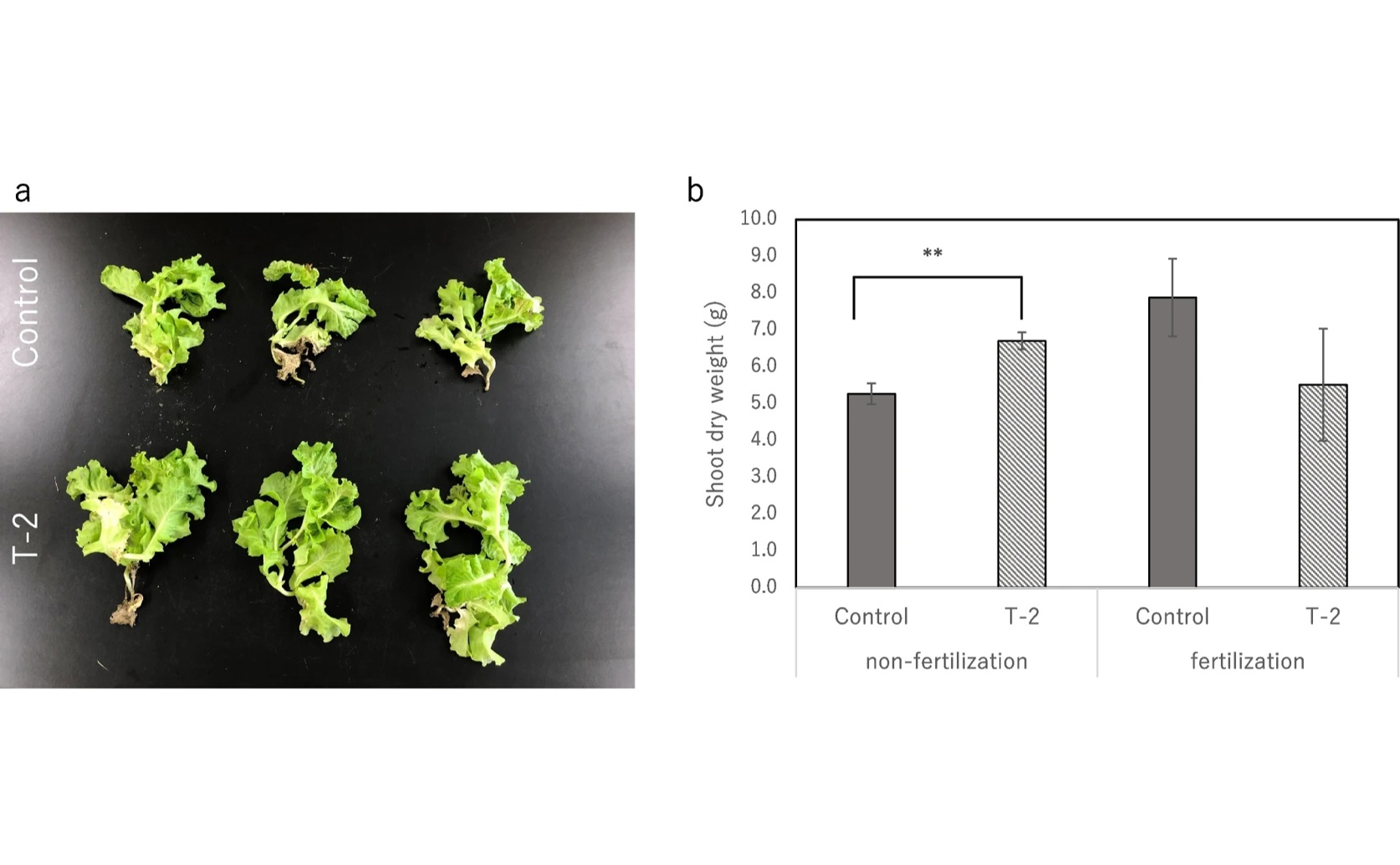
Demonstrating its effectiveness as a growth-promoter in a practical agricultural setting, lettuce inoculated with the endophytic fungus Leptosphaeria sp. strain T-2 showed significantly greater total dry weight under field conditions compared to untreated plants.

Image adapted from: Yamaguchi et al. / CC BY (Source)

Key Findings

  • Researchers at the University of Yamanashi discovered a fungus, Leptosphaeria sp. strain T-2, that helps plants grow better under drought and salinity stress
  • This fungus, isolated from barley roots, significantly improved the survival and health of lettuce plants in stressful conditions
  • The study suggests using this fungus as a natural and cost-effective biofertilizer to boost crop resilience in dryland agriculture
Drought and salinity stress are significant challenges to agricultural production, particularly in dryland regions. Traditional solutions, such as breeding and genetic modification, are often expensive and come with inherent risks. The potential use of endophytic fungi in enhancing plant stress tolerance is emerging as a promising alternative. A recent study conducted by researchers at the University of Yamanashi explored this approach by isolating and characterizing endophytic fungi with growth-promoting effects[1]. In this study, researchers isolated 77 growth-promoting endophytic fungi from barley roots, belonging to 20 different genera. Among these, strain T-2 demonstrated remarkable effects on plant growth parameters. Phylogenetic analysis identified strain T-2 as belonging to the genus Leptosphaeria. Interestingly, members of this genus are typically known as plant pathogens, making strain T-2 a novel discovery as an endophytic fungus that promotes plant growth. The study found that strain T-2 significantly alleviated the growth inhibition caused by drought and salinity stress, as evidenced by the survival and maintained health of lettuce plants inoculated with this strain. The findings of this study are in line with previous research on the beneficial roles of endophytic fungi in agriculture. For example, the mycorrhiza-like endophytic fungus Piriformospora indica has been shown to enhance plant growth, nutrient acquisition, and stress tolerance by manipulating plant hormone-signaling pathways[2]. Similarly, Trichoderma spp. are known for their ability to colonize plant roots, enhance root growth and development, and improve resistance to various stresses[3]. These fungi produce compounds that induce systemic resistance responses, protecting plants from pathogens and abiotic stressors. The study conducted by the University of Yamanashi adds to this body of knowledge by identifying a novel endophytic fungus, Leptosphaeria sp. strain T-2, that can be used as a biofertilizer to improve agricultural production in drylands. The researchers used phylogenetic analysis to characterize the strain and conducted experiments to evaluate its effects on plant growth under drought and salinity stress conditions. The results showed that plants inoculated with strain T-2 not only survived but also maintained their health, suggesting that this fungus can significantly enhance plant stress tolerance. This study highlights the potential of endophytic fungi as a sustainable and cost-effective solution to improve crop resilience in challenging environments. The ability of strain T-2 to promote plant growth and mitigate stress effects could be particularly beneficial for dryland agriculture, where traditional methods may fall short. Moreover, the use of endophytic fungi aligns with the principles of sustainable agriculture by reducing the need for chemical fertilizers and pesticides. In conclusion, the research conducted by the University of Yamanashi demonstrates the potential of Leptosphaeria sp. strain T-2 as a biofertilizer to enhance plant growth and stress tolerance in dryland agriculture. This study, along with previous findings on other beneficial fungi such as P. indica and Trichoderma spp., underscores the importance of exploring endophytic fungi as a natural and sustainable approach to improving agricultural productivity and resilience.

EnvironmentBiochemPlant Science

References

Main Study

1) Novel endophytic fungus Leptosphaeria sp. strain T-2 improves plant growth and environmental stress tolerance.

Published 9th December, 2024

https://doi.org/10.1007/s44154-024-00186-6


Related Studies

2) Piriformospora indica: Potential and Significance in Plant Stress Tolerance.

https://doi.org/10.3389/fmicb.2016.00332


3) Trichoderma species--opportunistic, avirulent plant symbionts.

Journal: Nature reviews. Microbiology, Issue: Vol 2, Issue 1, Jan 2004


Related Articles

An unhandled error has occurred. Reload 🗙