Using Smart Technology to Estimate Water Needs for Crops Across Different Fields

Jim Crocker
6th February, 2025

Using Smart Technology to Estimate Water Needs for Crops Across Different Fields

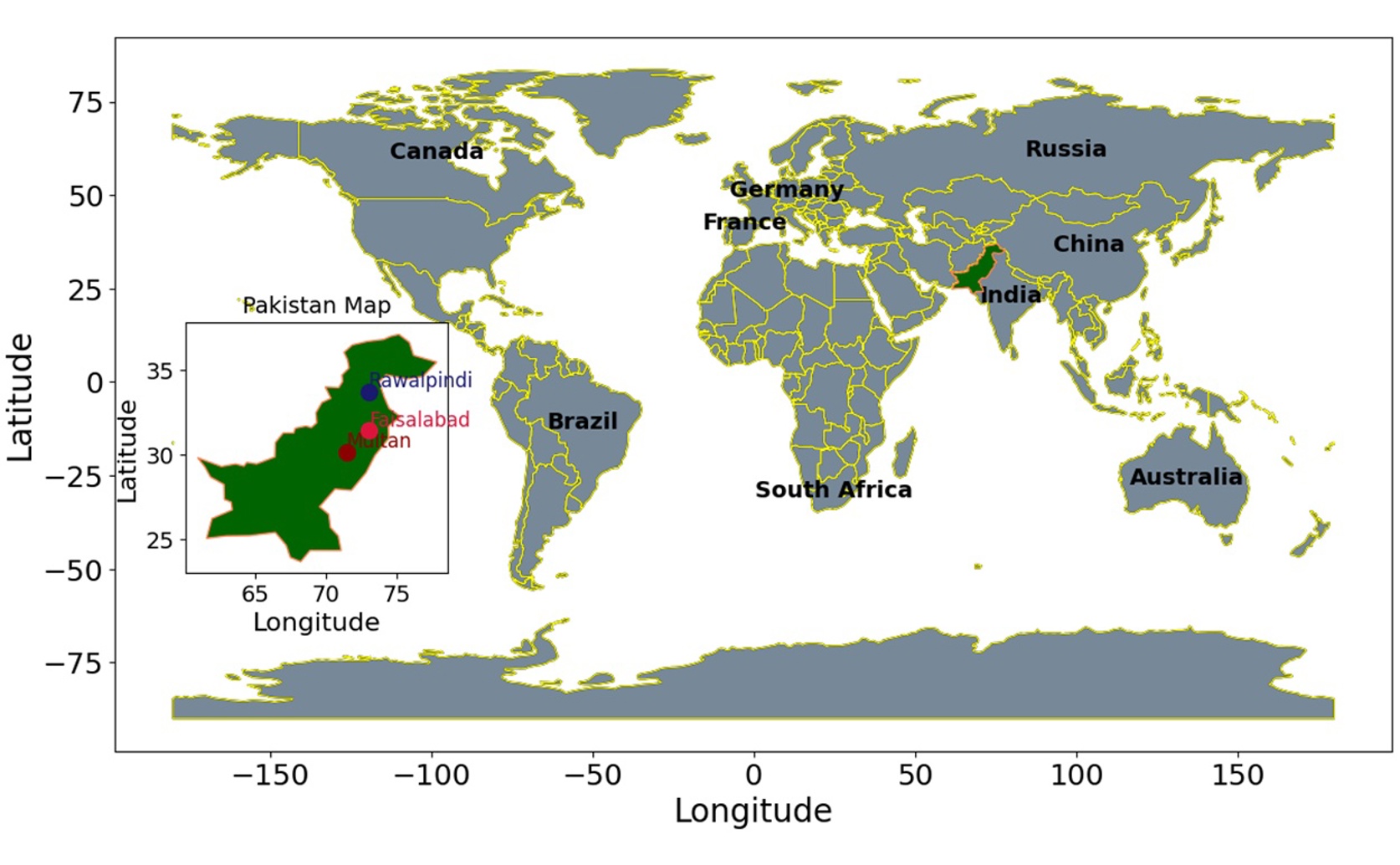
Geographical locations of the experiment cities from study.

Image adapted from: Tausif et al. / CC BY (Source)

Key Findings

  • Researchers in Pakistan developed a federated learning model to estimate water loss (ETo) across diverse climates using weather data from 2012-2022
  • The federated approach improved ETo accuracy by training models locally and combining results, addressing privacy and data transfer issues
  • The Random Forest Regressor outperformed other models, achieving high accuracy, with temperature and wind speed identified as key factors in ETo predictions
Accurate estimation of Reference Evapotranspiration (ETo) is critical for effective water resource management and sustainable agriculture. ETo represents the amount of water lost through evaporation and plant transpiration, and its precise calculation helps optimize water usage in agriculture, especially in regions with limited water resources. Traditional methods for ETo estimation, such as the Penman-Monteith equation, require extensive meteorological data, which may not be available in many regions. Additionally, most machine learning-based approaches for ETo estimation are limited to specific areas, making it difficult to generalize their application across diverse climatic zones. A recent study by researchers at The Superior University proposes a federated learning approach to address these challenges and improve ETo estimation across multiple locations with distinct weather conditions[1]. The study focuses on designing an ETo estimation model that leverages federated learning, a decentralized machine learning approach. Unlike traditional centralized methods that aggregate all data in one location, federated learning trains models locally at different sites and combines the knowledge to create a global model. This approach resolves privacy concerns and data transfer limitations while providing more generalized ETo predictions across diverse regions. The researchers implemented their model using weather data from 2012 to 2022 from three geographically distinct locations in Pakistan, each with unique weather conditions. The study evaluates three machine learning models—Random Forest Regressor (RFR), Support Vector Regressor (SVR), and Decision Tree Regressor (DTR)—for both local ETo estimation and the federated global model. The evaluation revealed that the federated learning approach significantly enhances the accuracy of ETo estimation. Among the tested models, the Random Forest Regressor (RFR) outperformed the others, achieving a coefficient of determination (R²) of 0.97, a Root Mean Squared Error (RMSE) of 0.44, a Mean Absolute Error (MAE) of 0.33 mm/day, and a Mean Absolute Percentage Error (MAPE) of 8.18%. These results demonstrate the robustness of the federated learning approach in providing accurate and generalized ETo estimates across diverse weather conditions. Additionally, the feature importance analysis identified maximum temperature and wind speed as the most influential factors in ETo predictions, consistent with findings from prior studies[2][3]. Previous research has highlighted the potential of machine learning models for ETo estimation. For instance, a study investigating the predictive power of multi-gene genetic programming (MGGP), M5 model trees (M5Tree), and K-nearest neighbor (KNN) algorithms found that MGGP performed best for long-term monthly ETo prediction in Turkey, with solar radiation being the most significant input variable[2]. Another study explored the use of ensemble learning approaches, such as bagged and boosted Long Short-Term Memory (LSTM) models, for ETo forecasting in Saudi Arabia. The bagged LSTM model demonstrated high accuracy with limited meteorological data, emphasizing the importance of efficient machine learning techniques for ETo estimation[3]. While both studies focused on specific regions, the federated learning approach proposed in the current study expands the applicability of ETo estimation models to multiple locations with diverse climatic conditions. The use of federated learning also addresses a critical limitation identified in earlier studies. For example, the reliance on centralized data aggregation in models using remote sensing data, such as the MOD16 product, can pose challenges in regions with insufficient weather stations[4]. Although the MOD16 product has shown promise for ETo estimation, the decentralized nature of federated learning eliminates the need for centralized data collection, making it a more scalable and privacy-preserving solution. The findings of this study have significant implications for water resource management and agricultural planning. By enabling accurate ETo estimation across diverse regions, the federated learning approach provides a practical solution for optimizing water usage in agriculture, particularly in water-scarce areas. The superior performance of the Random Forest Regressor in the federated model further underscores the potential of ensemble machine learning methods for tackling complex environmental challenges. In conclusion, the study by The Superior University demonstrates the effectiveness of federated learning in improving ETo estimation across multiple locations with distinct weather conditions. By addressing the limitations of traditional centralized approaches and leveraging the strengths of machine learning, this research paves the way for more accurate and scalable solutions in water resource management and sustainable agriculture.

AgricultureSustainabilityBiotech

References

Main Study

1) Federated learning based reference evapotranspiration estimation for distributed crop fields.

Published 5th February, 2025

https://doi.org/10.1371/journal.pone.0314921


Related Studies

2) Modeling monthly reference evapotranspiration process in Turkey: application of machine learning methods.

https://doi.org/10.1007/s10661-022-10662-z


3) IoT and Ensemble Long-Short-Term-Memory-Based Evapotranspiration Forecasting for Riyadh.

https://doi.org/10.3390/s23177583


4) Reference evapotranspiration of Brazil modeled with machine learning techniques and remote sensing.

https://doi.org/10.1371/journal.pone.0245834


Related Articles

An unhandled error has occurred. Reload 🗙