How Environment and Organisms Influence Ecological Relationships

Greg Howard
1st January, 2025

How Environment and Organisms Influence Ecological Relationships

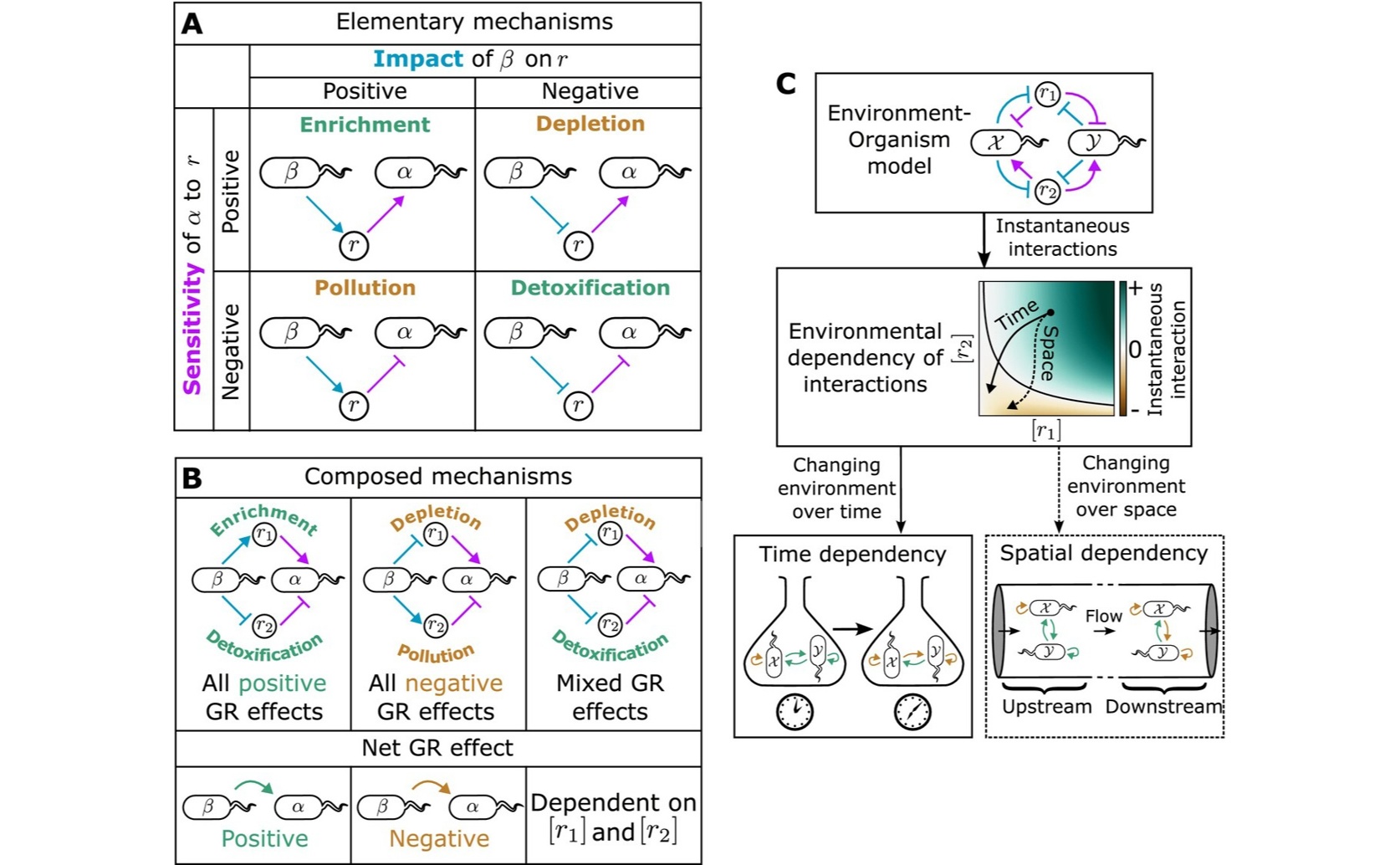
The proposed theoretical framework illustrates that environmentally mediated interactions are composed of elementary mechanisms (a), leading to a net effect that is dependent on the environmental context (b), thereby explaining how organism-driven changes to the environment create predictable variations in these interactions over time and space (c).

Image adapted from: Meacock et al. / CC BY (Source)

Key Findings

  • Researchers at the University of Lausanne found that organisms themselves can change their environment, affecting ecological interactions
  • They introduced a new framework called 'instantaneous interaction' to predict how these changes impact interactions over time and space
  • Using microbial communities, they showed how this framework can predict changes in interactions, such as toxin degradation and nutrient exchange
Ecological interactions are crucial for understanding how communities of organisms are structured and function. These interactions, which include competition, mutualism, and predation, are known to change based on environmental contexts. Traditionally, it has been assumed that these changes are driven by external environmental factors. However, a recent study by researchers at the University of Lausanne, Switzerland, offers a new perspective by suggesting that intrinsic environmental changes caused by the organisms themselves can also significantly alter these interactions[1]. The new study introduces a theoretical framework centered on the concept of 'instantaneous interaction.' This concept captures the feedback loop between the current state of the environment and the growth of organisms, creating context-dependencies that change over time and space as organisms modify their environment. This approach shifts the focus from external to intrinsic factors, providing a new way to predict variations in ecological interactions. To illustrate their framework, the researchers used small microbial communities. They demonstrated how the framework could predict time-dependencies in a system where microbes degrade toxins. Additionally, they showed how time- and spatial-dependencies could be related in communities where microbes exchange nutrients, a process known as crossfeeding. These examples highlight the dynamic nature of interactions as organisms continuously alter their surroundings. This study builds on previous research that has explored the variability and context-dependency of species interactions. For instance, a meta-analysis of 247 published articles found that the outcomes of interactions such as competition, mutualism, and predation can vary significantly depending on spatial and abiotic factors[2]. However, the new study by the University of Lausanne adds a layer of complexity by considering how the organisms themselves drive these changes over time. Further supporting this idea, earlier research on microbial communities has shown that the coexistence of multiple species can be an emergent phenomenon that does not necessarily depend on pairwise interactions[3]. This suggests that the community context, including the intrinsic changes organisms make to their environment, plays a crucial role in maintaining biodiversity. Additionally, studies on microbial interactions have demonstrated that the spatial scale of these interactions is fundamental in shaping community dynamics and functions[4]. The new framework aligns with these findings by emphasizing the importance of intrinsic, organism-driven environmental changes. In summary, the study from the University of Lausanne provides a novel theoretical framework for understanding ecological interactions. By focusing on the intrinsic changes organisms make to their environment, it offers a new way to predict how these interactions will vary over time and space. This approach not only enhances our understanding of community dynamics but also ties together previous findings on the context-dependency and emergent properties of ecological interactions.

EnvironmentSustainabilityEcology

References

Main Study

1) Environment-Organism Feedbacks Drive Changes in Ecological Interactions.

Published 31st December, 2024

https://doi.org/10.1111/ele.70027


Related Studies

2) How context dependent are species interactions?

https://doi.org/10.1111/ele.12279


3) Emergent coexistence in multispecies microbial communities.

https://doi.org/10.1126/science.adg0727


4) Short-range interactions govern the dynamics and functions of microbial communities.

https://doi.org/10.1038/s41559-019-1080-2


Related Articles

An unhandled error has occurred. Reload 🗙