How Wastewater Treatment Affects Coastal Pollution from Harmful Chemicals

Greg Howard
19th November, 2024

How Wastewater Treatment Affects Coastal Pollution from Harmful Chemicals

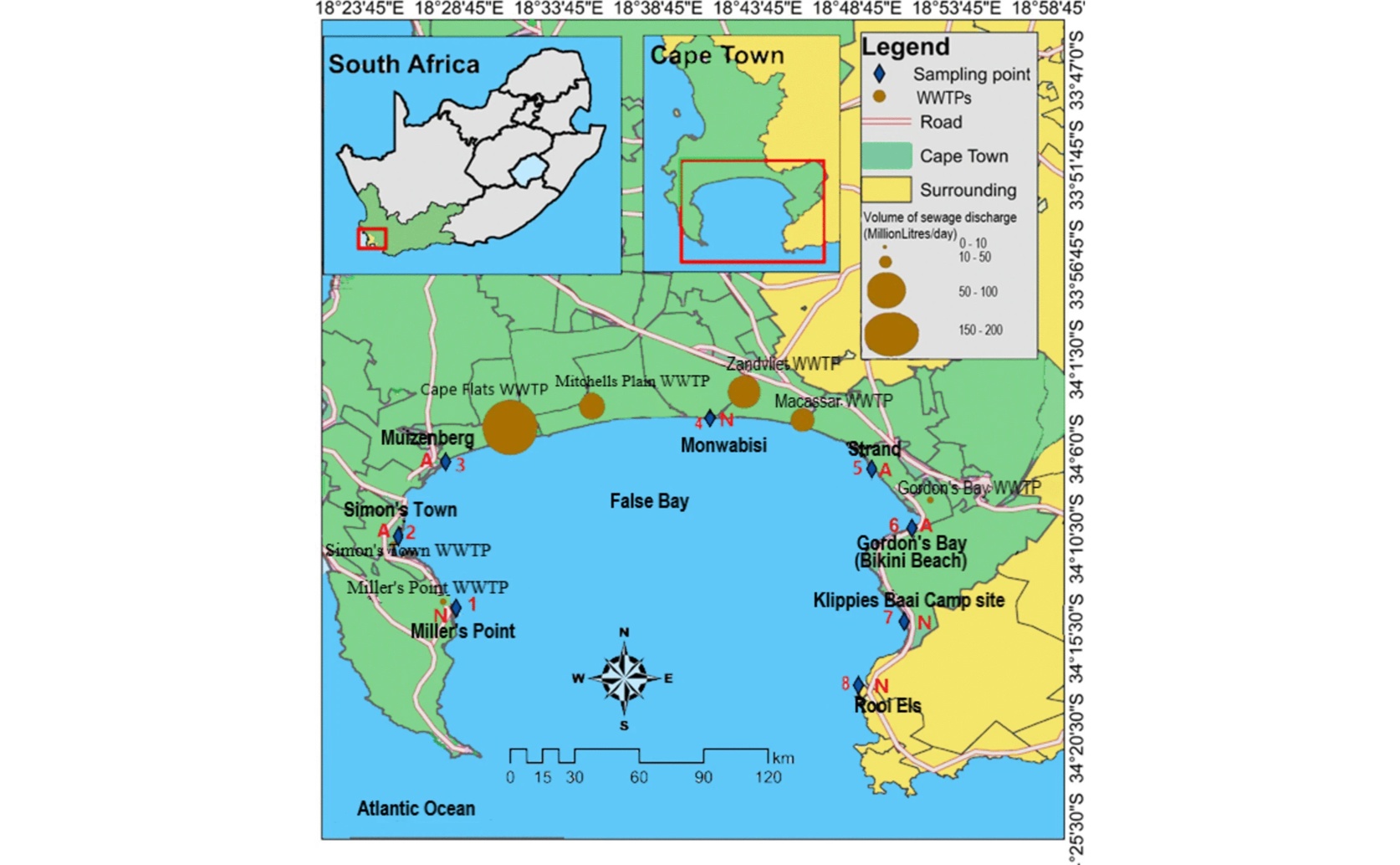
Location of sampling sites and WWTPs in False Bay

Image adapted from: Ojemaye et al. / CC BY (Source)

Key Findings

  • The study by the University of the Western Cape measured PFAS levels in wastewater, seawater, sediment, and marine organisms in False Bay, Cape Town
  • High levels of PFASs were found in all environmental samples, with perfluorononanoic acid (PFNA) being the most dominant
  • Current wastewater treatment processes are insufficient to fully remove PFASs, highlighting the need for improved treatment technologies
Per- and polyfluoroalkyl substances (PFASs), originating from both industrial processes and consumer products, are a growing concern due to their persistence in the environment and potential impacts on aquatic ecosystems. A recent study conducted by the University of the Western Cape aimed to quantify the emissions of PFAS from a municipal wastewater treatment plant (WWTP) into False Bay, on the Indian Ocean coast of Cape Town, South Africa[1]. This study is particularly significant as it provides insights into the prevalence and distribution of PFAS in various environmental matrices, including seawater, sediment, and marine organisms. PFASs are a group of man-made chemicals that have been used in a variety of industries since the 1940s. They are resistant to water, oil, and heat, making them useful in many applications but also leading to their persistence in the environment. Previous studies have highlighted the ubiquitous presence of PFASs in the aquatic environment, raising concerns about their potential adverse effects on flora and fauna[2]. The continuous emission of PFASs from point and nonpoint sources, such as sewage treatment plants and atmospheric deposition, further exacerbates the issue[2]. In the study conducted by the University of the Western Cape, the researchers measured the levels of five PFASs in both influent and effluent sewage water samples from a municipal WWTP. Additionally, they analyzed seawater, sediment, and biota samples from eight sites along the False Bay coast. The results showed a high prevalence of PFASs in all the environmental matrices studied. Perfluorononanoic acid (PFNA) was found to be the most dominant PFAS, with maximum concentrations in wastewater (10.50 ng/L), seawater (18.76 ng/L), marine sediment (239.65 ng/g dry weight), invertebrates (0.72-2.45 µg/g dry weight), and seaweed (0.36-2.01 µg/g dry weight). The study utilized the chemical fingerprint of the five PFASs detected in WWTP effluents to track their dispersion across the marine environment. This approach allowed the researchers to examine how each chemical accumulated in different marine organisms, providing a comprehensive understanding of the environmental fate of PFASs. The findings revealed that primary and secondary wastewater treatment processes are not sufficient to fully remove these compounds, underscoring the need for improved effluent quality before its release into the environment. Earlier studies have also emphasized the challenges associated with PFAS removal during wastewater treatment. For instance, research has shown that concentrations of most perfluorinated compounds (PFCs) are higher in effluents than in influents, indicating their formation during wastewater treatment processes[3]. Additionally, the shift in industry towards short-chain PFAS alternatives, due to recent regulations and restrictions on long-chain PFAS, has resulted in the increased detection of short-chain PFAS in various aqueous environments[4]. However, our understanding of the environmental fate and remediation of these short-chain PFAS remains limited[4]. The study by the University of the Western Cape contributes to this body of knowledge by highlighting the need for continuous monitoring of PFAS sources, their potential transformation products, and their ecological risks, particularly in areas receiving effluents from WWTPs. The researchers advocate for improved wastewater treatment technologies to enhance the removal of PFASs and mitigate their impact on marine ecosystems. In conclusion, PFASs pose a significant environmental challenge due to their persistence and potential adverse effects on aquatic ecosystems. The study conducted by the University of the Western Cape underscores the importance of monitoring PFAS emissions from WWTPs and improving wastewater treatment processes to protect marine environments. This research builds on previous findings and emphasizes the need for ongoing efforts to address the environmental and ecological risks associated with PFASs.

EnvironmentSustainabilityMarine Biology

References

Main Study

1) The efficacy of wastewater treatment plant on removal of perfluoroalkyl substances and their impacts on the coastal environment of False Bay, South Africa.

Published 18th November, 2024

https://doi.org/10.1007/s11356-024-35509-7


Related Studies

2) Fate and effects of poly- and perfluoroalkyl substances in the aquatic environment: a review.

https://doi.org/10.1002/etc.2663


3) Occurrence of different classes of perfluorinated compounds in Greek wastewater treatment plants and determination of their solid-water distribution coefficients.

https://doi.org/10.1016/j.jhazmat.2012.02.015


4) The overlooked short- and ultrashort-chain poly- and perfluorinated substances: A review.

https://doi.org/10.1016/j.chemosphere.2018.12.186


Related Articles

An unhandled error has occurred. Reload 🗙