Eco-Friendly Mushroom Farming and Biocomposites Using Brewery and Farm Waste

Jim Crocker
3rd November, 2024

Eco-Friendly Mushroom Farming and Biocomposites Using Brewery and Farm Waste

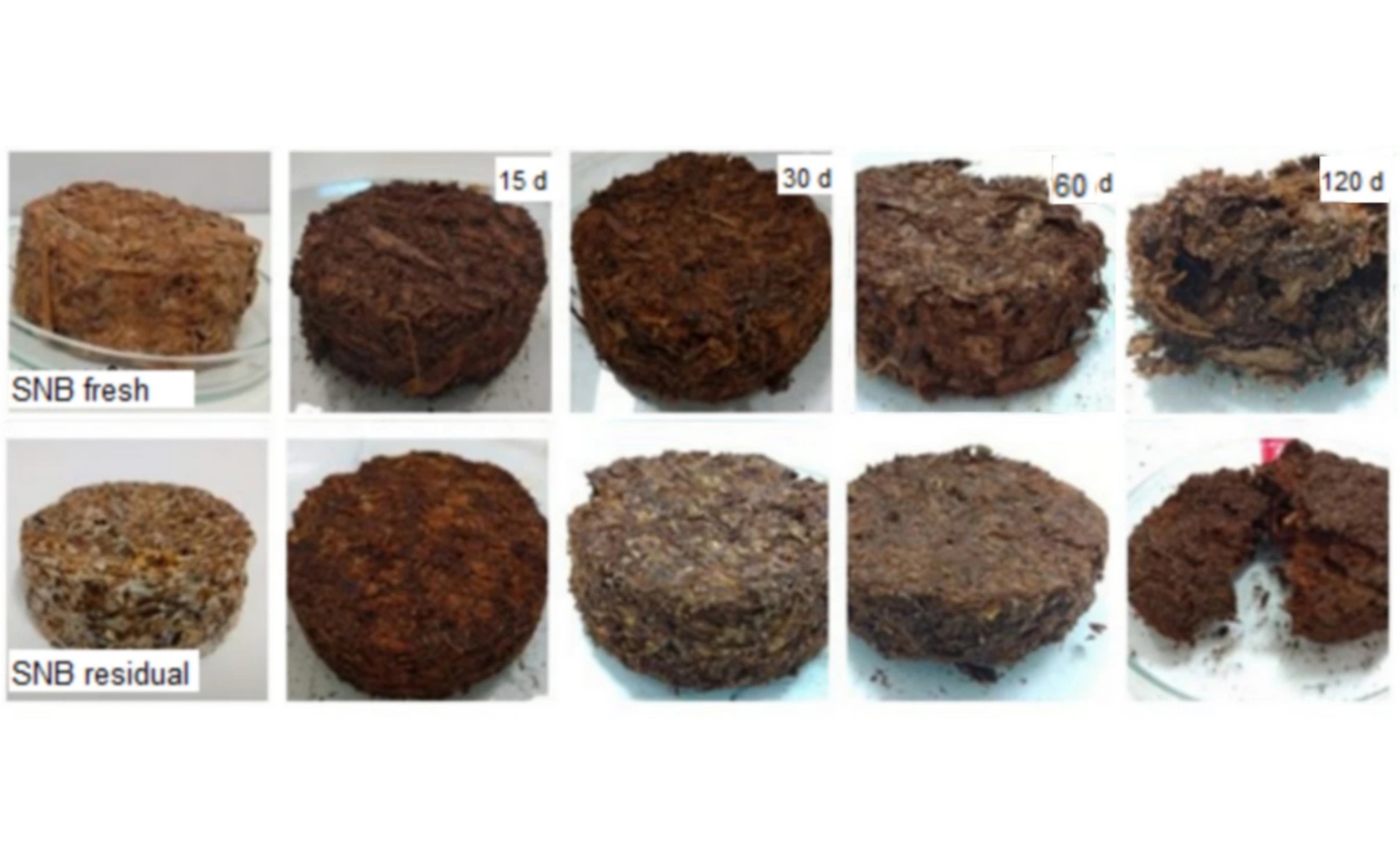
In a 120-day soil burial test, the mycelium composite made from fresh brewer's spent grain and banana leaves (top row) biodegraded more completely than the denser, more durable composite made from the same substrate after it was used for mushroom harvesting (bottom row).

Image adapted from: Deschamps et al. / CC BY (Source)

Key Findings

  • Researchers at UNIVILLE in Brazil found that brewer's spent grains can be used immediately for mushroom cultivation, reducing costs
  • Mixing brewer's spent grains with banana or peach palm leaves significantly improved mushroom production
  • The mushrooms grown were nutritious and free from toxic elements, making them safe for consumption
  • Residual substrates from mushroom cultivation were used to create strong, sustainable mycelium-based materials
Brazil is one of the world's largest beer and food producers, generating substantial amounts of residues that can negatively impact the environment if not properly managed. Researchers at the University of the Region of Joinville (UNIVILLE) conducted a study to explore the potential of repurposing these residues for mushroom cultivation and the production of mycelium-based composites[1]. The study focused on using brewer's spent grains, a byproduct of beer production, as a substrate for cultivating Pleurotus sajor-caju mushrooms. The researchers tested fresh and dried brewer's spent grains, both alone and mixed with banana leaves or peach palm leaves, which are abundant in northern Santa Catarina, Brazil. They found no significant difference in mushroom productivity between fresh and dried brewer's spent grains, suggesting that this residue can be utilized immediately after its generation, reducing production costs. Mixing brewer's spent grains with banana or peach palm leaves enhanced mushroom production (0.41 and 0.38 g day-1, respectively) compared to using the leaves alone. The mushrooms produced in this study were found to contain sugars, minimal sodium, and a good source of phosphorus, with no toxic elements like mercury (Hg) or lead (Pb). This aligns with previous findings that Pleurotus species are not only nutritious but also efficient in biosorption, which helps in removing toxic pollutants from the environment[2]. Additionally, the study explored the innovative use of mycelium-based composites. After harvesting the mushrooms, the residual substrate was used to produce mycelium-based materials with improved mechanical properties, such as compressive strength (0.04 MPa), density (242 kg m-3), and low humidity sorption. These properties are crucial for potential applications in replacing synthetic materials, promoting sustainability. This research builds on earlier studies that have shown the effectiveness of using lignocellulosic wastes for mushroom cultivation[3]. For example, a combination of rice straw and sugarcane bagasse was found to be an ideal substrate for Pleurotus ostreatus, enhancing yield and quality while reducing environmental pollution. Similarly, the current study highlights the benefits of using brewer's spent grains and other agro-residues for mushroom cultivation, further supporting the idea that combining different substrates can optimize mushroom production and waste management. Moreover, the study's findings on mycelium-based composites resonate with previous research on developing fibrous materials from mycelium[4]. Mycelium materials grown on different substrates exhibit varying properties, such as stiffness and hydrophobicity, depending on the nutrient composition. The current study demonstrates that using residual substrates from mushroom cultivation can enhance the mechanical properties of mycelium-based composites, making them suitable for various applications. In conclusion, the research conducted by UNIVILLE demonstrates a promising approach to waste valorization by utilizing brewer's spent grains and other agro-residues for mushroom cultivation and the production of mycelium-based composites. This dual approach not only enhances mushroom productivity but also contributes to the development of sustainable materials, promoting the rational use of natural resources and supporting environmental sustainability.

AgricultureSustainabilityMycology

References

Main Study

1) Sustainable production of Pleurotus sajor-caju mushrooms and biocomposites using brewer's spent and agro-industrial residues.

Published 1st November, 2024

https://doi.org/10.1038/s41598-024-77435-1


Related Studies

2) Mycoremediation potential of Pleurotus species for heavy metals: a review.

https://doi.org/10.1186/s40643-017-0162-8


3) Substrate level optimization for better yield of oyster mushroom (Pleurotus ostreatus) production, using different ratio of rice straw and sugarcane bagasse.

https://doi.org/10.1007/s11274-023-03714-0


4) Advanced Materials From Fungal Mycelium: Fabrication and Tuning of Physical Properties.

https://doi.org/10.1038/srep41292


Related Articles

An unhandled error has occurred. Reload 🗙