New Protein Interaction Boosts Growth and Defense in Tomato Plants

Greg Howard
27th October, 2024

New Protein Interaction Boosts Growth and Defense in Tomato Plants

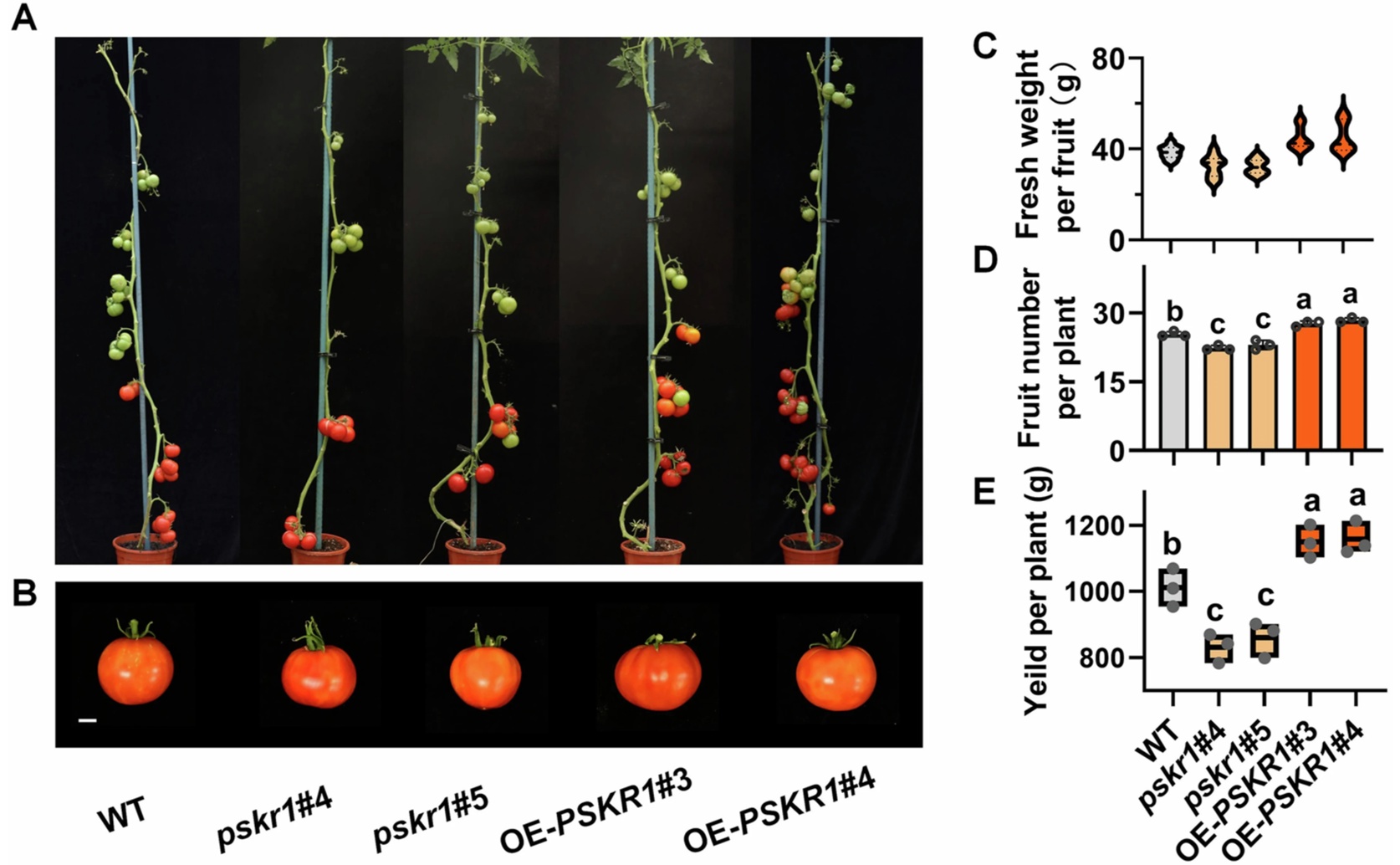
Supporting its role alongside BRAK in a key growth-regulating pathway, the phytosulfokine receptor PSKR1 enhances tomato production by increasing fresh weight per fruit (c), the number of fruits per plant (d), and the resulting total yield (e).

Image adapted from: Ding et al. / CC BY (Source)

Key Findings

  • Researchers at Zhejiang University identified a new protein in tomatoes, BRAK, that is crucial for plant growth and resistance to the pathogen Botrytis cinerea
  • Knocking out BRAK in tomato plants led to reduced growth and increased sensitivity to B. cinerea, while overexpressing it enhanced growth, yield, and resistance
  • BRAK interacts with another protein, PSKR1, and their mutual activation is essential for the plant's growth and defense responses
Plants constantly face threats from pathogens, leading to growth issues and crop failures. One key element in plant defense and growth are leucine-rich repeat receptor-like kinases (LRR-RLKs), which are proteins located on the cell surface that play crucial roles in recognizing external signals. However, their specific functions, especially in response to necrotrophic fungal pathogens like Botrytis cinerea, remain largely unexplored. A recent study by researchers at Zhejiang University sheds light on this topic by identifying a new LRR-RLK in tomatoes, named BRAK (B. cinerea resistance-associated kinase), which plays a significant role in plant growth and pathogen resistance[1]. Botrytis cinerea is a widespread plant pathogen responsible for gray mold disease, which affects many crops and leads to significant agricultural losses[2]. Traditional models of B. cinerea infection focused on the secretion of enzymes and toxins, but recent research has revealed a more complex interaction between the pathogen and the plant, involving multiple factors that contribute to disease development[2]. This new study provides further insights into how plants can defend themselves against such pathogens. The researchers identified BRAK as an LRR-RLK that is induced in tomatoes when infected by B. cinerea. Knocking out BRAK in tomato plants resulted in reduced growth and increased sensitivity to the pathogen, indicating its crucial role in both growth and defense. Conversely, overexpressing BRAK led to enhanced growth, higher yield, and increased resistance to B. cinerea, making it a promising target for developing disease-tolerant crops without compromising yield. One of the key findings of the study is the interaction between BRAK and the phytosulfokine (PSK) receptor PSKR1. PSK is a tyrosine-sulfated peptide that promotes cellular proliferation and expansion, and its perception depends on LRR-RKs like PSKR1[3]. The study revealed that BRAK and PSKR1 interact with each other, and this interaction is crucial for the plant's growth and defense responses. In pskr1 and brak single and double mutants, as well as in PSKR1-overexpressing plants with silenced BRAK, PSK-induced growth and defense responses were impaired. This indicates that both BRAK and PSKR1 are necessary for these processes. Further investigation showed that BRAK and PSKR1 phosphorylate each other, a process that promotes their interaction. Phosphorylation is a common post-translational modification where a phosphate group is added to a protein, altering its function. This reciprocal phosphorylation between BRAK and PSKR1 was found to be crucial for their role in growth and resistance. This finding aligns with earlier studies showing that post-translational modifications can confer special functions to peptides, such as the tyrosine-sulfated peptide PSY1, which promotes cellular proliferation and expansion in Arabidopsis[3]. The study also ties into broader themes in plant biology, such as the decision-making process between defense and symbiosis signaling. Plants use various receptor complexes, including LRR-RLKs, to recognize and respond to different external signals. For example, in defense signaling, receptor complexes form upon binding pathogen-associated molecular patterns (PAMPs) like the bacterial flagellin-derived peptide flg22 or chitin, while similar mechanisms operate during the perception of microbial symbiont-derived signals[4]. The interaction between BRAK and PSKR1 and their role in growth and defense responses adds another layer to our understanding of how plants manage these complex signaling pathways. In summary, the identification of BRAK as a novel regulator of seedling growth, fruit yield, and defense against B. cinerea offers new possibilities for developing fungal disease-tolerant plants without compromising yield. This study not only expands our understanding of LRR-RLKs' roles in plant biology but also provides practical insights for agricultural improvement. By leveraging the interaction between BRAK and PSKR1, researchers can potentially develop crops that are more resilient to pathogens while maintaining high productivity, addressing a significant challenge in modern agriculture.

GeneticsBiochemPlant Science

References

Main Study

1) A novel LRR receptor-like kinase BRAK reciprocally phosphorylates PSKR1 to enhance growth and defense in tomato.

Published 24th October, 2024

https://doi.org/10.1038/s44318-024-00278-z


Related Studies

2) Killing softly: a roadmap of Botrytis cinerea pathogenicity.

https://doi.org/10.1016/j.tplants.2022.08.024


3) Tyrosine-sulfated glycopeptide involved in cellular proliferation and expansion in Arabidopsis.

Journal: Proceedings of the National Academy of Sciences of the United States of America, Issue: Vol 104, Issue 46, Nov 2007


4) Knowing your friends and foes--plant receptor-like kinases as initiators of symbiosis or defence.

https://doi.org/10.1111/nph.13117


Related Articles

An unhandled error has occurred. Reload 🗙