Hidden Plant Virus Boosts Plant Defenses and Activates Self-Cleaning Mechanism

Jim Crocker
9th October, 2024

Hidden Plant Virus Boosts Plant Defenses and Activates Self-Cleaning Mechanism

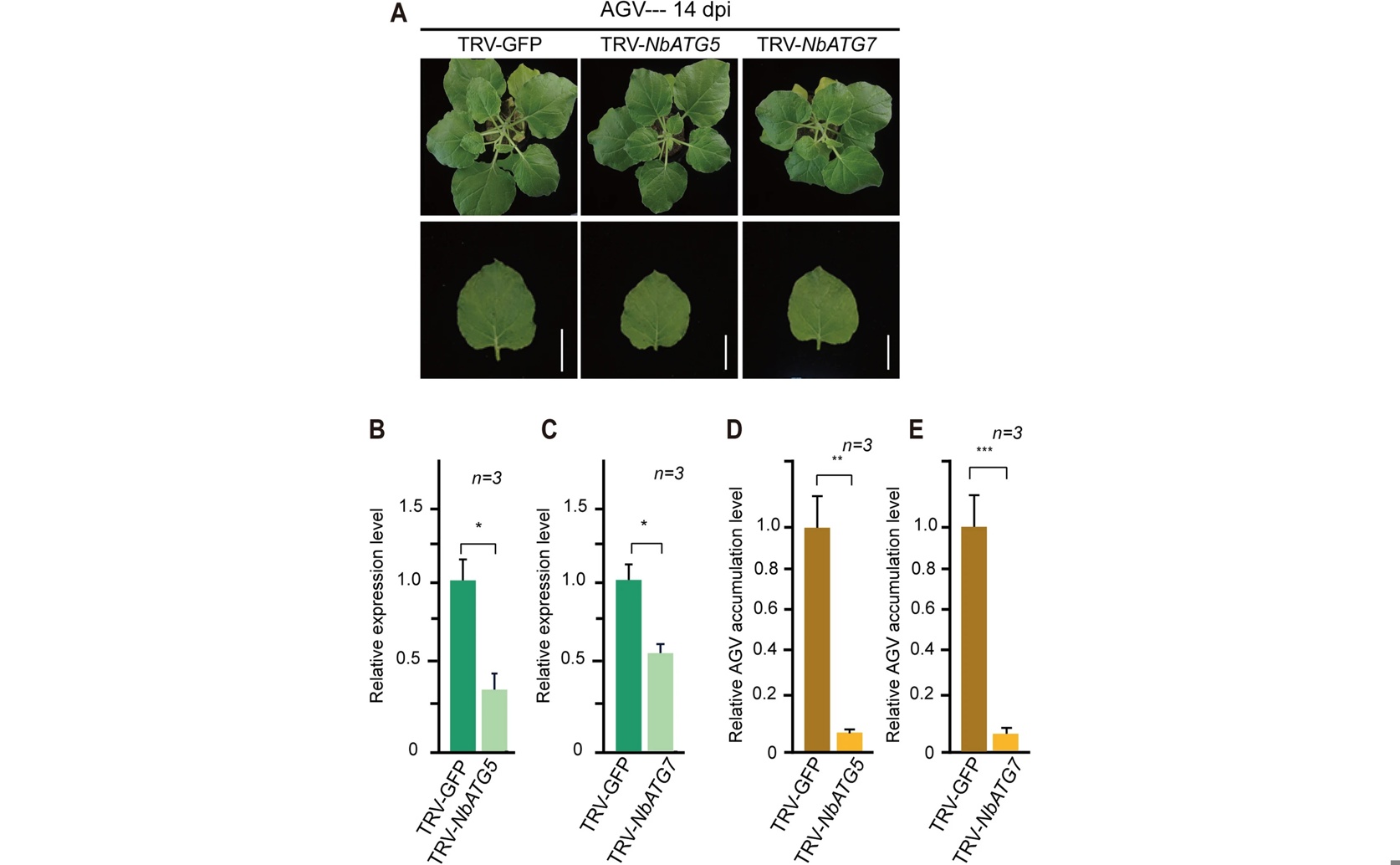
Although Apple geminivirus (AGV) infection remained asymptomatic in all Nicotiana benthamiana plants (a), silencing key autophagy genes NbATG5 and NbATG7 (b, c) significantly reduced viral DNA accumulation (d, e), demonstrating that the virus exploits the host's autophagy pathway to promote its own infection.

Image adapted from: Wang et al. / CC BY (Source)

Key Findings

  • Researchers at Northwest A&F University found that pre-inoculating plants with apple geminivirus (AGV) reduced the accumulation of various secondary viruses
  • AGV pre-inoculation increased autophagy-related gene activity, enhancing the plant's defense mechanisms
  • AGV also provided cross-protection against bacterial and fungal pathogens, suggesting its potential as a broad-spectrum biocontrol agent in agriculture
Plant viral diseases pose significant challenges to agricultural productivity, often leading to substantial crop losses. Traditional virus cross-protection strategies involve using a mild virus to shield plants from more severe viral strains, but this approach is typically limited to protection against the same type of virus. In a recent study conducted by researchers at Northwest A&F University, a novel method was explored that could potentially broaden the scope of viral protection in plants[1]. The study investigated the effects of pre-inoculating plants with apple geminivirus (AGV) on subsequent infections by various heterologous viruses, including cucumber mosaic virus, potato virus X, and tobacco mosaic virus. The researchers observed that AGV pre-inoculation reduced the accumulation of these secondary viruses in Nicotiana benthamiana, tomato, and pepper plants. This finding suggests that AGV has the potential to provide cross-protection against multiple types of plant viruses, rather than just homologous ones. One of the key discoveries in this study was the up-regulation of autophagy-related genes following AGV inoculation. Autophagy is a cellular process where cells break down and recycle their own components, often in response to stress or damage. This process involves the formation of autophagosomes, which are vesicles that transport cellular debris to the vacuole for degradation[2]. In plants, autophagy plays a crucial role in nutrient recycling, stress responses, and pathogen defense[2]. The study found that autophagic activity increased significantly after AGV infection, indicating that autophagy might be a critical component of the plant's defense mechanism against viral infections. Interestingly, the researchers also noted that AGV accumulation was reduced in autophagy-deficient plants. This suggests that the activation of autophagy not only helps in defending against secondary viral infections but also promotes the primary AGV infection. This dual role of autophagy highlights its complex involvement in plant-pathogen interactions. Moreover, the study extended its scope to examine the effects of AGV pre-inoculation on other types of pathogens. The results showed that AGV provided cross-protection against a phytopathogenic bacterium, Pseudomonas syringae, and a fungus, Botrytis cinerea, in Nicotiana species. This broad-spectrum protection underscores the potential of AGV as a biocontrol agent for managing a variety of plant diseases in agricultural settings. The findings from this study build on previous research that has highlighted the role of plant hormones and autophagy in plant defense mechanisms. Plant hormones such as salicylic acid (SA), jasmonates (JA), and ethylene (ET) have been well-documented in their roles in biotic stress responses[3]. However, the role of autophagy in these processes is less well-studied, particularly in the context of viral infections. This study contributes to filling that gap by demonstrating how autophagy can be harnessed to provide cross-protection against multiple pathogens. Additionally, the study aligns with earlier findings that autophagy is a critical component of the plant's innate immune response, particularly in the degradation of viral particles and the coordination of adaptive immunity[4]. By showing that AGV-induced autophagy can protect against a range of pathogens, this research provides new insights into the potential applications of autophagy in agricultural disease management. In conclusion, the study conducted by Northwest A&F University reveals that apple geminivirus (AGV) can activate autophagy pathways in plants, providing cross-protection against various viral, bacterial, and fungal pathogens. This discovery opens up new possibilities for using AGV as a biocontrol agent in agriculture, potentially offering a more versatile and effective strategy for managing plant diseases.

GeneticsBiochemPlant Science

References

Main Study

1) An asymptomatic geminivirus activates autophagy and enhances plant defenses against diverse pathogens.

Published 8th October, 2024

https://doi.org/10.1007/s44154-024-00176-8


Related Studies

2) Methods for analysis of autophagy in plants.

https://doi.org/10.1016/j.ymeth.2014.09.003


3) Role of plant hormones in plant defence responses.

https://doi.org/10.1007/s11103-008-9435-0


4) Autophagy during viral infection - a double-edged sword.

https://doi.org/10.1038/s41579-018-0003-6


Related Articles

An unhandled error has occurred. Reload 🗙