Factors Influencing Resting Behavior of Non-Breeding Seals in Antarctica

Greg Howard
14th July, 2024

Factors Influencing Resting Behavior of Non-Breeding Seals in Antarctica

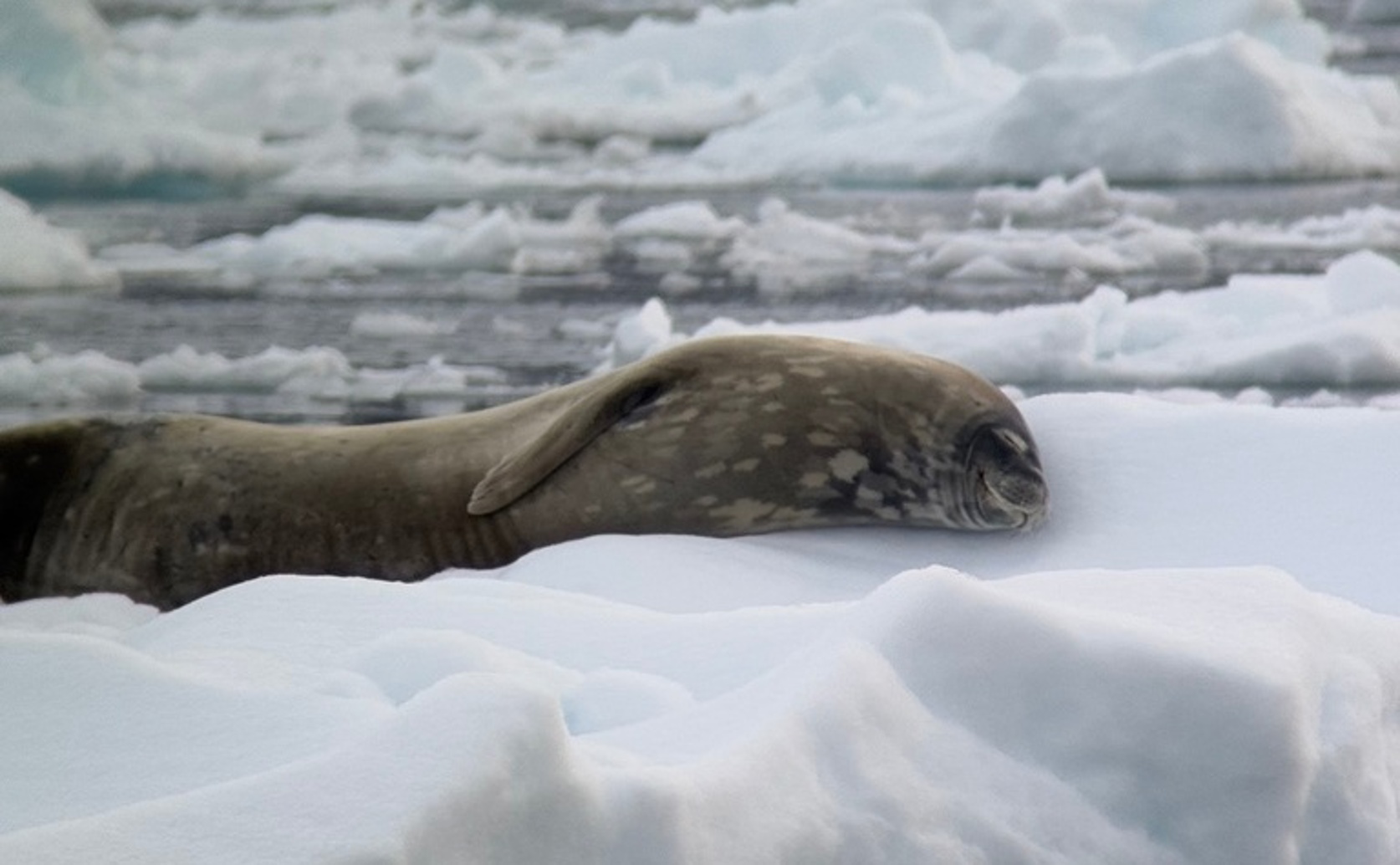
Weddell Seal (Leptonychotes weddellii)

Photo adapted from: Ingvild Riska / CC BY (Source)

Key Findings

  • The study at Cape Royds, Antarctica, found that Weddell seals haul out more in the afternoon than in the morning
  • Warmer temperatures and calmer winds lead to more seals hauling out on the ice
  • These findings help improve the accuracy of seal population estimates from satellite images by considering environmental factors
The Weddell seal (Leptonychotes weddellii) is a key species in the high-latitude, coastal Southern Ocean, playing critical roles in the marine food web as both predator and prey. Understanding their population dynamics is crucial for assessing the impacts of marine resource extraction and climate change on the Southern Ocean ecosystem. A recent study conducted by the University of Canterbury[1] has provided new insights into the environmental factors influencing the visibility of Weddell seals in satellite imagery, which is essential for accurate population monitoring. The study aimed to improve our understanding of the haulout behavior of non-breeding Weddell seals, which refers to the periods when seals leave the water and rest on the ice. This behavior is influenced by various environmental factors, and understanding it can help refine the techniques used to estimate seal populations from satellite images. Researchers captured 5054 trail camera photos over 59 days during the spring of 2017 at Cape Royds, Antarctica. They counted seals on the fast ice every 30 minutes, analyzing the data using a generalized additive model that explained 63% of the observed variability in haulout behavior. The study found that weather variables, particularly air temperature and wind speed, significantly influence when seals haul out. These findings are important because they allow researchers to predict the optimal times and conditions for observing the maximum number of seals on the ice, thereby improving the accuracy of population estimates. By integrating environmental parameters to correct for time-of-day patterns, the study enables better cross-site comparisons of seal abundance, leading to more reliable population estimates for the Ross Sea region and the wider coastal Antarctica. The study builds on previous research that has highlighted the importance of environmental factors in the behavior and distribution of marine species. For instance, earlier studies have shown how seasonal resource pulses, such as phytoplankton blooms, can drive changes in the vertical distribution of prey and affect the foraging behavior of top predators like Weddell seals[2]. Another study emphasized the need for advanced data capture technologies and integrated modeling frameworks to overcome data scarcity challenges in Antarctic biodiversity research[3]. The new findings also complement earlier work that used high-resolution satellite imagery and crowd-sourcing to estimate the global population of Weddell seals[4]. That study identified ocean depth and fast-ice variables as key factors influencing seal distribution, pointing to the complex interplay between environmental conditions and seal behavior. By quantifying the haulout patterns of Weddell seals and integrating environmental parameters, the University of Canterbury study provides a valuable tool for improving population monitoring techniques. This is particularly important given the ongoing changes in sea-ice extent and characteristics driven by climate change, which can have significant impacts on the availability of prey and the overall health of the Southern Ocean ecosystem. In summary, the study enhances our understanding of Weddell seal haulout behavior and offers a method to improve the accuracy of population estimates using satellite imagery. This research not only contributes to the effective management of marine resources but also provides insights into the broader impacts of climate change on Antarctic ecosystems.

WildlifeAnimal ScienceMarine Biology

References

Main Study

1) Factors influencing haulout behaviour of non-breeding weddell seals (Leptonychotes weddellii) at Cape Royds, Antarctica

Published 13th July, 2024

https://doi.org/10.1007/s00300-024-03274-5


Related Studies

2) Seasonal resource pulses and the foraging depth of a Southern Ocean top predator.

https://doi.org/10.1098/rspb.2020.2817


3) Forecasting the future of life in Antarctica.

https://doi.org/10.1016/j.tree.2022.07.009


4) Insights from the first global population estimate of Weddell seals in Antarctica.

https://doi.org/10.1126/sciadv.abh3674


Related Articles

An unhandled error has occurred. Reload 🗙