How Ginseng Compound Helps Protect Lungs from Sepsis Damage

Jenn Hoskins
13th July, 2024

How Ginseng Compound Helps Protect Lungs from Sepsis Damage

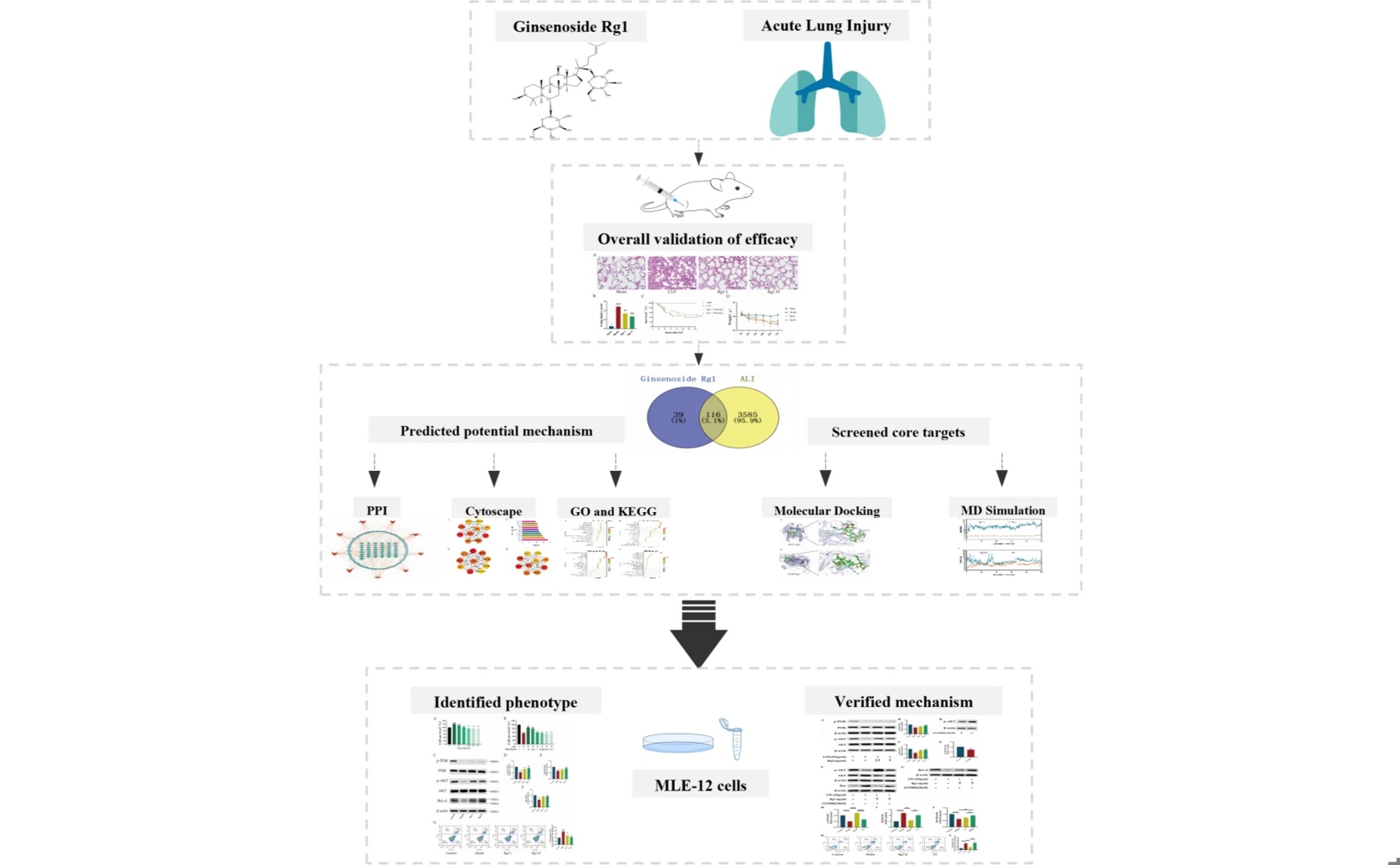
Flow chart showing the experimental design.

Image adapted from: Zhong et al. / CC BY (Source)

Key Findings

  • Researchers at Guangzhou University of Chinese Medicine found that Ginsenoside Rg1 (GRg1) from Ginseng can reduce lung damage in sepsis-induced acute lung injury (SALI)
  • GRg1 lowers levels of harmful inflammatory molecules like IL-6, TNF-α, and IL-1β in the lungs
  • GRg1 activates the PI3K-AKT pathway, reducing cell death in lung cells and improving survival rates in mice with sepsis
Sepsis-induced acute lung injury (SALI) is a severe condition characterized by inflammation and damage to lung tissues, leading to high mortality rates. Recent research conducted by Guangzhou University of Chinese Medicine has identified a promising therapeutic agent, Ginsenoside Rg1 (GRg1), derived from Ginseng, which shows potential in mitigating the effects of SALI[1]. This study provides new insights into the mechanisms by which GRg1 exerts its protective effects on lung epithelial cells. Previous studies have highlighted the persistent challenge of acute respiratory distress syndrome (ARDS) and its related conditions, such as SALI, which continue to exhibit high mortality rates despite advances in medical interventions[2]. The primary cause of death in these conditions is often sepsis, which leads to multiple organ failure[2]. In this context, the role of inflammation and the body's immune response is critical. For instance, the complement component C3a has been shown to play a significant role in sepsis-related acute lung injury by promoting endothelial cell pyroptosis, a form of programmed cell death[3]. The current study delves deeper into the potential of GRg1 to alleviate SALI by employing a relevant mouse model induced by cecal ligation and puncture (CLP), a standard method for mimicking sepsis in experimental settings. The researchers utilized network pharmacology, molecular docking, and molecular dynamics simulations to identify the action targets of GRg1. They found that GRg1 significantly reduced lung tissue damage and decreased levels of pro-inflammatory cytokines such as IL-6, TNF-α, and IL-1β, which are crucial mediators in the inflammatory response. The study identified 116 common targets between GRg1 and acute lung injury, with core targets including AKT1, VEGFA, SRC, IGF1, ESR1, STAT3, and ALB. Among these, AKT1 emerged as a key target with favorable binding activity for GRg1. This was confirmed through in vitro experiments on MLE-12 cells, a type of lung epithelial cell, exposed to lipopolysaccharide (LPS) to simulate inflammatory conditions. Further analysis revealed that GRg1 increased the ratio of Bcl-2/Bax protein expression, leading to reduced apoptosis (cell death) in the lung epithelial cells. It also decreased the expression of cleaved caspase-3, a protein involved in the execution phase of cell apoptosis. Additionally, GRg1 significantly enhanced the phosphorylation of PI3K and AKT1, which are part of a signaling pathway known to promote cell survival and reduce inflammation. Flow cytometric analysis using PI and Annexin-V assays further validated that GRg1 reduced the apoptosis rate in LPS-stimulated MLE-12 cells from 14.85% to 6.54%, demonstrating a significant protective effect. The use of an AKT1 inhibitor, LY294002, confirmed these findings, as it negated the protective effects of GRg1, underscoring the crucial role of the AKT1 pathway in mediating these benefits. These findings align with earlier research that emphasized the importance of targeting inflammatory pathways to improve outcomes in sepsis and related conditions. For example, the inhibition of the C3a-C3aR axis has been shown to prevent endothelial cell pyroptosis, suggesting that similar anti-inflammatory strategies could be effective[3]. Additionally, the anti-inflammatory properties of ginsenosides, components of Ginseng, have been documented to interact with inflammasomes, further supporting the potential of GRg1 in treating inflammatory diseases[4]. In conclusion, the study conducted by Guangzhou University of Chinese Medicine highlights the potential of Ginsenoside Rg1 as an effective adjunct therapy for sepsis-induced acute lung injury. By targeting AKT1 and activating the PI3K-AKT pathway, GRg1 reduces apoptosis in alveolar epithelial cells and lowers the secretion of pro-inflammatory cytokines, thereby significantly enhancing the survival rates of CLP mice. This research provides a promising avenue for developing new treatments for SALI, addressing a critical need in the management of sepsis-related conditions.

MedicineHealthBiochem

References

Main Study

1) The protective effect of ginsenoside Rg1 against sepsis-induced lung injury through PI3K-Akt pathway: insights from molecular dynamics simulation and experimental validation.

Published 11th July, 2024

https://doi.org/10.1038/s41598-024-66908-y


Related Studies

2) Causes and timing of death in patients with ARDS.

Journal: Chest, Issue: Vol 128, Issue 2, Aug 2005


3) Inhibition of the C3a receptor attenuates sepsis-induced acute lung injury by suppressing pyroptosis of the pulmonary vascular endothelial cells.

https://doi.org/10.1016/j.freeradbiomed.2022.02.032


4) Ginsenoside Rg1 prevent and treat inflammatory diseases: A review.

https://doi.org/10.1016/j.intimp.2020.106805


Related Articles

An unhandled error has occurred. Reload 🗙