Using Advanced Algorithms and Light Analysis to Measure Water in Wheat Leaves

Greg Howard
23rd June, 2024

Using Advanced Algorithms and Light Analysis to Measure Water in Wheat Leaves

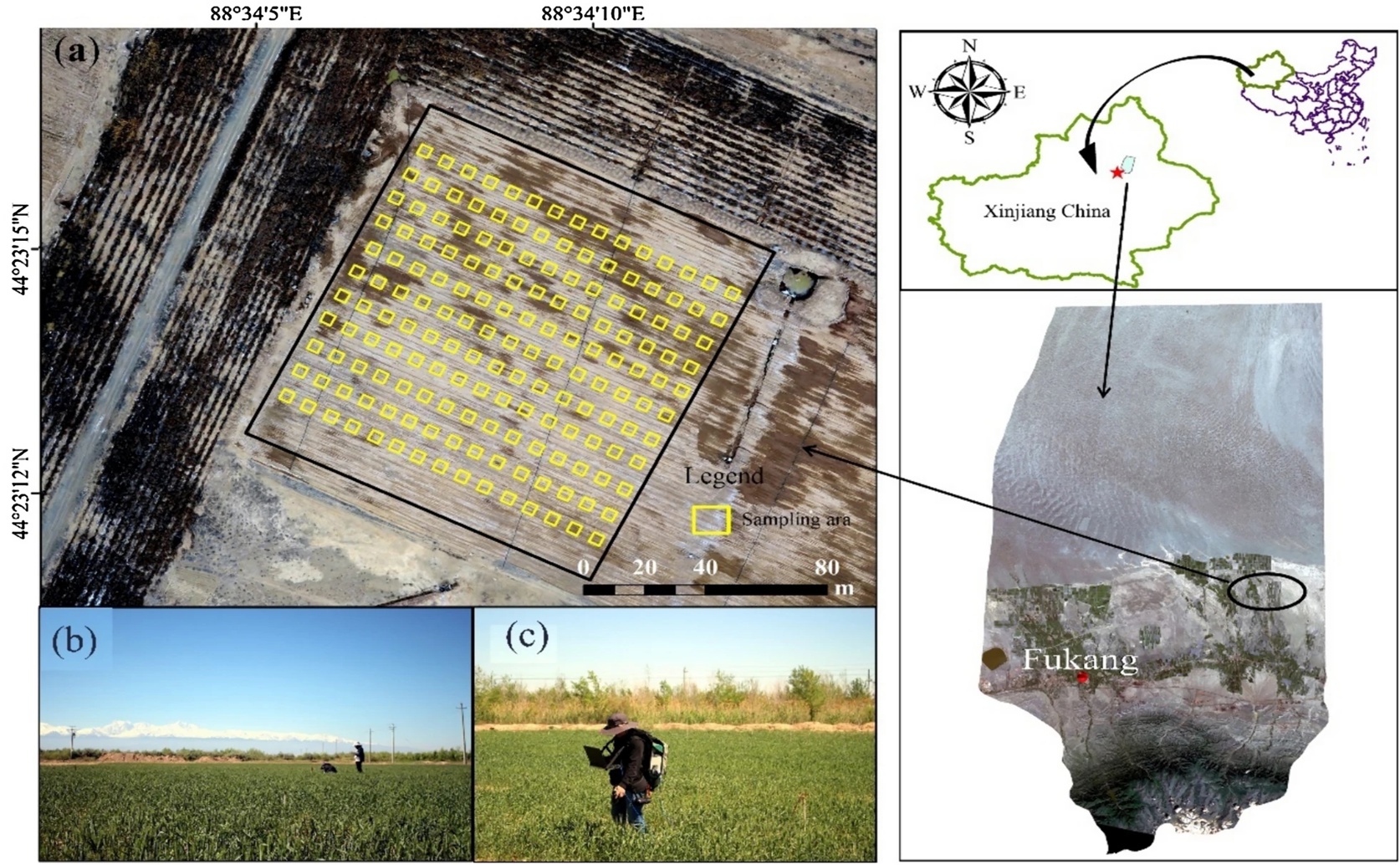
This study was conducted at a spring wheat planting region in Fu-kang City, Xinjiang, China, showing the specific areas used for field data sampling (a) and spectral data collection (b, c).

Image adapted from: Zununjan et al. / CC BY (Source)

Key Findings

  • Researchers at Yili Normal University developed a new method to estimate leaf water content (LWC) in spring wheat using advanced spectral processing and machine learning
  • The study found that using fractional order derivative (FOD) spectral processing significantly improved the accuracy of LWC estimation
  • The best predictive model combined traditional moisture indices with optimized two-band and three-band spectral indices, achieving a high accuracy with an R² of 0.86
Leaf water content (LWC) is a crucial metric for assessing crop growth and development. Accurate estimation of LWC can inform better irrigation and field management practices, ultimately enhancing agricultural productivity. Traditional methods of measuring LWC can be labor-intensive and time-consuming. However, advances in visible and near-infrared (VIS-NIR) spectroscopy offer promising non-destructive alternatives. A recent study by researchers at Yili Normal University has proposed a novel approach to estimate LWC in spring wheat using fractional order derivative (FOD) spectral processing combined with machine learning techniques[1]. The study aimed to develop an integrated index, termed the multiband spectral index (MBSI) and moisture index (MI), to improve the accuracy of LWC estimation. The researchers collected spectral data from spring wheat fields around Fu-Kang City, Xinjiang, China. They processed this data using FOD, which enhances the spectral information and increases the number of sensitive bands, particularly in the near-infrared range (700–1100 nm). This preprocessing step is crucial as it amplifies the subtle spectral features related to water content. The study constructed several multiband spectral indices based on the optimized spectral bands. These indices were then used to estimate LWC through machine learning models, including K-nearest neighbor (KNN), support vector machine (SVM), and artificial neural network (ANN). The results demonstrated that the fractional derivative pretreatment significantly improved the correlation between spectral indices and LWC. Specifically, the two-band index (RVI1156, 1628 nm) and various three-band indices (e.g., 3BI-3(766, 478, 1042 nm)) showed higher correlations with LWC compared to traditional moisture indices, with correlation coefficients ranging from -0.71 to 0.76. The prediction accuracy of these spectral indices was also noteworthy. The two-band spectral index (DVI(698, 1274 nm)) achieved an R2 of 0.81 for calibration and 0.79 for validation, indicating a strong predictive capability. Among the twenty-seven models evaluated, the FWBI-3BI−0.8 order model exhibited the best predictive performance, with an R2 of 0.86, RMSE of 2.11%, and RPD of 2.65. These findings align with previous research that underscores the utility of spectral indices for estimating plant water status. For instance, a study on winter wheat demonstrated that new combination spectral indices based on canopy reflectance could effectively estimate plant water status, with models achieving R2 values greater than 0.7[2]. Another study highlighted the importance of spectral absorption features at specific wavelengths (1,450 and 1,940 nm) for assessing leaf water status, showing strong correlations with fuel moisture content (FMC) and equivalent water thickness (EWT)[3]. The current study builds on these insights by integrating advanced spectral preprocessing techniques and machine learning models to enhance the accuracy of LWC estimation. Moreover, the use of machine learning in this study is consistent with recent trends in agricultural research. For example, a study on monitoring leaf chlorophyll (Chl) levels using UAV-hyperspectral imagery and machine learning demonstrated that combining spectral data with advanced algorithms could accurately capture temporal variations in Chl levels[4]. Similarly, the current study leverages machine learning to process and interpret complex spectral data, thereby improving the reliability of LWC predictions. In conclusion, the study by Yili Normal University researchers provides a robust framework for estimating leaf water content in spring wheat. By combining fractional order derivative spectral preprocessing with machine learning, the study enhances the accuracy and reliability of LWC predictions. This approach not only supports better irrigation and field management practices but also aligns with broader trends in agricultural research that emphasize the use of advanced technologies for crop monitoring and management.

AgricultureBiotechPlant Science

References

Main Study

1) Combining the fractional order derivative and machine learning for leaf water content estimation of spring wheat using hyper-spectral indices

Published 22nd June, 2024

https://doi.org/10.1186/s13007-024-01224-0


Related Studies

2) Assessment of plant water status in winter wheat (Triticum aestivum L.) based on canopy spectral indices.

https://doi.org/10.1371/journal.pone.0216890


3) Estimation of plant water content by spectral absorption features centered at 1,450 nm and 1,940 nm regions.

https://doi.org/10.1007/s10661-008-0548-3


4) Machine Learning Strategies for the Retrieval of Leaf-Chlorophyll Dynamics: Model Choice, Sequential Versus Retraining Learning, and Hyperspectral Predictors.

https://doi.org/10.3389/fpls.2022.722442


Related Articles

An unhandled error has occurred. Reload 🗙