
Using Deep Learning to Identify Grape Resistance to Mildew
Jim Crocker
14th June, 2024


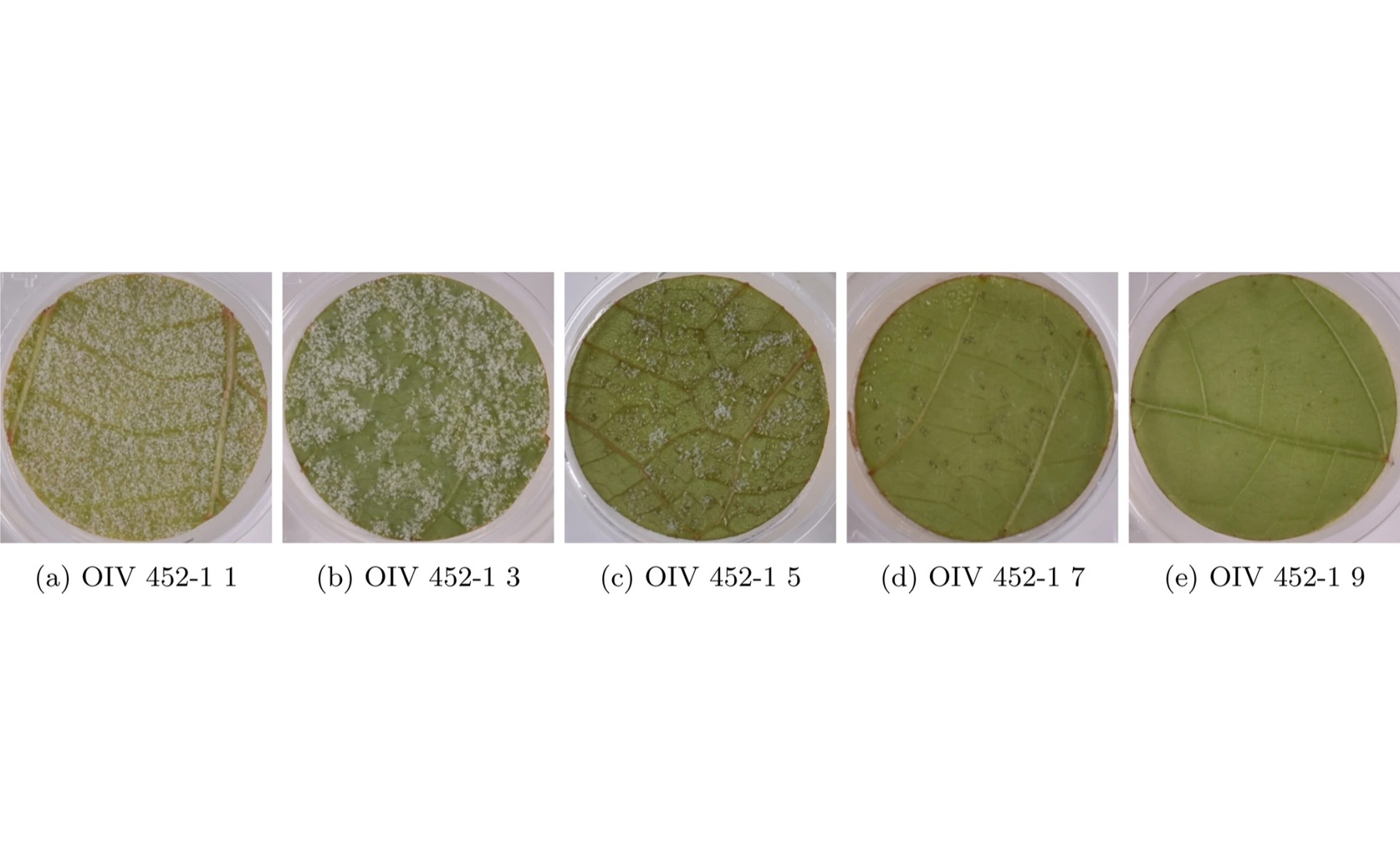
The OIV 452-1 scoring scale illustrates how increasing grapevine resistance to Plasmopara viticola is characterized by a shift from widespread pathogen sporulation (a, b) to minimal or no sporulation, often with visible necrotic spots as a defense response (c–e).
Key Findings
- Researchers from INRAE, CNRS, and Université de Toulouse developed a machine learning method to identify grapevine resistance to downy mildew
- The method uses images of infected grapevine leaf discs and a neural network to automate resistance assessment
- The Swin transformer model achieved 81.7% accuracy in predicting resistance and 97% accuracy in identifying genotype differences, much faster than human experts
AgricultureBiotechPlant Science
References
Main Study
1) Phenotyping grapevine resistance to downy mildew: deep learning as a promising tool to assess sporulation and necrosis.
Published 13th June, 2024
https://doi.org/10.1186/s13007-024-01220-4
Related Studies
2) Plasmopara viticola the Causal Agent of Downy Mildew of Grapevine: From Its Taxonomy to Disease Management.
3) Variation in Susceptibility to Downy Mildew Infection in Spanish Minority Vine Varieties.
4) Breakdown of resistance to grapevine downy mildew upon limited deployment of a resistant variety.
5) Europe as a bridgehead in the worldwide invasion history of grapevine downy mildew, Plasmopara viticola.
Related Articles
 9th June, 2024 | Jim Crocker