How Nutrients and Hormones Affect Tomato Seed Growth in Salty Conditions

Jim Crocker
13th June, 2024

How Nutrients and Hormones Affect Tomato Seed Growth in Salty Conditions

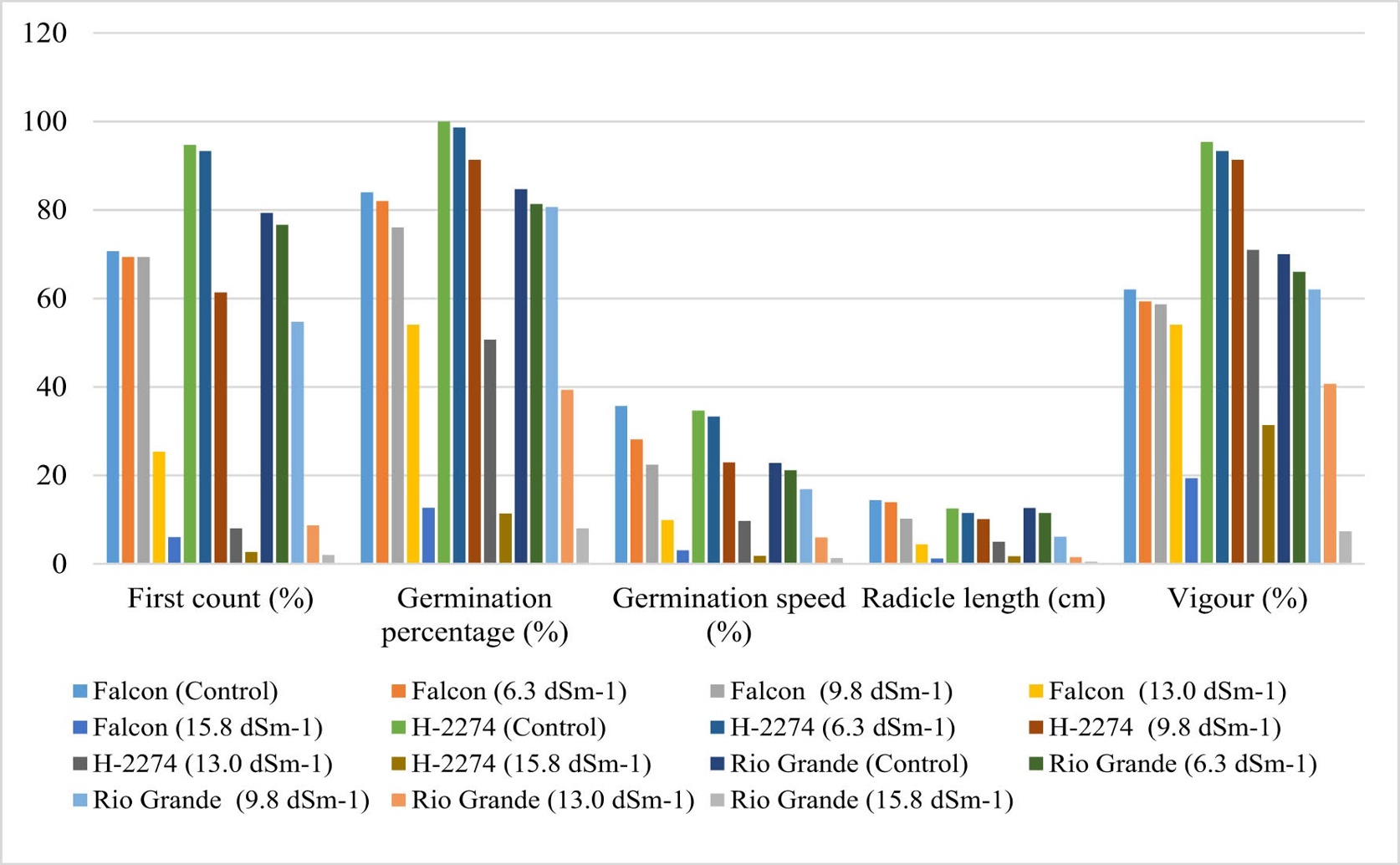
Increasing salinity stress impaired key germination and early growth metrics across all three tomato (Solanum lycopersicum) cultivars tested in the study, revealing cultivar H-2274 as the most salt-tolerant.

Image adapted from: Karakan et al. / CC BY (Source)

Key Findings

  • The study by Kilis 7 Aralik University tested three tomato cultivars under different salt concentrations to assess their salt tolerance
  • The cultivar H-2274 showed higher salt tolerance, indicated by higher levels of proline and citric acid
  • Biochemical analysis revealed distinct differences in amino acids, organic acids, and phytohormones among the cultivars, aiding in understanding salt tolerance mechanisms
Salinity accumulation poses a significant threat to the production and productivity of economically important crops such as tomatoes (Solanum lycopersicum L.). Addressing this issue, a recent study conducted by Kilis 7 Aralik University aimed to determine the ability of various tomato cultivars to tolerate salt stress based on seed traits through multiple biochemical pathways[1]. This research holds promise for enhancing agricultural productivity in saline environments by identifying salt-tolerant tomato cultivars. The study tested three tomato cultivars under different sodium chloride (NaCl) concentrations: 0, 6.3, 9.8, 13.0, and 15.8 dS m-1. The researchers analyzed the amino acids, organic acids, and phytohormones in these cultivars to understand their response to salt stress. The results indicated that the cultivar H-2274 exhibited higher tolerance to salt stress compared to the other cultivars. This conclusion was drawn based on germination traits, which showed that H-2274 had higher levels of proline (29 pmol µl-1) and citric acid (568 ng µl-1). To further understand the biochemical mechanisms underlying salt tolerance, the study employed multivariate discriminant analysis, including principal component analysis and two-way hierarchical clustering analyses. These methods demonstrated that the tomato cultivars could be distinctly separated based on their amino acid, organic acid, and phytohormone contents. This biochemical variability provides a valuable tool for investigating salt tolerance mechanisms in tomatoes. The findings of this study align with previous research on the impact of salinity on tomato plants. For instance, a study examining the effects of salt stress on tomato plants identified key amino acid and carbohydrate metabolic pathways that are significantly enriched during the adaptation to salt stress[2]. This earlier research highlighted the importance of specific metabolic pathways and genes in improving the plant's ability to resist salt stress, which complements the current study's focus on biochemical markers like proline and citric acid. Another relevant study investigated the role of proline and glycine betaine (GB) in improving salt tolerance in two commercial tomato genotypes[3]. The study found that proline accumulation, particularly through the ornithine pathway, contributed to better salt tolerance in the Grand Brix genotype. This finding supports the current study's observation that high proline levels in cultivar H-2274 are associated with increased salt tolerance. Furthermore, a review of the broader impacts of drought and salinity on plant growth emphasized the complexity of plant responses to these stress conditions[4]. The review discussed how various factors, including species, genotype, plant age, and stress intensity, influence plant responses and the effectiveness of mitigation strategies. The current study's focus on biochemical markers provides a more targeted approach to understanding and improving salt tolerance in tomatoes, which could help address some of the challenges highlighted in the review. In summary, the study conducted by Kilis 7 Aralik University provides valuable insights into the biochemical mechanisms underlying salt tolerance in tomatoes. By identifying key biochemical markers such as proline and citric acid, the research offers practical applications for developing salt-tolerant tomato cultivars. These findings, supported by previous studies on metabolic pathways and stress responses, have significant potential for enhancing agricultural productivity in saline environments and addressing socio-economic challenges.

AgricultureBiochemPlant Science

References

Main Study

1) Revealing the effects of amino acid, organic acid, and phytohormones on the germination of tomato seeds under salinity stress.

Published 13th June, 2024

https://doi.org/10.1515/biol-2022-0892


Related Studies

2) The Amino Acid Metabolic and Carbohydrate Metabolic Pathway Play Important Roles during Salt-Stress Response in Tomato.

https://doi.org/10.3389/fpls.2017.01231


3) Influence of the proline metabolism and glycine betaine on tolerance to salt stress in tomato (Solanum lycopersicum L.) commercial genotypes.

https://doi.org/10.1016/j.jplph.2018.10.013


4) Drought and Salinity Stress Responses and Microbe-Induced Tolerance in Plants.

https://doi.org/10.3389/fpls.2020.591911


Related Articles

An unhandled error has occurred. Reload 🗙