Compound S slows tomato fruit growth and seed production

Greg Howard
12th January, 2026

Compound S slows tomato fruit growth and seed production

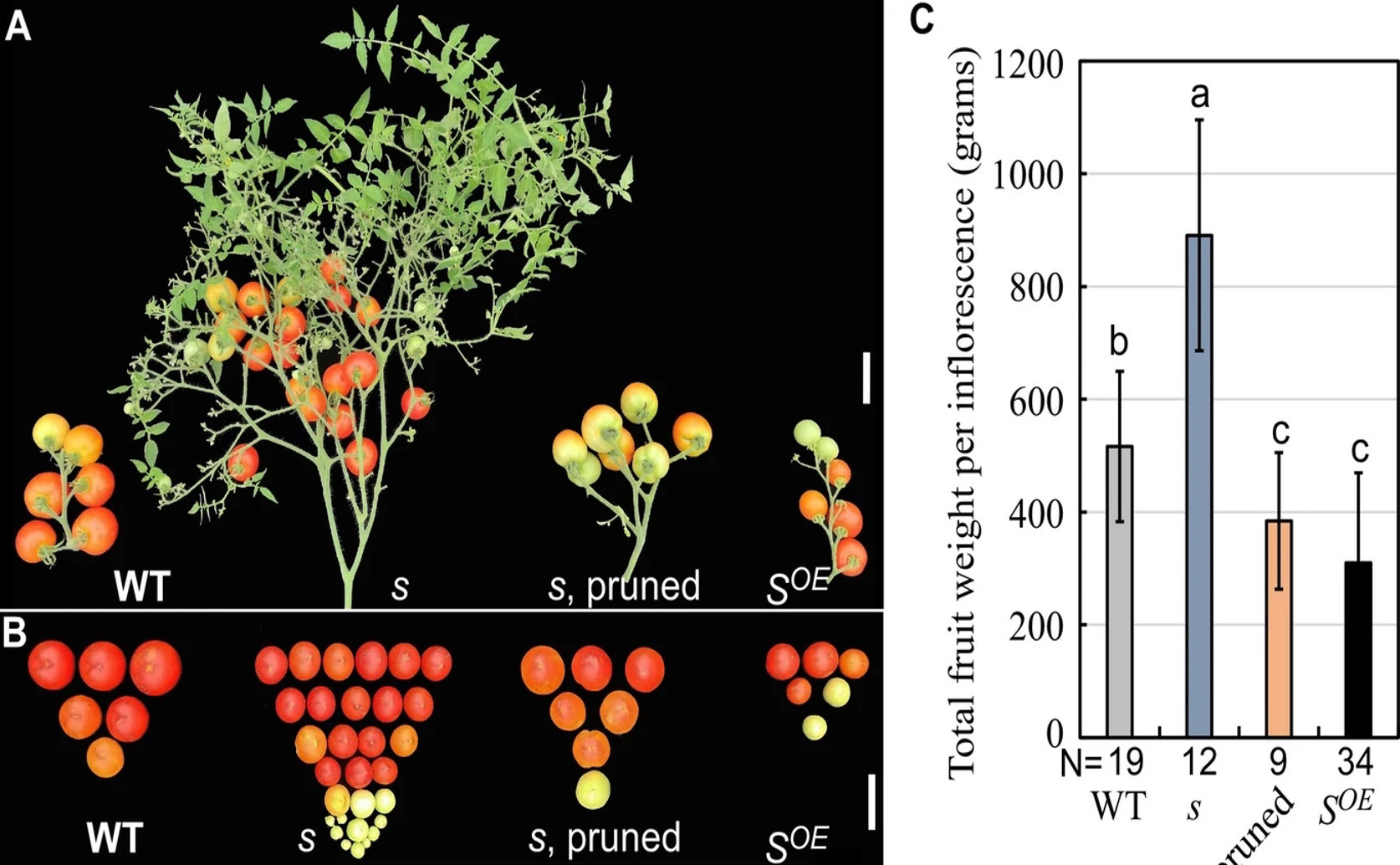
In the large-fruited Tomato (Solanum lycopersicum) cv. Moneymaker, the s mutation dramatically increases the number of fruits and total mass per inflorescence (a, c), but this severe fruit overload limits individual fruit size unless the inflorescence is pruned (b).

Image adapted from: Weng et al. / CC BY (Source)

Key Findings

  • In tomato plants, the SlWOX9 gene is essential for both fruit growth and seed development
  • Increasing SlWOX9 activity reduces seed size and overall fruit growth, while decreasing it boosts fruit growth in some varieties
  • SlWOX9 controls fruit growth by directly suppressing the activity of another gene, SlTEL1, which is important for seed development
Fruit development in plants, particularly in tomatoes, relies on a carefully balanced process between the growth of the fruit itself and the development of its seeds. Understanding how this coordination works is crucial for improving crop yields and fruit quality. Researchers at the Chinese Academy of Sciences[1] have recently investigated the role of a key gene regulator, SlWOX9, in controlling this process. SlWOX9 is a transcription factor – a protein that controls the activity of other genes. It’s known to be important for both the branching of plant stems (inflorescence branching) and the early development of the embryo. The study focused on understanding how SlWOX9 affects fruit and seed development, and what genes it interacts with to achieve this. The team found that SlWOX9 is essential for both fruit growth and seed development. When they artificially increased the activity of SlWOX9 in tomato plants (ectopic expression), the seeds became smaller, and the overall growth of the fruit was reduced. Conversely, reducing SlWOX9 activity (using a specific s-classic allele) boosted fruit growth in a wild tomato variety (S. pimpinellifolium LA1781), although this came with drawbacks like excessive fruit production and a reversion to more primitive flower forms in larger-fruited tomato types. To understand how SlWOX9 exerted its control, the researchers used several advanced techniques. Transcriptome profiling – measuring the activity of all genes in the plant – revealed that SlWOX9 influences a specific group of genes involved in seed development. Further investigation using a technique called DNA affinity purification sequencing (DAP-seq) identified the genes that SlWOX9 directly interacts with. This revealed a key target: a gene called SlTEL1. SlTEL1 is part of a family of genes encoding RNA binding proteins, a family that has been previously studied in other plants like Arabidopsis thaliana and Oryza sativa[2]. These RNA binding proteins contain a conserved structural motif first identified in the mei2 gene of fission yeast. Interestingly, the mei2-like genes in Arabidopsis show specific expression patterns in areas of active plant growth, like the shoot and root tips, suggesting a role in maintaining the plant’s ability to continue growing[2]. The researchers demonstrated that SlWOX9 directly represses the activity of SlTEL1. This repression appears to be a major mechanism by which SlWOX9 regulates fruit and seed development. Essentially, SlWOX9 controls fruit growth by controlling the expression of SlTEL1. This study builds on earlier work showing the importance of genetic variation, particularly structural variants (SVs), in influencing crop traits[3]. While[3] highlighted the role of SVs in affecting gene dosage and expression, and even influencing complex traits like fruit flavor and size through interactions between multiple genes, the current study focuses on a specific transcription factor (SlWOX9) and its direct target (SlTEL1). The findings suggest that changes in SlWOX9 activity, potentially through SVs affecting its expression, could contribute to the variation in fruit size and seed weight observed in different tomato varieties. Furthermore, the identification of SlTEL1 as a key downstream target provides a specific gene to focus on when attempting to improve fruit development through breeding or genetic engineering. The research also highlights the complex regulatory networks involved in plant development, and the importance of understanding these networks to improve crop yields.

FruitsAgriculturePlant Science

References

Main Study

1) Compound Inflorescence (S) represses fruit growth and seed development in tomato

Published 8th January, 2026

https://doi.org/10.1186/s43897-025-00183-x


Related Studies

2) Diversification of genes encoding mei2 -like RNA binding proteins in plants.

Journal: Plant molecular biology, Issue: Vol 54, Issue 5, Mar 2004


3) Major Impacts of Widespread Structural Variation on Gene Expression and Crop Improvement in Tomato.

https://doi.org/10.1016/j.cell.2020.05.021


Related Articles

An unhandled error has occurred. Reload 🗙