How Inclined Trellis Shapes Impact Light Capture, Cherry Quality and Yield

Jim Crocker
7th March, 2025

How Inclined Trellis Shapes Impact Light Capture, Cherry Quality and Yield

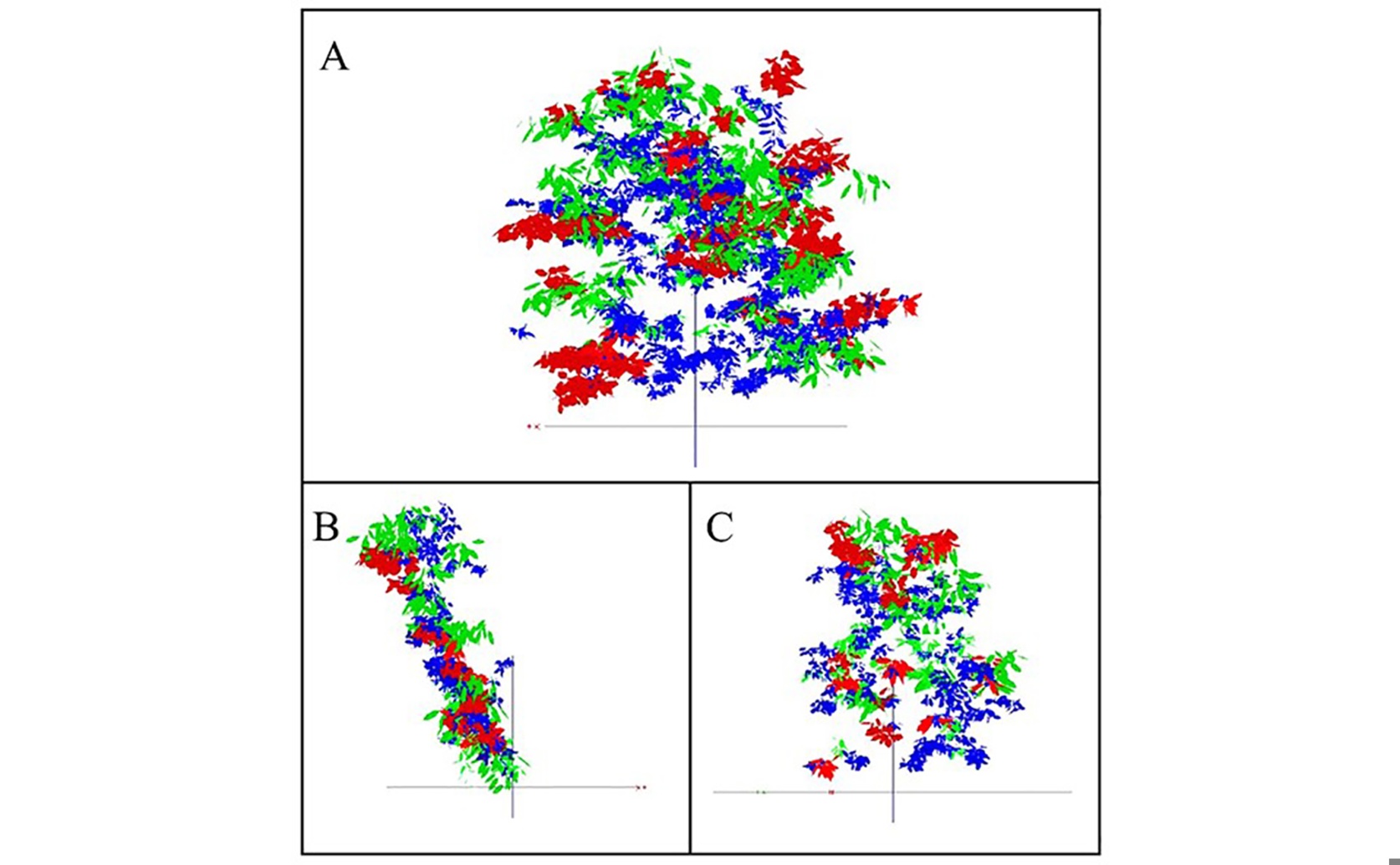
The reconstructed three-dimensional canopies show that the Yangling inclined trellis tree shape (YLL-TS; B, C) creates a more open, inclined branch architecture than the super slender spindle (SSS-TS; A), providing the structural basis for the higher canopy light interception efficiency that underpins its superior yield per unit area reported in the study.

Image adapted from: Zhang et al. / CC BY (Source)

Key Findings

  • In Northwest A&F University, China, researchers found that the Yangling inclined trellis (YLL-TS) shape captures more sunlight than the Super slender spindle (SSS-TS) shape
  • YLL-TS trees produced significantly more cherries per area, making them more efficient for dense planting
  • While SSS-TS trees had higher single fruit quality, YLL-TS offered greater overall fruit yield and better adaptability to climate challenges
Different tree shapes significantly influence how fruit trees capture light, manage water, and ultimately produce fruit. Understanding these relationships is crucial for optimizing tree performance, especially in the face of climate change. A recent study by Northwest A&F University[1] explored how two distinct tree shapes affect the quality and yield of “Jimei” sweet cherry fruits, providing insights that can enhance agricultural practices. The researchers compared two specific tree architectures: the Yangling inclined trellis arm tree shape (YLL-TS) and the Super slender spindle tree shape (SSS-TS). Using advanced three-dimensional digitization techniques, they meticulously analyzed the growth patterns of branches and leaves, constructing virtual models of the tree canopies. This allowed for a detailed examination of branch composition, leaf area, and the spatial distribution of foliage within each tree shape. One of the key findings was the difference in light interception efficiency (LIE) between the two tree shapes. LIE is a measure of how effectively a tree canopy captures sunlight, which is essential for photosynthesis—the process by which plants convert light into energy. The YLL-TS exhibited a significantly higher LIE (0.53 STAR value) compared to the SSS-TS (0.20 STAR value). This higher efficiency means that YLL-TS trees are better at capturing light, which can lead to improved fruit quality and yield. Despite having fewer branches and a smaller leaf area, YLL-TS trees demonstrated a 48%, 42%, and 27% increase in light interception for the overall canopy, fruit-bearing branches, and nutrient-bearing branches, respectively. This suggests that YLL-TS trees allocate their leaves more effectively, ensuring that the most productive parts of the tree receive adequate sunlight. In contrast, SSS-TS trees, while having a greater leaf area, did not utilize the available light as efficiently. The study also revealed differences in photosynthetic parameters between the two tree shapes. Photosynthetic parameters such as net photosynthetic rate (Pn), transpiration rate (Tr), stomatal conductance (Gs), and internal CO₂ concentration (Ci) were higher in SSS-TS trees. These parameters indicate the overall photosynthetic activity and water usage of the trees. Although SSS-TS trees showed higher photosynthetic activity, the increased light interception efficiency of YLL-TS trees resulted in a higher economic yield, with YLL-TS producing 4.075 kg/m² of cherries. Additionally, YLL-TS trees are more suitable for dense planting, making them a practical choice for large-scale cultivation. Previous research has highlighted the importance of tree architecture in managing water use and optimizing light interception. For instance, a study conducted by Tarim University[2] demonstrated significant genetic variability in tree architecture and its impact on water-deficit responses in apple trees. This variability suggests that selecting the right tree shape can help mitigate the effects of water scarcity. Another study from the same institution[3] examined how different training systems affect canopy structure and light interception in apple cultivars, finding that training methods can significantly influence light distribution within the canopy. The current study builds on these findings by showing that not only does tree shape affect light interception and photosynthesis, but it also has a direct impact on fruit yield and quality. By using three-dimensional digitization and virtual modeling, the researchers were able to precisely quantify these effects and identify the most efficient tree shape for sweet cherry production. This approach aligns with earlier studies that emphasize the importance of combining architectural and functional traits to develop ideotypes—ideal plant types optimized for specific environmental conditions and production goals[2]. Moreover, the study’s use of virtual canopy models provides a futuristic tool for breeders and farmers to visualize and optimize tree structures without the need for extensive field trials. This method enhances the ability to predict how different tree shapes will perform under various climatic scenarios, thereby supporting more informed decision-making in orchard management. In conclusion, the findings from Northwest A&F University demonstrate that the Yangling inclined trellis arm tree shape offers superior light interception efficiency and higher economic yields compared to the Super slender spindle tree shape. These results suggest that adopting YLL-TS could lead to more productive and resilient sweet cherry orchards. By integrating these insights with previous research on tree architecture and water use, farmers and breeders can better navigate the challenges posed by changing climates and optimize fruit production for the future.

FruitsAgriculturePlant Science

References

Main Study

1) Effect of Yangling inclined trellis tree shape on light interception efficiency, fruit quality, and yield of sweet cherry cv: ‘Jimei’

Published 5th March, 2025

https://doi.org/10.1371/journal.pone.0317101


Related Studies

2) Tree architecture, light interception and water-use related traits are controlled by different genomic regions in an apple tree core collection.

https://doi.org/10.1111/nph.17960


3) Light interception and partitioning between shoots in apple cultivars influenced by training.

Journal: Tree physiology, Issue: Vol 28, Issue 3, Mar 2008


Related Articles

An unhandled error has occurred. Reload 🗙