How Palm Pollen Affects the Quality of Date Fruits

Jim Crocker
26th September, 2025

How Palm Pollen Affects the Quality of Date Fruits

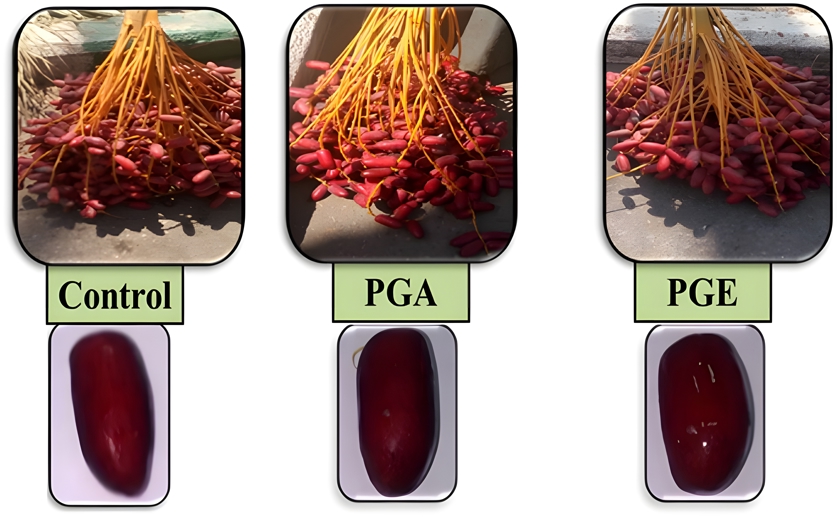
Date bunches treated with pollen extracts (PGA and PGE) are visibly plumper than the untreated bunch (control).

Image adapted from: Talaat et al. / CC BY (Source)

Key Findings

  • In Egypt, spraying date palm trees with pollen extract from ‘Barhi’ dates improved the production and quality of ‘Zaghloul’ date fruits
  • Applying either aqueous or ethanolic pollen extract at key fruit development stages increased fruit size, sugar levels, and nutritional content like protein and minerals
  • Ethanolic extract was slightly more effective than aqueous extract, likely due to better extraction of beneficial compounds, enhancing fruit yield and quality
Date palm fruits are a staple food in many arid and semi-arid regions, prized for their nutritional value and versatility. However, optimizing fruit yield and quality remains a key challenge for date palm cultivation. Recent research from Cairo University[1] investigated whether extracts from date palm pollen could act as a natural ‘bio-stimulant’ to improve fruit production in the ‘Zaghloul’ date variety. The study focused on the effect of spraying date palm trees with either water-based (aqueous) or alcohol-based (ethanolic) extracts made from the pollen of ‘Barhi’ date palm trees. These extracts were applied at two critical stages of fruit development: the ‘Hababouk’ stage (when cells are actively dividing) and the ‘Kimri’ stage (when cells are elongating). The researchers then measured a range of factors in the resulting ‘Zaghloul’ fruits to see if the pollen extracts had any positive effects compared to trees sprayed only with water (the control group). The results showed a clear benefit from both types of pollen extract. Trees treated with either 700 ppm aqueous or ethanolic extract produced fruits with significantly higher levels of dry matter, crude fiber, and ash content – indicators of overall fruit quality and nutritional density. Importantly, the extracts also boosted the levels of various sugars (total soluble solids, reducing sugars, non-reducing sugars, and total carbohydrates) and protein within the fruits. These are all desirable characteristics for both consumers and date palm growers. Furthermore, the study found that the pollen extracts increased the concentration of essential mineral nutrients in the fruits. Dates are already known to be a good source of minerals like potassium, boron, calcium, magnesium, and zinc[2], and the pollen extracts appeared to enhance their uptake and accumulation within the fruit. This is particularly important as mineral deficiencies can limit date palm growth and fruit development. Beyond basic nutritional components, the research also examined the fruit’s antioxidant capacity. The extracts increased the levels of total phenols, compounds known for their health-promoting properties. Simultaneously, they enhanced the activity of two key antioxidant enzymes, peroxidase (POD) and catalase (CAT). These enzymes help protect the fruit from oxidative stress, which can damage cells and reduce quality. Interestingly, the pollen extracts also influenced other aspects of fruit composition. They reduced the moisture percentage and titratable acidity, while also decreasing the concentration of tannins, compounds that can sometimes impart a bitter taste. The increase in fruit amino acids is also a positive finding, as dates contain 23 amino acids, some of which aren’t found in other common fruits[2]. The researchers observed that the ethanolic extract tended to have a slightly more pronounced effect on improving fruit yield and quality compared to the aqueous extract, suggesting that the alcohol may be more effective at extracting beneficial compounds from the pollen. This improvement is thought to be linked to better regulation of nutrient acquisition, sugar accumulation, and the fruit’s antioxidant response. These findings build upon earlier research demonstrating the rich chemical composition of dates[2][3]. Dates are naturally high in carbohydrates, fats, fiber, vitamins, and minerals, making them a nutrient-dense food source. The current study suggests that applying pollen extracts can further enhance these inherent qualities, potentially maximizing the nutritional value of the fruit. The observed increase in total phenols and antioxidant enzyme activity is particularly noteworthy, as these compounds are linked to various health benefits. The study’s methodology – utilizing a controlled experimental design with repeated spraying at key developmental stages – provides strong evidence for the positive effects of date palm pollen extracts. The use of a specific concentration (700 ppm) allows for targeted application and optimization of the bio-stimulant effect. The rapid analysis method for protein nitrogen[4] would be useful in future studies to further investigate the effects of pollen extracts on protein metabolism.

FruitsAgriculturePlant Science

References

Main Study

1) The effect of external application of palm pollen grains extracts on phoenix dactylifera cv. zaghloul fruits quality

Published 23rd September, 2025

https://doi.org/10.1038/s41598-025-14703-8


Related Studies

2) The fruit of the date palm: its possible use as the best food for the future?

Journal: International journal of food sciences and nutrition, Issue: Vol 54, Issue 4, Jul 2003


3) Simple phenolic composition, flavonoid contents and antioxidant capacities in water-methanol extracts of Tunisian common date cultivars (Phoenix dactylifera L.).

https://doi.org/10.1080/09637480903124333


4) Protein Nitrogen Determination by Kjeldahl Digestion and Ion Chromatography.

https://doi.org/10.1016/j.xphs.2016.03.039


Related Articles

An unhandled error has occurred. Reload 🗙