Diverse microbes in glaciers exist independently of insect life

Greg Howard
11th January, 2026

Diverse microbes in glaciers exist independently of insect life

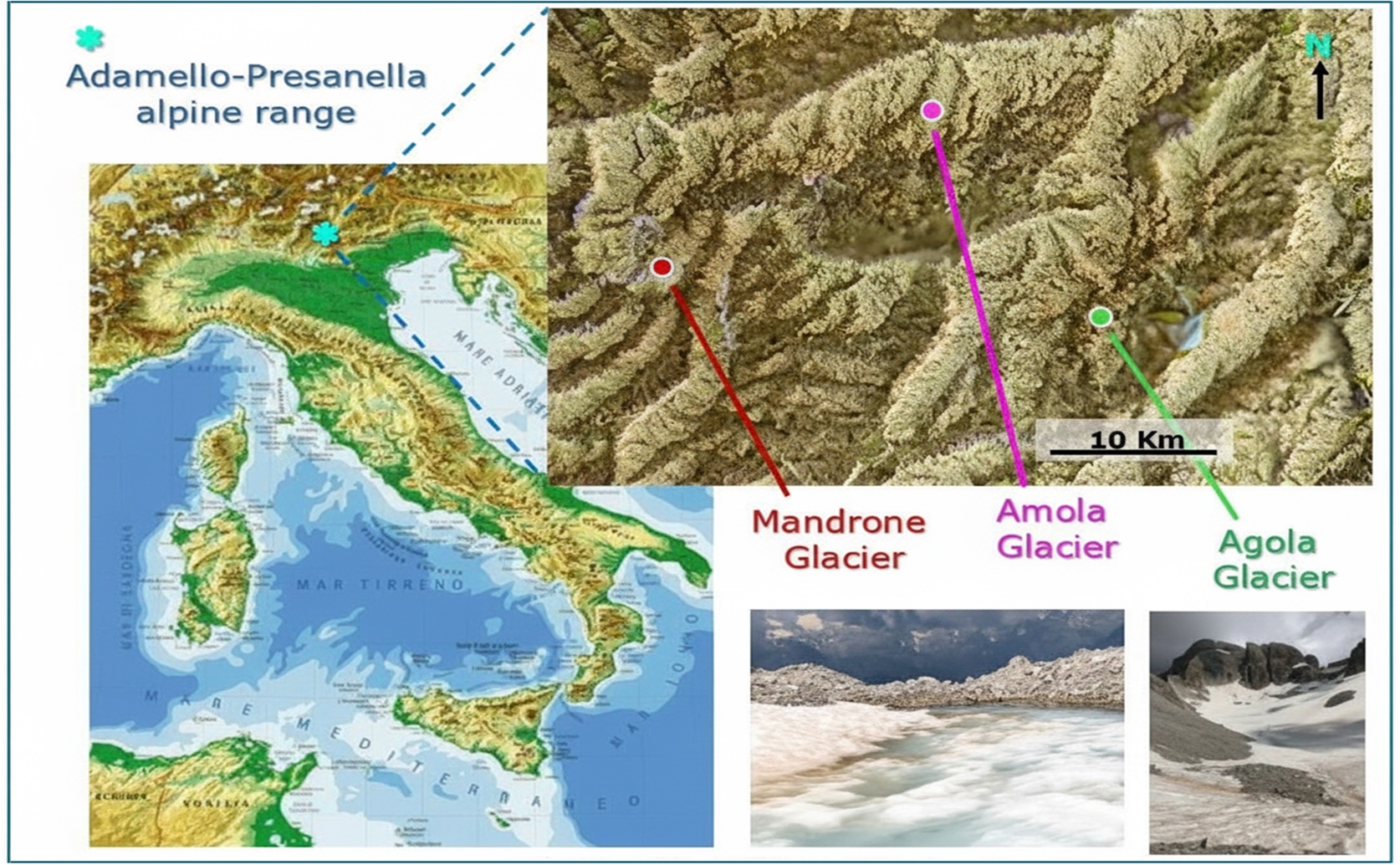
Samples were collected from three glacier systems in the Italian Alps, including the Agola glacier (right) and its proglacial pond (center), to investigate the highly distinct and specialized microbiomes of chironomid insects compared to their microbially diverse glacial habitats.

Image adapted from: Lencioni et al. / CC BY (Source)

Key Findings

  • Glacier ecosystems in the Italian Alps harbor surprisingly high bacterial diversity, similar to that found in warmer, more fertile soils
  • Chironomid larvae host unique bacterial communities distinct from those in their surrounding glacier habitats, with minimal overlap in species (less than 5%)
  • The bacterial communities within chironomids appear to be driven by the insect itself, not by diet or location, suggesting a specialized relationship for survival
Glacier ecosystems are changing rapidly due to climate change, impacting the life within and around them. Invertebrates, particularly the Chironomidae family of insects (non-biting midges), are key components of these environments, playing a vital role in nutrient cycling and food webs. Understanding how these insects interact with their surroundings, specifically the microorganisms they carry and the habitats they inhabit, is crucial for predicting the future of these ecosystems. A recent study by researchers at MUSE - Museo delle Scienze, University of Padova, University of Padua, and Free University of Bolzano[1] investigated the bacterial communities found within ten different chironomid species in the Italian Alps, comparing them to those present in the icemelt water and surrounding wet and terrestrial environments. The research focused on whether the bacteria found inside the insects were specific to their bodies, potentially involved in essential functions, or simply transient organisms picked up from their surroundings. To achieve this, the team analysed physical and biological samples from two glacier-fed streams and a proglacial pond, using a technique called 16S rRNA gene bacterial metabarcoding sequencing – a method to identify bacteria without needing to grow them in a lab. Surprisingly, the bacterial diversity in the glacial habitats was found to be remarkably high, comparable to that of fertile soils in warmer climates. This was almost seven times greater than the diversity found within the insects themselves. This challenges the assumption that glacial environments are inherently limited in microbial life. More importantly, the study revealed very little overlap in bacterial types between the insects and their habitats, with only around 4.9% of sequence variants shared. This suggests a strong degree of specialization, where the insects harbour a unique bacterial community distinct from that of the surrounding environment. The few bacteria found in both insects and habitats were often more abundant within the insects, hinting that these specific organisms may be actively maintained by the insects. Further analysis showed that even bacteria assigned to the same taxonomic name differed slightly in their genetic makeup depending on whether they were found in the insects or the environment, indicating a degree of microevolutionary adaptation. These findings build upon previous work that highlighted the importance of Diamesa species, a type of Chironomid, in glacier-fed streams[2]. That earlier research showed Diamesa were strongly associated with cold temperatures and high glacial influence, and their populations were declining with glacier retreat. The current study expands on this by looking at the microbial world within these insects, providing a deeper understanding of their ecological role and potential vulnerability. It also corroborates findings from the Ödenwinkelkees river, where Chironomidae were found to have highly connected food webs[3], suggesting a complex ecological interaction. Interestingly, the study found limited evidence that the insects’ diet directly reflected the bacterial composition of their habitat. This suggests they are likely feeding on dissolved organic matter and detritus – decaying plant and animal material – rather than actively consuming bacteria as a primary food source. This contrasts with other animals, like ruminants and birds, where gut bacteria are closely linked to their diet. The research suggests that the food resource for these insects likely consists mostly of dissolved organic matter and detritus of various origins, rather than intact bacteria with sequenceable genomes. The low symmetry observed between insect and environmental bacterial communities indicates a high degree of specificity to each condition. This specificity suggests that the bacteria associated with these insects aren’t simply hitchhikers, but play a specific role in their survival and function. Further research is needed to determine the exact nature of these interactions, but this study provides a valuable starting point for understanding the complex relationship between invertebrates and their microbial world in rapidly changing glacial ecosystems.[4] has shown that dispersal limitation is a dominant process shaping river invertebrate communities, and this study could provide insights into how microbial communities are dispersed and maintained in these isolated environments.

EnvironmentEcologyMycology

References

Main Study

1) High microbial diversity in glacial habitats uncoupled from the specialized microbiomes of resident chironomid fauna

Published 8th January, 2026

https://doi.org/10.1371/journal.pone.0340651


Related Studies

2) Glacial influence and stream macroinvertebrate biodiversity under climate change: Lessons from the Southern Alps.

https://doi.org/10.1016/j.scitotenv.2017.11.266


3) Food web structure in a harsh glacier-fed river.

https://doi.org/10.1371/journal.pone.0060899


4) Functional diversity and community assembly of river invertebrates show globally consistent responses to decreasing glacier cover.

https://doi.org/10.1038/s41559-017-0426-x


Related Articles

An unhandled error has occurred. Reload 🗙